WASHINGTON, D.C. — Today, the American Fuel & Petrochemical Manufacturers (AFPM) is launching a seven-figure ad campaign in the Beltway and in eight states urging Congress to act on the six California waivers transmitted by EPA under the Congressional Review Act (CRA). If passed, the CRA resolutions would effectively stop a series of California electrification mandates and red tape affecting passenger cars and trucks, manufacturers of lawn equipment, marine vessels, and the cost of consumer goods around the country. The ad, CA Red Tape, is featured below.
AFPM President and CEO Chet Thompson issued the following statement on the importance of Congress approving all six CRA resolutions:
“The consequences of California mandates and red tape are still reaching far outside the state into other Americans’ lives, garages, homes, and pocketbooks. Congress can stop this — and protect American consumers, manufacturers, and U.S. energy security in the process — by using their Congressional Review Act authority to permanently revoke the unlawful EPA rules that enabled California’s overreach. There aren’t many days left for Congress to vote, so these six CRA resolutions need to be a priority.”

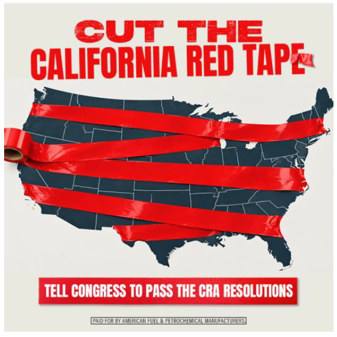
Brief descriptions of the California regulations at issue — pertaining to passenger cars and trucks, gas-powered lawn equipment and portable generators, ports and ships — and their far-reaching impacts are available from AFPM here.
In addition to cable TV and streaming video ads, AFPM’s campaign is utilizing digital ads, text messages and phone calls to tell Americans about the six CRAs and provide them with opportunities to communicate their support of the effort to stop California’s costs, mandates and red tape from impacting the rest of the country. Beyond the D.C. Beltway, AFPM’s CA Red Tape ad is running in Michigan, Texas, North Carolina, Maine, Washington, Nevada, New Mexico and Georgia.
The American Fuel & Petrochemical Manufacturers (AFPM) is the leading trade association representing the makers of the fuels that keep us moving, the petrochemicals that are the essential building blocks for modern life, and the midstream companies that get our feedstocks and products where they need to go. We make the products that make life better, safer and more sustainable — we make progress.