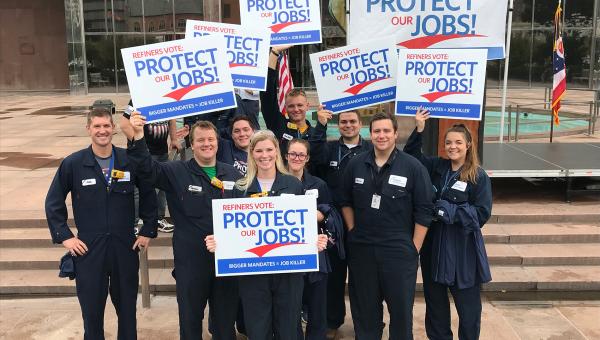
TOLEDO, OHIO – More than one hundred refinery workers, labor leaders, and elected officials from key battleground states Ohio and Michigan gathered today in Toledo.
Drones are cutting edge technology that have received an uptick in attention over the last couple of years—gaining notoriety despite their beneficial commercial and recreational uses.
As more states limit the size of gatherings and even consider shelter-in-place policies in response to COVID-19, AFPM is working to see that refineries and petrochemical facilities.
U.S. fuel and petrochemical manufacturers are committed to doing their part to limit the spread of COVID-19 while maintaining the core services and functions our nation requires daily.
WASHINGTON, D.C. – AFPM released the following statement today in response to the President signing into the law the reauthorization of the Chemical Facility Anti-Terrorism Standards program.
By an act of Congress and with the stroke of a pen, the Federal Aviation Administration’s (FAA) programs will continue to receive funding for the next 14 months.
Government overreach is an issue that strikes a bipartisan chord. For some, the May 19th ruling by a federal appeals court – which eliminates the Federal Aviation Administration’s (FAA) 2015 requirement that hobbyists register their drones – may serve as a badge of freedom from the perpetual gaze of “Big Brother.”
It’s been two and a half years since Congress granted the Department of Homeland Security’s Chemical Facility Anti-Terrorism Standards (CFATS) program long-term authorization.