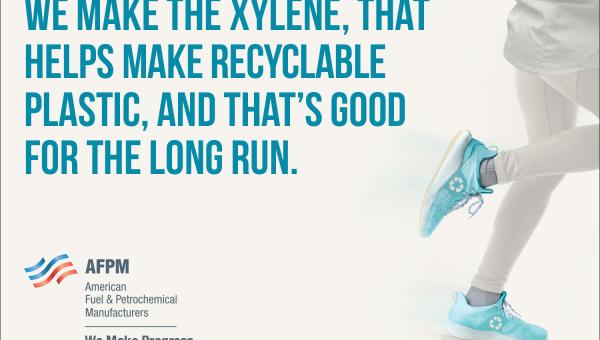
As petrochemicals and recycling advancements give old plastic new life over and over again—from shoes and clothes made of recycled plastic recovered from the ocean, to plastic bottles being chemically recycled into fuel and a raw material to make new petrochemicals—what it means to “recycle” is changing right before our eyes.
Plastic roads and buildings, the influence of energy and petrochemicals in geopolitics, and chemical and molecular recycling processes that could create a truly circular economy for plastic products were just a few of the topics discussed at AFPM’s 44th International Petrochemical Conference (IPC) in San Antonio last week.
Preface: So, I was asked if we can somehow tie Moon Day with petrochemicals. I said that I’m pretty sure space suits are made from synthetic materials, so that’s a pretty good tie-in.
Ottawa, Canada — As the fourth session of the United Nation’s Intergovernmental Negotiating Committee (INC-4) to create a global agreement on plastic pollution concluded Monday in Ottawa, AFPM released the following statement.
Pundits and politicians often frame energy technologies like solar generation and liquid fuels as competitors, not companions. But a visit to Flint Hills Resources’ Pine Bend refinery might change their minds.
WASHINGTON, D.C. — Today, Rob Benedict, AFPM Vice President of Petrochemicals and Midstream, issued the following statement in response to the new government-wide strategy to combat plastic pollution. Paying particular attention to the elimination of single-use plastic, the strategy announces the Biden-Harris administration’s goal to phase out federal procurement of single-use plastics.
WASHINGTON, D.C. — American Fuel & Petrochemical Manufacturers (AFPM) President and CEO Chet Thompson issued the following statement today in response to reports indicating that the United States is shifting its position on the United Nations’ global agreement to end plastic pollution and will now support calls for plastic production caps and the establishment of a global list of banned chemicals. AFPM has been a participant in the United Nations’ (UN) Intergovernmental Negotiating Committee (INC) process for the past two years:
Given low domestic recycling rates for plastic, the efficacy of recycling is often called into question. But that doesn’t mean recycling doesn’t work. Advanced recycling technologies — as well as traditional mechanical recycling — play a pivotal role in addressing plastic waste and recovering the value in used plastics.
No single solution can solve the global challenge of plastic waste. First, we must recognize that there is immense value in plastics and the ability to reuse or recycle these products. From there, we need to get a recycling system that works.