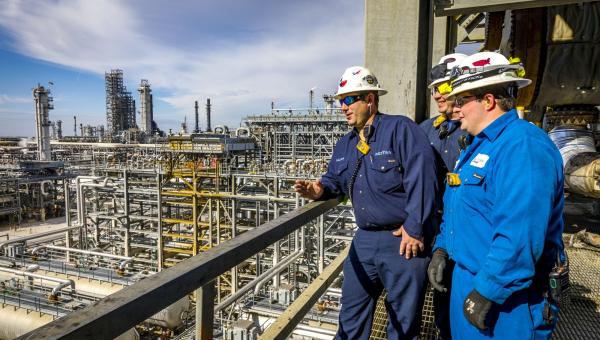
WASHINGTON, D.C. – The American Fuel & Petrochemical Manufacturers (AFPM) has announced the winners of the 2020 Annual Safety Awards, part of an ongoing mission to enhance and recognize outstanding workplace safety.
Beyond digitization (converting analog information to digital) and digitalization (the technology-driven shift to business processes) lies digital transformation.
Safety has always been and will continue to be the top priority of the refining and petrochemical industries — which is why refiners and petrochemical manufacturers are consistently ranked in the top industries for safety, out of more than 500 U.S. manufacturing industries.
Refinery utilization, measures how much crude oil refineries are processing or “running” as a percentage of their maximum capacity. It tells us roughly how much of our refining muscle is being put to work manufacturing fuel. American refineries are running full-out, at about 95% of total capacity, contributing more fuel—gasoline, diesel, jet fuel, etc.—to the global market than any other country. In fact, U.S. refineries process more crude oil every day than the United States produces, and we make more finished fuels than the United States consumes.
With the possibility that the EPA and policymakers could make updates to the Risk Management Plan (RMP) program, there are three things we encourage them to keep in mind: 1. RMP is working as intended and keeping people safe. 2. Any changes to RMP must be evidence-based and actionable. 3. Using RMP to zero in on hydrofluoric acid (HF) alkylation at refineries could have major impacts on U.S. fuel supplies.
EPA’s existing Risk Management Plan (RMP) is doing what it was designed to do: drive continual safety improvements across workplaces to keep industry employees, contractors, facility neighbors and local environments safe. Any changes to a regulation as effective as the RMP need to be solidly evidence-based. Unfortunately, today’s proposal is filled with costly and misinformed changes, with little-to-no data to back them up. In fact, many of the proposed changes will adversely impact the safety and security missions of refining and petrochemical sites. AFPM looks forward to providing detailed comments on this proposal.
Because of the extensive safety and mitigation steps refiners take wherever hydrofluoric acid (HF) alkylation is concerned, the risks from this process pale in comparison to those we assume every day when we engage in routine activities like riding a bike, driving a car and playing with pets.
The American Fuel & Petrochemical Manufacturers (AFPM) today released a new video highlighting the safety approach and measures used by U.S. refineries with hydrofluoric acid (HF) alkylation units.
In a tight refined product market it has been U.S. refiners that have stepped up. Our industry ran full-out for most of 2022 making sure American consumers, our domestic economic centers and our allies had enough gasoline, diesel and jet fuel to keep everyone moving. Our refining sector leads the world in liquid fuel production and is effectively doing more than any other to bring better balance to the global market.