In recent weeks, President Trump returned to Iowa to court U.S. farmers ahead of the official launch of his reelection campaign and to sign his much-anticipated rulemaking allowing year-round sales of E15, an unlawful action that the U.S. refining industry is challenging in court.
A legal representative for numerous U.S. small refineries has submitted a letter to the Environmental Protection Agency opposing calls for the agency to share confidential business information of small refineries with the U.S. Secretary of Agriculture.
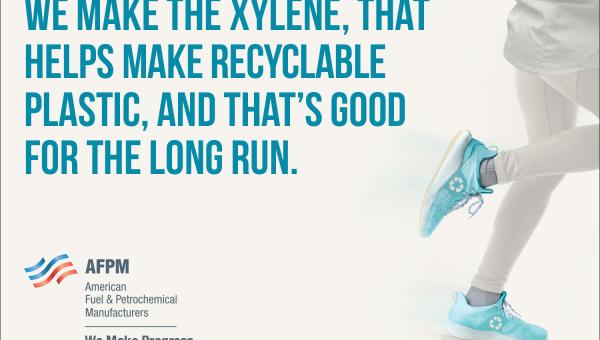
As petrochemicals and recycling advancements give old plastic new life over and over again—from shoes and clothes made of recycled plastic recovered from the ocean, to plastic bottles being chemically recycled into fuel and a raw material to make new petrochemicals—what it means to “recycle” is changing right before our eyes.
WASHINGTON D.C. – The American Fuel & Petrochemical Manufacturers (AFPM) today released the following statement in response to the U.S. Senate procedural vote on the Green New Deal resolution.
Plastic roads and buildings, the influence of energy and petrochemicals in geopolitics, and chemical and molecular recycling processes that could create a truly circular economy for plastic products were just a few of the topics discussed at AFPM’s 44th International Petrochemical Conference (IPC) in San Antonio last week.
Chet Thompson, President and CEO of the American Fuel & Petrochemical Manufacturers (AFPM), issued the following statement on the Environmental Protection Agency’s proposed rule regarding modifying the interpretation of Clean Air Act Section 211(h)(4) to extend the E10 volatility waiver to E15, on which AFPM today submitted comments.