

Chris Krebs
Former Director of the Department of Homeland Security’s Cybersecurity & Infrastructure Security Agency (CISA)
Question 60: With an increasingly varied crude slate, how are you managing substantial variability in salt levels in desalted crude and overhead neutralizer rates? How can this impact the amount and location of amine salt and other deposition in the atmospheric tower and overhead system?
CLIFFORD (Motiva Enterprises LLC)
The salt loading in the overhead is set by the salt loading leaving the desalters. Two key factors are the salt content of the oil and the salt coming in with the entrained water. With increasing variability of the crude, it is important to focus on the performance of your desalters in order to manage the chloride levels in the crude charge-in before the crude is charged to the unit, rather than responding to it afterwards. There are sites where we try to manage incoming water and salt levels with pretreatment in tankage. Chemical vendors offer various products to do this. The performance of these treatment options is a function of settling time and available tankage. So, there are some limitations around their use. At some refineries, the water content of the crude is managed with BS&W testing and then pumping the bottoms of the tanks to another tank if we cannot manage to get below 2%.
The next point of control is around desalting: optimization of the desalters, mix valves, and washwater rates. As you increase the water, you may get more water breakthrough afterwards. And as you increase mix valve pressure, it may tighten the emulsion. However, there is an optimal point, which is a function of the properties of the crude and the hydraulic loading of your desalters. Chemical vendors also offer various additives to assist with demulsification to improve desalter performance.
Once the salt loading has gone past the desalters and into the unit, you obviously want to focus on maintaining proper pH and monitoring for your chloride content. There are online analyzers available to help with this monitoring.
You also want to monitor your neutralizer addition rates. Tramp amines and other chemicals may be present in your overhead system, which can affect your neutralizer usage. The varying crude slate will also change your dew point as you shift. If you have increased flow rates, it may affect your waterwash performance and your required water to get to 25% liquid water.
The impact of the increasing neutralizer rates: Many units will recycle overhead waterwash and use it as desalter water, so the neutralizers are being recycled at the end of the desalters. There is a partitioning effect that is a function of the quality of the water and the quality of the oils. Those neutralizers will then carry through the units and essentially function as a tramp amine in the unit, which will have an effect on the salt point versus your water dew point. So, you will see formation of amine hydrochloride salts upstream of water injection, which will then manifest as fouling. Differential pressure will increase, and you can even see corrosion.
The chemical vendors all offer various ionic equilibrium monitoring. With an appropriate amount of sampling, combined with pressure and temperature monitoring, you can model the overhead system and predict salt points and water dew points. With this information, you can vary the neutralizers you are using, as well as their composition, in an attempt to affect the location where that salt point is occurring. One caution is that the ammonium chloride salt point, from the breakdown of nitrogen compounds in the crude, may still be a concern, especially if you have ammonia coming into the desalter via externally supplied waters. Ammonium chloride may actually drive the location of your salt point concerns.
DION (GE Water & Process Technologies)
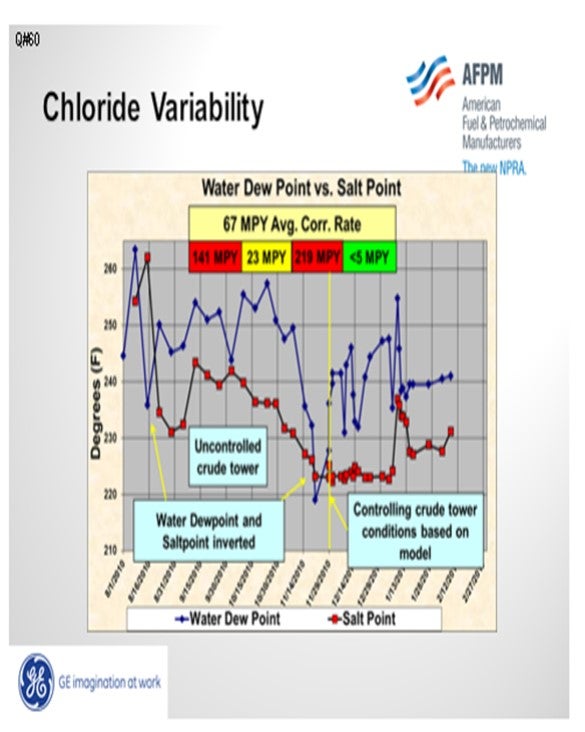
The overhead salt point is dependent upon the chloride content. In the bottom right-hand corner of the slide, you see a red line on the corrosion rate graph. That red line represents the salt point and will slide to the left or right depending upon many factors, such as the partial pressures of amines and acid species in the overhead. The salt point will continually shift back and forth with varying concentrations of acids and bases in the overhead, including chloride from hydrochloric acid; in general, the greater the volatility of the overhead chlorides, the greater the volatility of the salt point. In such a situation, it is extremely important to minimize high salting tramp amines. Mapping the amines by measuring type and quantity in overhead waters, desalter washwater, effluent brine, and tank water drains can assist in determining the source of high salting amines and stimulate remediation strategies. If warranted, injecting caustic into the desalted crude can reduce the impact of high chlorides in the overhead.
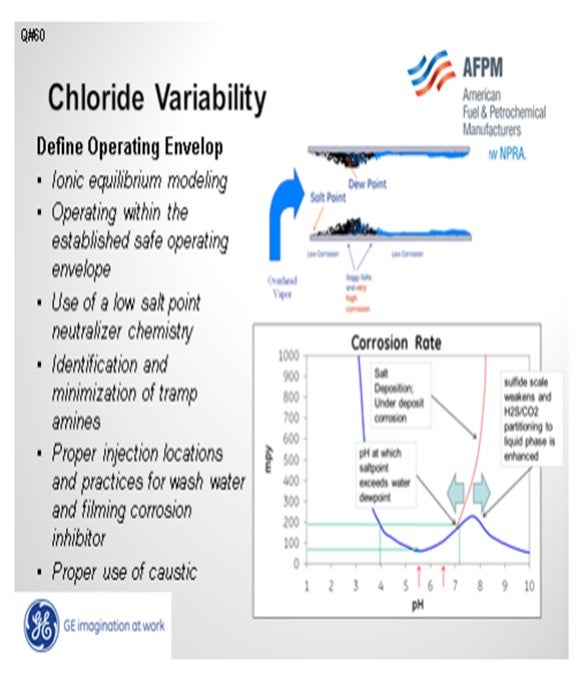
Most important is running the ionic equilibrium model frequently to establish a safe operating envelope. Operating within certain parameters can ensure that the salt point is not upstream of the water dew point. The slide below is an example of documenting the salt and dew point using GE’s LoSalt* ionic equilibrium model. The dew point and salt point were plotted daily. Severe corrosion occurred when the salt point exceeded the dew point. A safe operating envelope was established from the model. Tramp amines were minimized to extend the safe operating environment. Operating parameters, including stripping steam, were controlled to ensure that the salt point would always be below the water dew point.
VILAS LONAKADI (Foster Wheeler USA Corporation)
As an alternate to desalters for BS&W removal, has anyone used the gun barrel technology in refineries processing heavy crudes?
DION (GE Water & Process Technologies)
Gun barrel vessels are usually a separation device for the oil field. I have not seen gun barrels in refineries.
SAM LORDO (Nalco Energy Services)
Although it is ideal to have the salt point below the water dew point, in most cases, as long as you are within about 25°F, you are probably okay. I have done a lot of these over the last 30 years. I would say that most of the refiners run with the salt point above the water dew point and still do not have corrosion issues.
HAROLD EGGERT (Champion Technologies) Another commercial: This afternoon there is going to be a P&P on Best Practices for what makes a good waterwash and what makes a bad waterwash. I encourage people to attend that P&P also.
CORY NOYES (Marathon Petroleum Company)
What is the panel’s experience with the online chloride analyzers and adjusting caustic rates based on online chloride sampling? I would like to ask the same question for neutralizers as well.
CLIFFORD (Motiva Enterprises LLC)
I do not have any experience with automation based on online chloride analyzers.
DION (GE Water & Process Technologies)
We are beta testing an automated feed system to control the neutralizer based on the overhead pH. That is an easy measurement, and there is hardly any interference with it. Automating chloride measurement is more complex and must account for interferences from bisulfides. It is still important to understand the operating boundaries to avoid excessive neutralizer feed rates which may move the salt point too far upstream. Automation should not replace defining the boundaries of a safe operating environment and routine monitoring.
SAM LORDO (Nalco Energy Services)
To address the question about automation, Nalco has been field-trialing for over two and a half years. A complete package is now commercially available and being deployed globally. There was an article in today’s AFPM newspaper. If you need to find out more information, please see me. It does work. I fully agree that you cannot just turn it over to the machines. You have to know what is going on. Otherwise, you will have issues.
CLIFFORD (Motiva Enterprises LLC)
Salt loading to the unit is set by two factors, salt content of the oil, and salt coming in with entrained water from tankage. The best option to manage corrosion in the Atmospheric tower overhead is to optimize salt removal prior to the atmospheric tower.
Some sites attempt to control salt via pretreatment in tankage. Chemical vendors offer various products to address this. However this is a function of settling time and available tankage and infrastructure to hold the crude and the water/sediment from the dewatering process. At a minimum Convent requires that a spot sample of the crude be caught and analyzed for BS&W. If the BS&W results are above 2%, then the bottoms of the tank are pumped to another tank until the results are less than 2%.
The next point of control for chloride variability is around desalting. Optimization of desalter washwater rates and mix valve differential pressure is essential. Insufficient water will result in poor contacting with the salts in the oil phase and high salt content in desalted crude. Excess water will increase the loading on the desalter and result in poor dehydration and both high water and salt content leaving the desalter. High water rates may also increase loading on brine treatment units and result in inefficiencies depending on washwater temperature. Insufficient mix valve differential pressure will lead to poor mixing and contacting of the water phase with salts in the oil phase. Excessive mix valve differential pressure will result in a tight emulsion which may not be resolved in the desalter. Various chemical vendors offer products which can help with demulsification. Chemicals are also available which can help with the impact of solids coming in with the feed.
The final option for prevention of salt loading to the atmospheric tower is via caustic injection. The caustic will convert calcium and magnesium chlorides into hydroxides and sodium chloride which has a lower rate of hydrolysis at conditions in typical crude unit furnaces. However, this will increase the sodium loading to downstream units.
To manage overhead corrosion, the pH of the overhead accumulator water streams is analyzed via an online pH analyzer. Samples for pH and chlorides are periodically caught to monitor for changes. Neutralizer addition rates are adjusted to maintain pH within the control range. If the chlorides exceed a predetermined limit, additional troubleshooting is undertaken as it is a sign that excessive neutralizer is being used.
High neutralizer rates can have an adverse impact to unit performance. Crude overhead waters are reused as desalter washwater. Once used as desalter washwater, some of the neutralizer may partition into the oil phase. This along with tramp amines from upstream of the crude units can have an effect on salt formation and corrosion within the crude unit, upstream of the water dew point. Essentially, as amine injection rates increase along with chloride content, the salt point in the atmospheric tower overhead system will get warmer. This may move salt points outside of areas which are designed to handle it. This can manifest itself as fouling, increasing differential pressure across sections of the atmospheric tower overhead or in the column itself or as corrosion depending on the type of salt formed, how close to water dew point it is formed, and other such as the type of neutralizer employed.
It is possible that with an appropriate amount of sampling and data collection, ionic equilibrium models can be built to predict conditions which would allow salt formation, and many chemical vendors offer such services and neutralizer packages tailored to the process conditions of each unit.
Another concern with changing crude slates will be varying compositions, reflux ratios, and cut points in the top section and overhead of the crude tower will alter the water dew point, salt point, and the amount of required washwater. This will impact the amount of water required to maintain sufficient waterwashing or shift the location of water dew point and is especially true if temperatures are lowered in order to maintain previous yield structure of product quality.
DION (GE Water & Process Technologies)
Overhead pH control is, perhaps, the most important aspect of overhead corrosion control and is the single most significant driver of the aqueous corrosion process. The pH is directly related to the corrosivity and provides a direct measure of the [H+] ion concentrations. It is the acidic protons, [H+], that drive corrosion. Furthermore, pH is an indirect indication of salt fouling potential at fixed chloride loading. Chlorides themselves, on the other hand, are only an indirect indicator of corrosion as they do not take into account the neutralization state of all acids present in the system. In general, the measured pH depends upon all the acids and bases present in the system, and it dictates the overall availability of free acidic protons. The balance of total acids and bases is directly related to corrosion rates and salt fouling.
To address aqueous corrosion, neutralizers are injected to elevate the pH and minimize acid attack of the system’s metal surfaces at the initial condensation point (ICP) of water in the overhead. This acid neutralization reaction produces a salt that will precipitate from the vapor phase at a given temperature, depending on the base (amine) involved in the reaction. This neutralizer “salt point,” or temperature at which the first neutralization salts begin to precipitate from the vapor phase, will also affect the fouling and corrosion potential in the overhead system.
Salt points are directly driven by the product of chloride and amine partial pressures and the proper selection of the neutralizer is critical to maintaining overhead system integrity. However, neutralizing amines that are intentionally added to control overhead pH conditions are not the only amine species that play a role in overhead salt formation. Depending on the relative concentrations, the presence of “tramp amines” may play a larger role in overhead salt formation than the injected neutralizer amines. For the purpose of this discussion, tramp amines are defined as any amines, other than the appropriate neutralizer being used, found cycling in the system. Tramp amines that are entering and recycling in the system will strongly affect overhead pH and typically have very high salt points. These amines can make it virtually impossible to either keep salt points below the ICP or to drop the pH to the targeted control range of 5.5 to 6.5.
As the number of hydrolysable salts exiting the desalter increases, the partial pressures of chloride ions present in the overhead increases. This substantially increases the acidic corrosion potential, which is subsequently addressed through increased neutralizer dosage with a resulting higher salt point temperature. Additionally, any tramp amines present in the desalted crude increase the salting potential in the overhead and can drive the salt point temperature even higher. These higher salt points drive the location of neutralizer salt precipitation further and further upstream into hotter areas of the overhead system, possibly even into the tower itself.
To prevent this undesirable condition in the overhead system, there are several approaches that can be employed to keep the system in control. These approaches include:
1. Use of ionic modeling to establish tower operating envelope,
2. Operating the tower within the established safe operating envelope,
3. Use of a low salt point neutralizer chemistry,
4. Identification and minimization of tramp amines,
5. Proper injection locations and practices for washwater and filming corrosion inhibitor, and
6. Proper use of caustic in the desalted crude.
Understanding the dynamics of the overhead system is the first step in properly diagnosing the corrosion and fouling potential of a given unit. The frequent use of a robust and rapid ionic modeling tool will allow for the calculation of the salt point temperature, ICP temperature, and the subsequent prediction of salt point location in the system. GE has equipped field representatives with the GE LoSALT* Ionic Model and trained them to work with the asset operator to develop an operating envelope that will aid the refiner in remaining within safe operating ranges with respect to salting potential across the desalter effluent salt variability range. Where GE has implemented this control and mitigation approach, asset operators adjust tower operating conditions (e.g., overhead outlet temperatures, tower steam injection rates, etc.) to manipulate and control the salt point location in the overhead system.
Once safe operating boundaries are established, the overhead neutralizer injection rate can be automatically controlled with a pH sensor in the overhead accumulator boot. It is important to note that automation without appropriate boundary definition may lead to under deposit corrosion failure from amine salt deposition. For this reason, frequent use of an ionic equilibrium model is recommended, preferentially onsite for quick response to unforeseen changes in operations.
BASHAM (Marathon Petroleum Corporation)
Assuming no change in neutralizer addition, the swing in crude overhead chlorides is most always directly related to desalter performance. However, a refiner may not be seeing widely distributed desalted crude salt numbers even when the crude overhead chloride concentrations are swinging. It is important to ensure a representative sample is obtained.
It has been published in literature, and can be verified by calculations, that a system that has 1 ptb (pound per thousand barrels) of salt in the desalted crude will result in an overhead chloride concentration of approximately 25 ppm. This correlation incorporates several assumptions, namely the salt cation distribution, the efficacy of the NaOH (sodium hydroxide) neutralization, and consistent water influx to the tower. However, it does provide an order of magnitude estimate.
RANDY RECHTIEN (Baker Hughes)
Variations in crude oil quality certainly place more burden on desalter operation. Higher salt content in desalted crude requires more diligent monitoring of both caustic injection rates (where applicable) and overhead neutralizer rates to address correspondingly higher overhead HCl (hydrochloric acid) levels. The effects of higher overhead HCl levels on amine-HCl salt formation can be successfully determined with the Baker Hughes TOPGUARD™ Corrosion Risk Monitor. The TOPGUARD™ monitor is an extension of the Baker Hughes Ionic Model technique, which provides for ongoing monitoring in response to variations in unit operations.
DENNIS HAYNES (Nalco Energy Services)
Optimization of desalter operations and maximization of washwater rates and injection strategies will assist in minimizing swings in chlorides, and automated analysis of overhead aqueous condensate to improve response to swings is important. Elevation of chlorides and/or amines in an overhead system will move salt points to higher temperature areas, so systems with limitations on waterwash should track salt points so operational adjustment can be made to control salt points when required (such as tower top temperatures, pressures, steam rates, etc.).
SAM LORDO (Nalco Energy Services)
Optimization of desalter operation and use of caustic is the best-in-class management of chlorides in the crude column overhead circuit and tower top sections. The frequency of monitoring and level of detail water analysis is also important; the more frequent, the better, Nalco’s new continuous analyzer for crude overhead systems measures pH continuously and chlorides every 30 to 60 minutes. This data then can be used to close-loop control the pH control and caustic injection, respectively. Going to this level of control minimizes the variability impacts of changing and challenging crudes. This information can also be used in conjunction with data management tools and overhead simulations to run dew points and salting deposition temperatures at a near continuous frequency.
Year
2012
Process
Question 61: Extensive use of upstream H2S scavengers in crude oils can cause salt deposition in atmospheric tower overhead systems, as well as on atmospheric tower trays, particularly when trying to operate at lower naphtha endpoints. What adjustments in desalter operation are used to mitigate amine salt deposition?
DION (GE Water & Process Technologies)
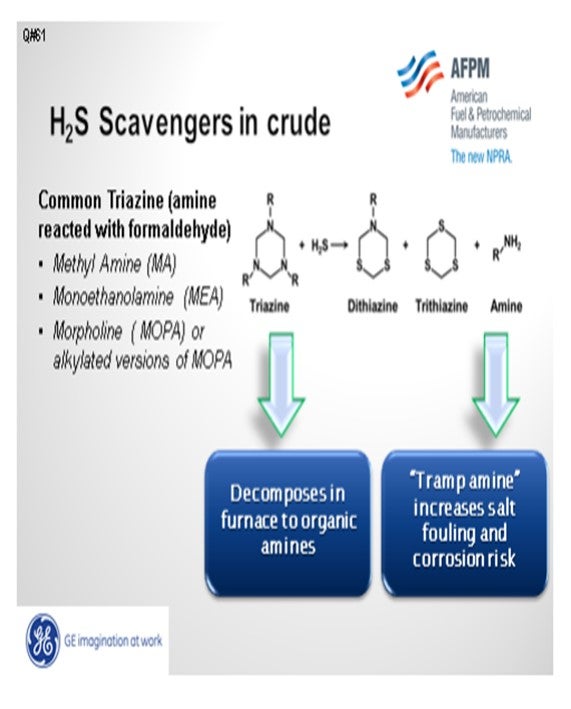
H2S scavengers may cause salt deposition in atmospheric towers. Triazine, the most common scavenger, is made by reacting formaldehyde with an amine, such as MEA (monoethanolamine), and creates an MEA-based triazine; similarly with methylamine-based triazine. One of the byproducts from the reaction of triazine with the hydrogen sulfide is an organic amine. The organic amine, and any unreacted amine from the manufacture of triazine, can increase the amine loading in the overhead, move the salt point, and increase amine salt corrosion risk.
Additionally, the triazine itself can decompose. An MEA-based triazine may decompose to MEA in the crude unit furnace and increase the MEA loading in the overhead. The salt risk is from both a byproduct of triazine reacting with hydrogen sulfide and from the decomposition of triazine in the crude unit furnace. One method to minimize overhead salt issues is to inject an acid upstream of the desalter to achieve an acidic effluent brine pH. An acidic environment will protonate some alkyl amines, thus creating an ionic compound like RNH3+ (protonated alkyl amine) instead of RNH2 (alkyl amine). The ionic species increases its partitioning to the water phase, thereby driving more organic amines into the effluent brine. The partitioning coefficient for those materials is dependent upon the R (alkyl group). In general, the more carbons on the amine, the less likely it will partition into the water phase.
LEE (BP North America)
The primary H2S scavengers used in the industry, as Mike mentioned, are methyl triazine and ethanol triazine. Between the two triazines, we favor the use of methyl triazine due to the lower amine salt point temperatures for the salts that can be formed downstream with the free amine byproducts.
As far as desalter operation impacts from H2S scavenger use, methyl triazine H2S scavengers react to form monomethylamine byproducts. Literature and operating data support that a large portion (greater than 80%) of the amine byproduct will be solubilized into the desalter water if the water is between 6 pH and 8 pH. Lower amine partition percentages will be seen at the higher pH range. The amine partitioning can be improved by lowering pH or even acidifying, as Mike mentioned, but we have not done any of those practices ourselves within BP. As far as dithiazine byproducts, the ethanol dithiazine is reported to be water-soluble, and the methyl dithiazine is reported to be oil-soluble. We do not have any independent quantifiable data to elaborate on these literature reports. High water solubility of the byproducts will support maximizing desalter washwater usage in general.
Reducing the chloride content of the desalter crude will, in turn, suppress the amine salt point of the system. Desalter optimization parameters include maximizing washwater rate, making washwater quality enhancements (particularly pH and ammonia content), conducting mix valve pressure drop optimization, optimizing demulsifier use, optimizing grid voltage settings, and achieving the optimum, usually meaning maximum, operating temperature on the desalters.
VIJAY KRISHNAN (CITGO Petroleum Corporation)
Mike was talking about the use of acids. I would like to know how many people on the panel or in the audience use sulfuric acid to control or reduce pH.
PUI-NANG LIN (Flint Hills Resources, LP)
We have not used sulfuric acid for pH control in desalter application, but we have used it in other applications. We had a very bad experience because this inorganic acid is not buffered, so it is easy to over-inject and get results in a very low pH.
DION (GE Water & Process Technologies)
1,3,5 triazine-based products are commonly used commercially to treat a wide variety of petroleum products throughout the oil production and refining industry to reduce the volatility of hydrogen sulfide (H2S) in these products, making them safer to transport and store. The use of certain chemicals can provide health and safety benefits in shipping petroleum fluids but may also have side effects that are detrimental to refinery operations.
Triazine is a generic term for a small class of chemicals that contain a six-member ring with alternating nitrogen and carbon atoms. Differences between triazine compounds are derived by the atoms bonded to the nitrogen, but not included in the ring structure. Various amines are reacted with formaldehyde to form the triazine. Commercial triazines are comprised of formaldehyde and primary amines including, but not limited to:
• methyl amine (MA),
• monoethanolamine (MEA), and
• morpholine (MOPA) or alkylated versions of MOPA.
The triazine H2S complex that partitions to the oil phase or is carried over in the desalted crude BS&W can decompose in the crude unit furnace. The decomposition products typically contain an amine that adds to the partial pressure in the overhead and, depending on the amine, can form high salting amine chloride deposits.
Impact on Refinery Processes: High triazine levels in crude oil (greater than 1,000 ppm) have been found to negatively impact desalter performance in simulation studies. Triazine that remains in the oil phase will quantitatively decompose to amines at high temperatures in the crude furnace. Depending on the amine used to produce the triazine, a portion of the amine released in the reaction of H2S with triazine will remain in the oil phase and pass through the crude furnace and into the atmospheric tower. Contingent on the level of chlorides present in the desalted crude, amine chloride salts will form and can deposit in process equipment and cause fouling and corrosion. The amine chloride salts are insoluble and heavier than the hydrocarbon fractions and are corrosive to most metals at these temperatures. The type of amine used in the triazine determines where the salt deposition may occur based on the salt point at the specific operating conditions in a specific unit. MEA is known for forming a hydroscopic chloride salts above the gas oil section of the crude tower and is primarily a corrosion problem in the naphtha pump around section and overhead. Should MEA triazine or the sulfur containing reaction product survive the furnace and flash zone, additional concerns include increased sulfur content of the side cut products and fouling. Generally, MA chlorides will deposit in the overhead line or condensers and cause poor distribution, fouling and corrosion in the overhead system. These deposits and resulting corrosion and fouling may negatively impact the performance of the atmospheric tower and result in lost throughput or unplanned outages.
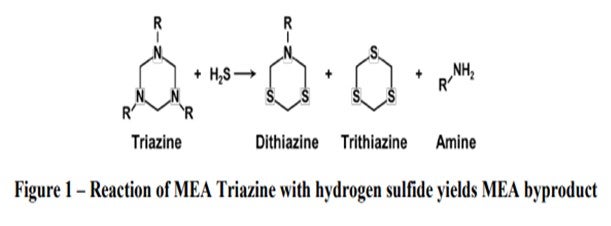
The reaction of triazine and H2S forms heavy sulfur compounds. The ratio of the dithiazine and trithiane that are formed depends on the relative ratio of reactants present. In most cases, dithiazine is the predominant species. Trithiane is more difficult to form, but it is more likely to form in the presence of excess H2S and/or low pH conditions. Both of these molecules can decompose in the crude furnace and distill into the refined product cuts. Dithiazine is hydrocarbon soluble and most remains in the oil phase. It distills at ~300°C (572°F) and may distill into middle distillate cuts. Some has been found to decompose to form CS2 (carbon disulfide) and free amine. Trithiane is generally insoluble in water and hydrocarbon. These solids that are dispersed in oil can sublime at >250°C (482°F).
1. Effects on Wastewater Treatment Plant (WWTP): All of the amines from triazine and reaction products will eventually flow to the WWTP. The amount of nitrogen will be the same regardless of amine since the stoichiometry of the triazine reaction is dependent on the number of Formaldehyde molecules that are consumed and not the molecular weight of the amine. These amines are readily consumed in the wastewater plant but may result in sudden microorganism growth and reproduction, followed by depletion of the oxygen supply. If the oxygen supply cannot be replenished, the microorganisms die from lack of oxygen and must be repopulated. The impact to the WWTP can be minimized by either limiting the blend ratio of triazine-treated crude oil or inoculating the WWTP with Nitrification organisms.
2. Carbon Disulfide: Field Experience demonstrates a 10-time increase in CS2 content in naphtha produced from triazine-treated crude. This is expected from any triazine since the CS2 is formed when the dithiazine cleaves, as shown below
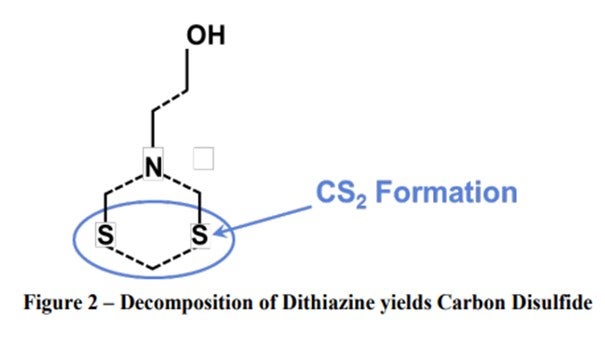
Small amounts of carbon disulfide and dimethyl sulfides may be formed as a result of thermal decomposition or reactions with other chemical species or the reaction product of MEA triazine and H2S. This does not create a problem for most refiners but could be a problem in petrochemical plant reactions because it is a catalyst poison. There are very few refineries in the world that send naphtha directly to petrochemical processes and may be affected.
The impacts of triazine-treated crude can be mitigated in several ways. The crude buyer must request information on treatment levels if they suspect that crude oil cargoes have been treated for H2S. Once this information is obtained, the crude blend rate can be controlled to limit the amine content in the crude.
Alternately, an acid can be added to the crude and/or desalter washwater to maintain an acidic effluent brine pH. The reduced pH protonates amines and creates an ionic compound that is more soluble in the bulk water phase, thereby extracting amines from the crude into the effluent brine. The types of amines and extraction efficiency will be dependent on the type of amine involved. In general, the more carbons there are on the amine molecule, the less efficient the extraction. For example, ammonia will be easier to extract than MEA and MEA easier to extract than DMEA.
If possible, the best solution is removing the potential processing hazard completely. The refiner may request that the crude producer or broker use a non-amine based H2S scavenger such as a select GE Water & Process Technologies’ non-amine ProSweet* product to completely eliminate the potential impacts of H2S scavenger treatments across the entire refinery.
RANDY RECHTIEN (Baker Hughes)
When amine-based H2S scavengers are present in crude oils, desalter operating conditions affect the extent to which amines partition to the desalted crude. The key operating parameter is desalter water pH. At higher pHs, higher levels of amines partition to the crude and increase the risk for amine-HCl salt formation in the atmospheric tower and overhead system. The application of desalter acidification additives, such as Baker Hughes EXCALIBUR™ program, can successfully decrease amine levels in desalted crude. In conjunction with an EXCALIBUR™ program, the potential for amine/HCl salt formation can be determined using Baker Hughes TOPGUARD™ Corrosion Risk Monitor.
BASHAM (Marathon Petroleum Corporation)
Control of the desalter water pH is key. Amines will partition between oil and water depending on pH. Amines will go with the water at lower pHs, and conversely stay with the oil at higher pHs. This can lead to cycling up of amines in the system.
DENNIS HAYNES (Nalco Energy Services)
Elevation of washwater flow rates, injection strategies (moving towards a more dominantly primary versus secondary injection where possible), not using desalter washwater with an elevated amine loading, and pH control of desalter washwater are all strategies that will assist to certain degrees.
SAM LORDO (Nalco Energy Services)
Acidification of the desalter washwater, typically using organic acids, can be done and achieve some success in extracting amines from the crude oil. This does have its downside, though, and has to be monitored closely or one could end up with additional acid loading on the overhead circuit. This additional acid loading could result in additional neutralizers being used, which could then also raise the salting temperature of the chloride salts. A thorough review of the system to be treated should be conducted so that the proper acid is chosen and the side effects are minimized.
Year
2012
Process
Question 62: What are causes of foaming in crude pre-flash drums and towers, and what options are available to mitigate foaming?
SHELTON (KBC Advanced Technologies, Inc.)
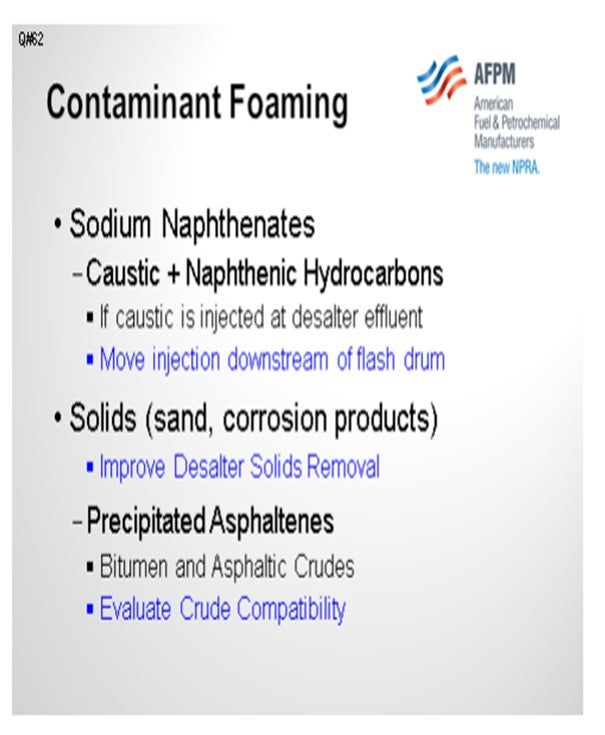
Surfactants cause foaming. Mike will discuss surfactants and amines that should not be in the crude. Sodium naphthenate is a common surfactant produced by the reaction of caustic injected at the desalter effluent and naphthenic hydrocarbons.
A simple solution is to move the injection downstream of the pre-flash or pre-fractionator to the bottom pumps. If the injection point is at the desalter effluent, solids and corrosion products can cause foaming.
Improving desalter solids removal will mitigate foaming. Precipitated asphaltenes that frequently occur with bitumens and asphaltic crudes can also cause foaming, so we would evaluate crude compatibility in that case.
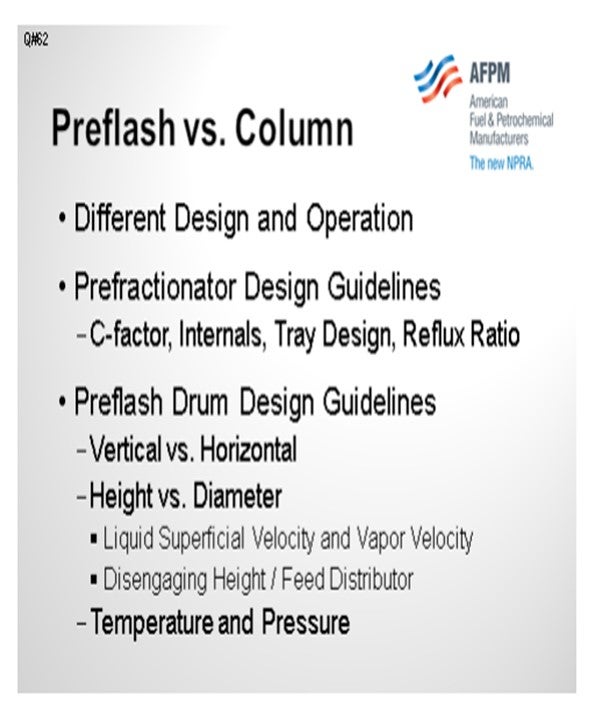
The question includes pre-flash drums and towers, which I assume is a pre-fractionator. These applications are quite different in design and operation. In our pre-fractionator designs, we consider C factors, internals, tray design, and tower loadings.
We have used pre-flash drums in our latest grassroots designs because the hot trains have been so efficient that crude heater inlet temperatures are 600ºF to 610ºF. A flash drum removes water and requires lower pressure to suppress vaporization at the end of the hot train. The flash drum design avoids elevated pressures in the hot train and 900-pound flanges. Obviously, we specify vertical versus horizontal. We consider height versus diameter and liquid superficial velocity versus vapor velocity to optimize the ratio. We also consider disengaging height and the feed distributor inlet design. Of course, temperature and pressure have a major impact.
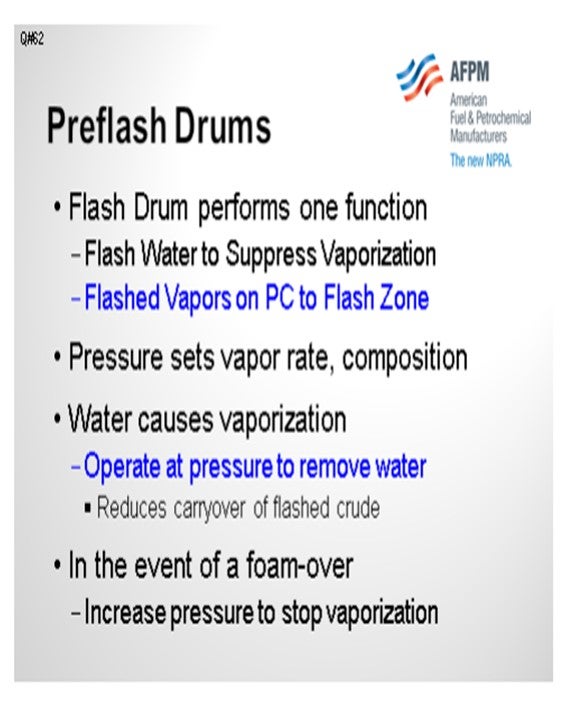
The pre-flash drum performs two functions: flashing water and suppressing vaporization. Many pre-flash drums are operated to remove light hydrocarbons. However, water causes vaporization, and operating pressure and temperature determine the vapor rate and composition. It is important to model the optimum pressure. Operate at the pressure required to remove water and not generate excessive hydrocarbon vapor load, which can result in carryover of bottoms.
In our designs, flashed vapors are sent to the flash zone. Designs where the flashed vapors are introduced in higher sections of the column can create problems. For any design, in the event of a foamover, temporarily increase pressure. With the flash drum, increase pressure until there is no vaporization. That will stop the foamover. It is important to have a pressure controller on that vapor line to the flash drum.
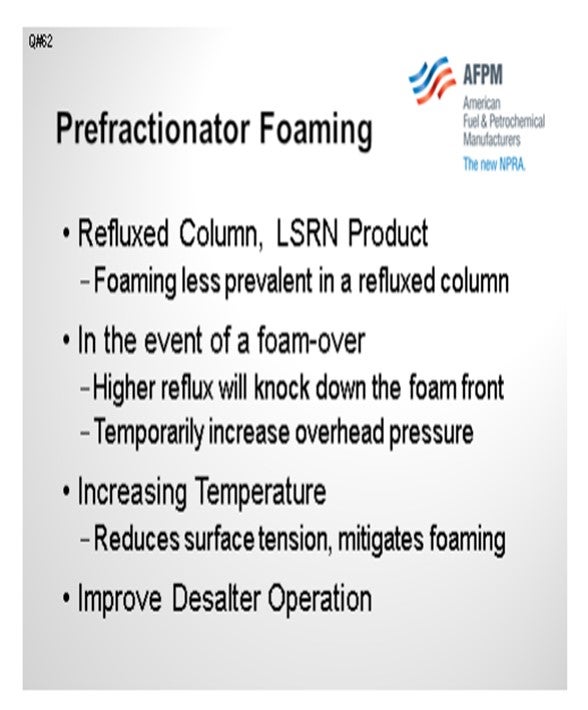
Pre-fractionator foaming is less likely because it is a refluxed column with an overhead product. The trays mitigate foaming, and the liquid loading should tend to knock down the foam. Again, in the event of a foamover, you could temporarily increase pressure. This may not be obvious, but we try to design for higher temperatures to reduce surface tension, which also mitigates foaming. In a new design, the pre-flash drum operating temperature is determined by the location in the hot train. Finally, improving desalter operation will mitigate foaming in the downstream columns.
BASHAM (Marathon Petroleum Corporation)
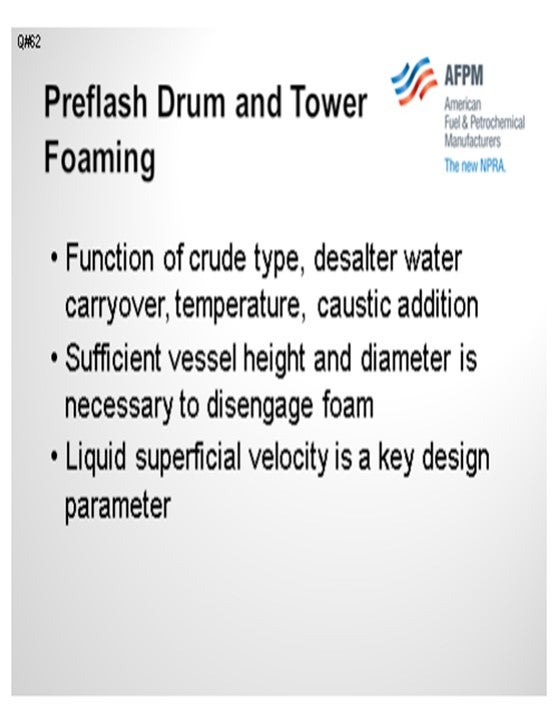
I want to reinforce some of Al’s points here. As he already mentioned, pre-flash tower or vessel foaming is a function of crude type salt or water carryover, temperature, and caustic addition. You are always going to have foaming occurring in a pre-flash drum or tower. The key here is to manage the foam and keep it in the tower. You must have sufficient vessel height and diameter necessary to disengage the foam. As Al also mentioned, the liquid superficial velocity is the key design parameter. It is important to keep in mind that the smaller the diameter of the vessel, the larger the foam height; so in narrow vessels, the liquid superficial velocity will need to be low in order to keep the foam height low. It is possible to add silicone-based antifoam to the pre-flash drum or tower, but consideration needs to be given to the downstream, gasoline, and distillate hydrotreater reactor catalyst.
DION (GE Water & Process Technologies)
Al and Kevin covered operational and mechanical issues regarding foam. Part of the question asked about the causes of foaming. There are surfactants in crude oil. Surfactants can be any organic molecule that has an atom that is not carbon or hydrogen, such as organic acids, organic amines, mercaptans, and other molecules with a polar group associated with them.

RUSSELL STRONG (Champion Technologies)
I have heard several comments that silicone antifoams in crude are problematic. There have been recent events offshore in the Gulf where so much antifoam was being used upstream that it was actually poisoning hydrotreater catalyst in the refinery from the upstream application. Other causes of silicone contamination can come from the crude while trying to control foaming in a flash drum or in a crude tower. To control those, silicone antifoams are sometimes used with occasional success. Several years ago, at a refinery down in the Houston, Texas area, I encountered severe foaming in a crude tower that would not go away. Standard silicone antifoams did nothing to solve the problem, but a fluorosilicone antifoam worked well. It was far more efficient and actually worked where the polysiloxane was deficient. It also offered less risk of downstream silicon contamination. So, keep this in mind as an option if you have crude unit foaming.
STEVEN FISCHER (Delek Refining)
At a previous refinery, we reintroduced the vapors to the flash zone with the result being quench to the flash drum that resulted in poor cutpoints. When we introduced the flash vapors from the flash drum to the flash zone, we saw that that the flash drum had actually acted like a quench, which could result in a poor cutpoint at the bottom of the crude tower.
SHELTON (KBC Advanced Technologies, Inc.)
Simulations do not indicate flash zone quenching if, as previously mentioned, the flash drum operating pressure is optimized to flash-only water. We have evaluated the flow schemes in models with the two streams mixed outside of the column and combined in the flash zone, but we get the same overflash.
STEVEN FISCHER (Delek Refining)
That was our assumption when we designed it that way, but our performance did not show that result. Our performance improved when we introduced it higher up.
ANDREW SLOLEY (CH2MHILL)
Addressing that last comment, I think what you are seeing there, when you see the poor performance, is the mixing of transfer line liquid with the vapor coming in, which is an issue with the equipment and not having the vapor segregated from the transfer line.
SHELTON (KBC Advanced Technologies, Inc.)
Our designs do have a separate flash drum vapor nozzle in the flash zone. It is important to have a pressure controller on the flashed vapor line, so the drum is not riding on the lower flash zone pressure. I do not know if that is your case or not. Do you have pressure control on the pre-flash drum? If not, a large pressure drop will produce a very high vapor rate, and then hydrocarbons will be flashed. In that case, there could be some quenching. We try to just flash the water and no hydrocarbons. When you think about it, if there were substantial light hydrocarbons, the desalter would overpressure. So, there are not a lot of light hydrocarbons in the crude because the only difference in the flash drum versus desalter operation is the desalter pressure, which is also low compared to the elevated hot train pressure.
STEVEN FISCHER (Delek Refining) We had some light hydrocarbons going overhead in addition to water.
SHELTON (KBC Advanced Technologies, Inc.)
There may also be recycle streams quenching the flash zone.
ROBERTSON (AFPM) Al, could you comment on the superficial velocity?
SHELTON (KBC Advanced Technologies, Inc.)
Liquid superficial velocity is a function of the vessel height versus diameter and design of the drum, which differs for vertical versus horizontal vessels. It is specific to each design and not a variable for an existing drum. Pressure is the important operating variable. If there is no pressure controller on the vapor from the flash drum, then that deficiency can be remedied online because there is usually a block valve at the column. In that case, the back pressure controller can be installed online.
VILAS LONAKADI (Foster Wheeler USA Corporation)
Is there any experience with the use of any internals in the pre-flash drums?
SHELTON (KBC Advanced Technologies, Inc.)
There are several types of feed distributors, including vortex tube clusters (VTC) and tangential nozzles. There are many effective feed distributors that will improve disengaging.
VILAS LONAKADI (Foster Wheeler USA Corporation)
Not about just the feed entry, but in the drum itself.
SHELTON (KBC Advanced Technologies, Inc.)
We do not recommend demisters on vapor outlets, and flash drums do not typically have any internals.
VILAS LONAKADI (Foster Wheeler USA Corporation)
Some vendors offer vortex tube clusters. I want to know if anyone has used them.
SHELTON (KBC Advanced Technologies, Inc.)
Yes, we mentioned vortex tube clusters (VTC), which have been used successfully in drums that operate at high velocities. We have also seen VTC distributors used for revamps to increase throughput at higher drum velocities. They have been very effective.
VILAS LONAKADI (Foster Wheeler USA Corporation)
Did it reduce foaming?
SHELTON (KBC Advanced Technologies, Inc.) Yes, VTC distributors have been used to solve foaming problems for existing vessels.
SHELTON (KBC Advanced Technologies, Inc.)
Foaming in flash drums and pre-fractionators is often caused by crude contaminants. Inorganic fines (sand, corrosion products, etc.), precipitated asphaltenes and sodium naphthenates formed from the reaction of caustic and naphthenic hydrocarbons have been identified as precursors. If caustic is injected at the desalter effluent, a simple solution is to move the caustic injection downstream of the flash drum to the pre-flash bottoms or hot train pumps.
The immediate solution to a foaming problem is to increase pressure to decrease vaporization. In a prefractionator, in addition to increasing pressure, higher reflux or wash rates will tend to knock down the foam front. Increasing temperature will reduce surface tension and mitigate foaming. Long term solutions include improving desalter operation (particularly solids removal) and improved selection of treating chemicals for the preheat train and desalters.
The design and operation of pre-flash drums and refluxed pre-fractionator columns are different. Vessel design (vertical versus horizontal) and disengaging height affect foaming. KBC design guidelines for pre-flash drums include height versus diameter, liquid superficial velocity versus vapor velocity, disengaging parameters, feed distributors and pressure. For any design, increasing operating pressure will reduce foaming.
Pre-flash drums are located in the hot crude train downstream of the desalters to flash water and suppress vaporization at the end of the hot train. Flash drum vapors on pressure control are routed to the crude column flash zone. Flash drum pressure sets the vapor rate and composition. Simulations show that water causes vaporization in heat exchanger services at the end of the hot train, not light hydrocarbons. Very light hydrocarbons would overpressure the desalters, if present. Simulations will determine the flash drum pressure required to remove dissolved water from the desalter effluent. The flash drum should be operated at the pressure required to remove water and no lower to reduce carryover of flashed crude. In the event of a foamover, the foam can be broken by temporarily increasing drum pressure to reduce vaporization. Good desalter operation with no water carryover to the flash drum will minimize foaming. Desalters should be operated with less than 0.5% BS&W in the effluent. Prefractionators are typically refluxed distillation columns with an overhead product such as light naphtha and may also have sidecuts. Foaming is less prevalent in a refluxed column. In the event of a foamover the foam front can be broken by first increasing reflux rate and if necessary, temporarily increasing overhead pressure.
BASHAM (Marathon Petroleum Corporation)
Foaming is always present in pre-flash drums and towers. It can be a function of several parameters including crude type, desalter performance (water carryover), drum or tower temperature, and caustic addition. Depending on its feed location in the atmospheric crude tower, pre-flash drum vapor can cause black distillate, black atmospheric gas oil, and increased atmospheric tower bottoms if the foam contains flashed crude. Similarly, in pre-flash towers foam with entrained flashed crude can cause black naphtha. The key to managing foam is keeping it in the pre-flash drum or tower.
A properly designed vessel (drum or tower) will allow sufficient height to disengage the vapor from the liquid. The most important design parameter is the superficial velocity of the flashed crude. The foam height is directly proportional to the liquid superficial velocity. The liquid superficial velocity must be sufficiently low enough to keep the foam height below the vapor outlet of the drum or tower. The foam height is also a function of the tower or drum diameter (cross-sectional area.): the smaller the diameter, the larger the foam height. This means that foaming will be a bigger concern in narrow vessels, so the liquid superficial velocity will need to be low in order to keep the foam height low.
It is possible to add silicone-based antifoam to the pre-flash drum or tower, but consideration must be given to downstream gasoline and distillate hydrotreater catalyst silicon loading.
LEE (BP Products North America)
A potential cause is water carryover out of the desalter that is vaporized in the flash drum. If there is water carryover and high shear stresses associated with a letdown valve with high pressure drop, this situation can generate small droplets which would contribute to foam generation. Foaming is often associated with high vapor rates, so a crude with a significant amount of vaporization at the flash drum conditions may have high potential for foaming. Antifoam use, and additional enhanced separations hardware, such as vortex cluster internals, can be considered.
DION (GE Water & Process Technologies)
Any organic molecules with atoms other than hydrogen or carbon are potential surfactants. Examples of such molecules are; alkyl phenols, organic amines, organic acids, and mercaptans. Foaming can be mitigated through the use of a defoamer or antifoam chemistry.Defoamers function by reducing the interfacial surface tension and viscosity. Antifoams function by modifying the interfacial surface elasticity. Most products commercially available from specialty chemical suppliers, such as GE Water & Process Technologies, function in both manners due to the behavior of their surfactant structure. The most effective defoamers in hydrocarbon environments are typically silicone based. If silicone poisoning is a concern, non-silicone-based defoamers, such as glycolic materials, are available.
BRUCE WRIGHT (Baker Hughes) Pre-flash tower foaming is most often caused by high solids loading coupled with high gas flows. Foam control with Baker Hughes Si-based antifoams has proven to be effective.
DENNIS HAYNES (Nalco Energy Services)
Crude viscosity, hydrocarbon polarity, solids content, caustic use, and vapor disengaging in flash sections and tower bottoms are discussed as causes for foaming. Antifoams have been around for quite a while that may be utilized in this area; however, the first step in corrective action is to determine that it is actually a stabilized foam layer and not tower flooding. There are instances where pre-flash towers are operated above design or have had some internal damage that causes flooding which is mistaken for foaming.
ANDREW SLOLEY (CH2M HILL)
One major cause of foam formation in these units is surface-active agents stabilizing the foam film on the liquid-vapor interface. Some of these agents are inherent components of specific crudes. However, many of them have been added to crude as well stimulation, drag-reducing, anticorrosion, or hydrogen sulfide scavenging additives. With continued production of heavier crudes and more aggressive well stimulation operations, foaming problems should be expected to get worse.
Solutions to foam formation include; antifoaming additives; foam-breaking inertial separators; and modifying operating conditions.
Silicone-based antifoaming additives can be effectively used. Their downside is that they vaporize and end up in the lighter products, particularly naphtha. This puts the antifoam into the downstream naphtha hydrotreater feed. Few hydrotreaters can tolerate this. Antifoams are rarely used.
Foam-breaking inertial separators have been used in a number of plants. They are derived from equipment design for oil production operations. In the oil fields they are proven technology. Experience in refineries, while limited, has been mostly successful. For certain plants and feeds they may be a choice worth serious consideration.
The most common method of avoiding foam-created problems has been to modify the plant operating conditions. This may include changes in feed rate, pressure, or temperature. Feed rate reduction increases effective residence time in equipment. It also reduces total vapor rate formation. While expensive, some plants are constrained to do this. Increasing pressure reduces vapor formation and increases vapor density. Both reduce the volume of vapor. Increasing operating pressure reduces foam problems. Temperature changes are more complex. Higher temperatures (at the same pressure) create more vapor volume, they also decrease liquid viscosity. These are competing changes. More vapor volume increases foam make. Lower viscosity speeds foam decay. In a plant with a foam problem, small temperature changes, in either direction, may help solve the problem. Experience has shown an operating temperature change as little as 10°F may change the vapor volume, or the viscosity, enough allow the flash drum or tower work, or be catastrophically worse.
Proper pre-flash installation includes balancing many factors including equipment size, expected operating conditions, and how to connect the pre-flash system to the existing unit. Revamps to add, or improve, pre-flash drums or towers need to be carefully evaluated.
Year
2012
Process
Question 63: Crude and vacuum tower off gas production from bitumen crudes can be quite variable depending on feedstock quality. Please comment on observed off gas production when processing bitumen crudes.
LEE (BP North America)
Our response to this particular question is based on the presumption that bitumen crudes include the conventional Canadian heavy supply of crudes such as Lloydminster and Cold Lake. There has not been much Canadian tar sands bitumen actually processed within BP, either as a synbit (bitumen diluted with synthetic crude) or a dilbit (bitumen diluted with condensate) as of yet. Some of this new bitumen supply includes supplies such as Christina Lake, Sunrise, and Firebag bitumen. The vacuum resid cut has a very high asphaltenes content, and we expect to see a significant cracked gas production rate. The cracked gas production will vary largely with the vacuum furnace thermal severity, mainly film temperature, residence time, and feed quality. We do not see any particular notable cracked gas production from many of our crude furnace operations.
There are other factors, besides those cited, that can also contribute to gas production. If the bottom surge volume in the vacuum tower has a long residence time, say above three minutes, and it is also unquenched, then gas can be generated by cracking in this zone. We typically like to quench this zone to less than 680°F or so. Another mitigating parameter for gas cracking is the use of coil steam to increase furnace tube velocity and minimize residence time and film temperature. Most of our high severity vacuum furnaces utilize coil steam.
We generally correlate the furnace feed quality to API gravity, but the feedstock factors need to be applied based on experience with the supply source. Generally, heavier, more asphaltenic crudes will produce more off gas at a given furnace temperature. Feedstock factors are important as we know that there are more reactive and less reactive asphaltenes content present. There are also not a lot of correlated or quantified experiences with gas production rates. We have found that our conventional Canadian heavy oil supply, for example, produces roughly one and a half times the gas make predicted by a base cracked gas correlation we use. We expect the synbit or dilbit supply to produce even higher cracked gas production rates. We also recognize that once a feedstock produces a significantly higher off gas production rate than this, it will likely become uneconomical to run higher severity furnace operation – that is, higher cutpoint operation – due to the costs associated with attendant coking, fouling, and other cycle life maintenance expenses.
Year
2012
Process
Question 64: Based on your experience, what are causes of fouling in the diesel/distillate draws of crude, vacuum, and coker fractionation towers? Does this migrate to downstream diesel hydrotreating units? What mitigation strategies are being employed to overcome these issues?
LEE (BP North America)
We have been concerned with potential phosphorous fouling on units processing Canadian heavy crude oil. We are aware that some refiners have experienced and reported on significant phosphorus fouling issues in the light diesel or jet draw section of the crude tower, as well as in the crude furnace. While we are concerned with the issue and monitor for it, we have not had any particular callout issues with CDU phosphorus fouling. In our view, the fouling of interest in the diesel draw section is differentiated from the amine or ammonia salt fouling that we typically see in the cooler top section of the tower. These particular salts condense at colder temperatures about less than 300°F, and we have not typically seen issues with these salts in the diesel section except for a particular example that I will describe shortly.
We have converted from conventional moving valve trays to fixed valve trays in the diesel section of a crude tower to help mitigate fouling. However, we have not yet definitively demonstrated the benefit of the modification as it is difficult to achieve site-by-site comparative conditions for doing such. This is a preemptive type of tower internals modification.
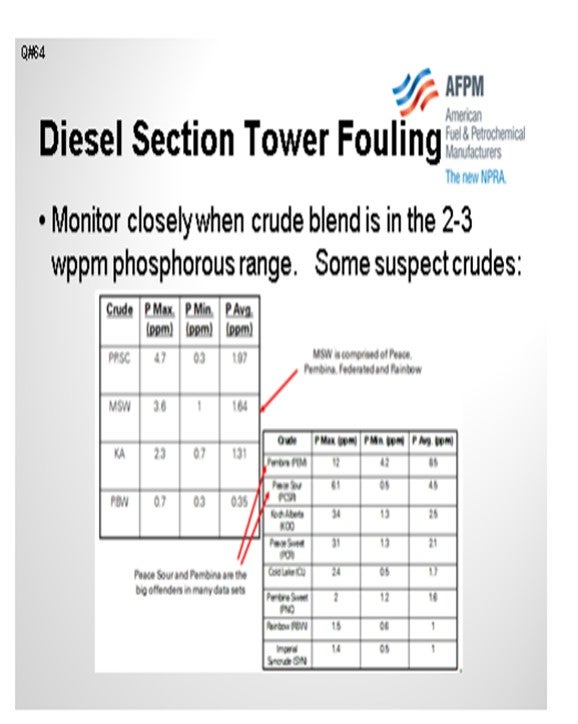
Many of our refineries are particularly concerned with any downstream unit impacts. We take phosphorus samples in our CDU products and closely monitor if issues are suspected or if there is a phosphorous-bearing crude scheduled or suspected to be in the crude supply. In the table below, you can see examples of some suspect Canadian crudes. The phosphorous contents are shown for these crudes. We monitor unit health and operations closely on our CDU blends that are in the 2 ppm to 3 ppm phosphorous content range.
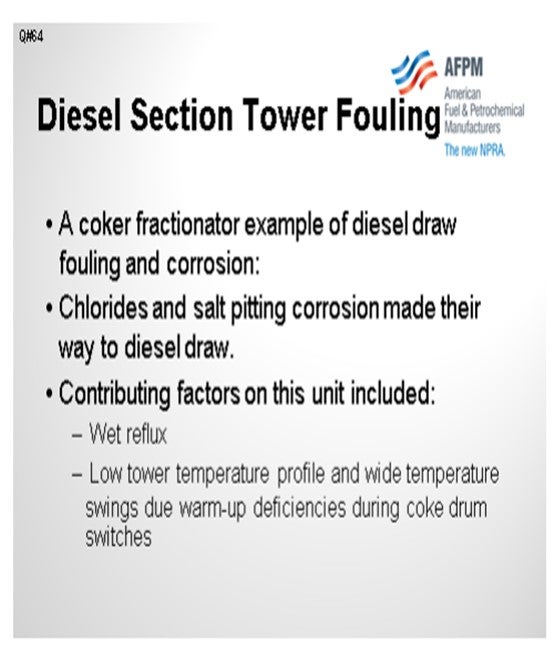
Let me add that one example I said I would give you. In this case, we did get some diesel section salt fouling. This one happened to be on a coker diesel draw tray. We saw nozzle corrosion on this unit that was due to chloride and salt pitting corrosion and which was the result of both wet reflux and lower tower temperature profiles during drum swings. This particular coker has had issues with wider-than-typical temperature swings during the coke drum switches and a relative deficiency of warmup capacity, both of which contributed to the lower temperature profile seen on the coker fractionator. So, chlorides in this coker naphtha and diesel products did find their way to downstream units in this particular refiner.
BASHAM (Marathon Petroleum Corporation)
We experienced a similar situation as Howard just mentioned. At our Robinson Refinery crude unit, we have seen phosphorous fouling over the kerosene section for about three to five trays. We also had floating valves that we replaced with a fixed valve design to help out with that fouling as well. In a coker fractionator tower, it is important that, as Howard said, you do not let the overhead temperature get too low; because when you force the colder temperatures down in the tower, you can see the salt formation in the distillate section.
DION (GE Water & Process Technologies)
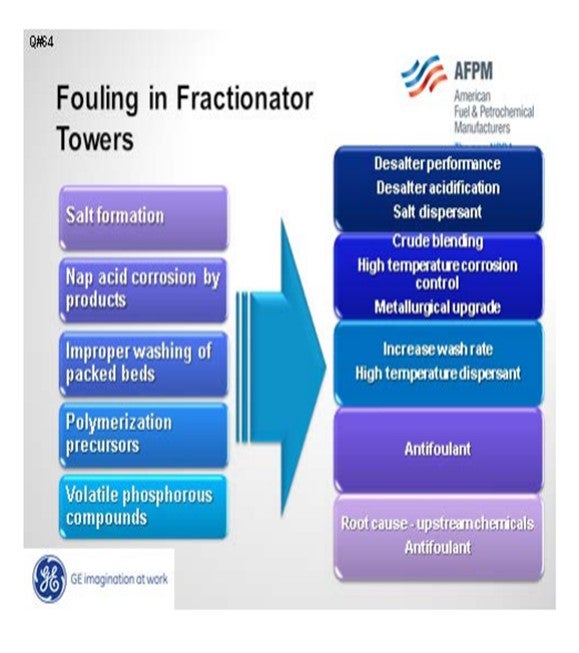
Fouling in the distillate trays and other locations can be divided into five different categories: salt, corrosion byproducts, coke, polymers, and volatile phosphorous compounds. Amine salt fouling can be mitigated with improved desalter performance, removal of tramp amines, and the use of a salt dispersant. Acidifying the desalter will partition a greater number of amines into the effluent brine.
If you do not have the proper metallurgy, corrosion byproducts can foul downstream units. This can be addressed with metallurgical upgrades and high temperature corrosion control programs, as well as blend control to minimize the TAN (total acid number) and NAN (naphthenic acid number) of the crude blend.
Improper washing of packed beds can contribute to fouling. This condition is usually seen in vacuum towers that have high surface area and very high molecular weight heavy hydrocarbon molecules that may precipitate, dehydrogenate, and create coke. This fouling can be addressed operationally with wash rates and the use of a high temperature dispersant to move coke particles.
Bitumen streams, such as dilbit from Canada and DCO (diluted crude oil) from Venezuela, may have the potential to induce polymerization. These crudes are typically bitumen with a diluent added to reduce viscosity. If these diluents come from cracking processes, there is the potential that they may contain olefins which could encourage fouling from polymerization products.
Howard addressed volatile phosphorus. These are most likely from phosphorus-based oil field chemical additives.
AHMAD AL-JEMAZ (Kuwait National Petroleum Company)
Again, I want to ask about mitigating fouling in the coker fractionator. Also, how effective is the introduction of online antifoulants to clear the fouling material created from corrosion products or coke fines and salts? Is there any record of successful implementation of antifoulants to clear the fractionators?
DION (GE Water & Process Technologies)
It is easier to prevent fouling from occurring than to remediate after the fact. An example is asphaltene precipitation. It is easier to prevent asphaltene molecules from agglomerating to a size where they precipitate than it is to redisperse them once they are agglomerated. Sloughing the tower to wash fouling material out of the system is usually a last resort. A better approach would be to examine methods to minimize coke entrainment into the tower including: an effective coker defoamer, defoamer to diluent ratio, coker overhead corrosion inhibitors, upward vapor velocities in coke drum vapor line, and an antifoulant in the gas oil or other reflux.
CELSO PAJARO (Sulzer Chemtech USA, Inc.)
For our delayed coker main fractionator, we have successfully used antifouling trays (VG AF™). They have several advantageous characteristics to mitigate fouling including fixed valves, push valves, fouling-resistant downcomer designs, and special outlet weirs. These features generally resist fouling and/or serve to move sediment across the trays to minimize accumulation of these fouling components.
LEE (BP North America)
I have one other comment on the first question: the use of antifoulants. Maybe the vendors know more about this, but I think there is some literature or some publications where folks have successively used iron dispersant to move around the iron scale. We considered that for the salted-up tower we had; but to us, it felt very much like a last resort because if we moved those solids to a draw nozzle or somewhere else, we would be shutting down the unit. So, we considered it, but we thought it was too risky to try.
BASHAM (Marathon Petroleum Corporation)
At Marathon Petroleum Company, the only issue we have had is the phosphorus fouling in our Robinson refinery crude tower, which only occurred over three to five trays in the kerosene section. We have reason to believe that phosphorus will migrate to both the kerosene and diesel sections, thus affecting the diesel hydrotreater. However, only the volatile phosphorus is believed to result in tower fouling. We replaced the trays (floating valve) with an antifouling fixed valve design.
DION (GE Water & Process Technologies)
There are five primary ways that foulants can be generated and deposited in the diesel/distillate sections:
Salt Formation: With more focus on diesel maximization, more tower operations have been changed to run at lower overhead temperatures. The shift in tower operation coupled with tramp amines either in the crudes or recycled via other streams can cause salting in the tower. The salts will foul the tower and since they are very corrosive, will end up generating corrosion byproduct which will also contribute to the fouling.
Naphthenic Acid Corrosion: Naphthenic acids can distill and concentrate in these cuts. If the temperature is high enough and the metallurgy has not been properly upgraded (SS 316L and SS 317L), corrosion will occur. Depending on the severity of the corrosion, the fouling rate from corrosion byproducts can be quite significant.
Improper Washing of Packed Section: This typically happens more in vacuum towers where packed beds are more common. There is more surface area for compounds such as asphaltenes and other heavy molecular weight material to deposit and dehydrogenate forming coke. Some of the coke fines will end up going with the draw and can foul the downstream exchangers.
Polymerization Precursors: With the increased availability of dilbit, synbit and diluted crude oil, there is an increased risk the diluent used for these synthetic crude or bitumen products are from cracking processes. If the diluent is from a cracking process and either not hydrotreated or the hydrotreater is not completely efficient, polymerization precursors can be present.
Volatile Phosphorous Compounds: With the increased availability of unconventional crudes, fouling from volatile phosphorous compounds is becoming more prevalent.
All of these foulants and foulant precursors have the potential to impact downstream units.
Mitigation Strategies
1. Salt formation:
a. Desalter performance improvement (chloride reduction)
b. Desalter acidification to reduce tramp amines
c. Salt dispersants
2. Naphthenic corrosion:
a. Crude blending to reduce naphthenic acid content
b. High temperature corrosion control program (chemical treatment)
c. Metallurgical upgrades
3. Improper wash:
a. Increase wash rate.
b. Apply high temperature dispersant.
4. Polymerization precursors
a. Apply antifoulant chemistry to minimize polymerization.
5. Volatile phosphorous
a. Perform root cause analysis of upstream chemical additives to minimize or eliminate the risk.
b. Apply of antifoulant chemistry, such as dispersant, to minimize fouling due to phosphorous compounds.
BRUCE WRIGHT (Baker Hughes)
Salt deposition is the most common. Both ammonium and amine chloride salts have been identified. The salts most likely will not migrate downstream, but can lead to additional iron sulfide formation, via underdeposit corrosion, which has been seen to migrate downstream. The deposition of the salts is a function of temperature and concentration. Identification of the operating window in which salts will deposit can be determined by use of the Baker Hughes Ionic Model. The Ionic Model can also be used to select the most appropriate neutralizer to reduce salt deposition for the operating window. Baker Hughes salt dispersant additives have also been successfully employed. iron sulfide fouling is also not uncommon. Effective mitigation has been achieved with Baker Hughes corrosion inhibitors and/or iron sulfide dispersant additives. Organic phosphorus compound deposition has also been experience. Both mitigation and online cleanup have been achieved with Baker Hughes additive application.
DENNIS HAYNES (Nalco Energy Services)
Diesel/distillate draw fouling in distillation columns is distinct from the problems reported in the literature for naphtha section fouling. Fouling that has been seen at this area lower in the tower, in certain cases, has been related to some specific chemicals used in the production of crude oil. The Canadian Crude Quality Technical Association has done projects in this area over past years. Where the fouling has become apparent in columns, dispersant type chemistries have been successful in reducing material buildup.
SAM LORDO (Nalco Energy Services)
In this part of the tower, amine/ammonia salting is the primary fouling encountered. The following has been done to minimize this type of following:
• Raise tower overhead temperatures,
• Optimize desalting operation to minimize chloride and/or amine traffic in the tower, and/or,
• Use salt dispersant chemistries.
Year
2012
Process