Lunch in Exhibit Hall
The vendor exhibition offers attendees an opportunity to learn about the latest products and services available to the industry. The Passport Drawing will take place during this lunch session.
GAMBOA-ARIZPE (CITGO Refining & Chemicals, L.P.)
Unplanned shutdowns: In the refining business, we understand the nature of unplanned shutdowns. Despite our best efforts to avoid them, it seems like Murphy’s Law really loves our industry. “Whatever can happen, will happen” is a phrase often attributed to Edward Murphy, an Air Force physicist who uttered the words in response to the failure of devices he was testing that failed to work as designed back in 1948. What most folks do not realize is that the mathematician Augustus De Morgan first published the phrase on June 23, 1866, or about 92 years before Murphy used it. This observation raises the possibility that if something went wrong, is that Murphy is really De Morgan being misremembered.
In a broad sense, every piece of process equipment within a unit has a purpose and a function. However, the functionality of any given process equipment is reduced over time, most likely from fouling. The performance deficiency against ideal conditions can then be calculated and quantified in terms of process impact, which, in turn, can be quantified as lost economic impact. With heat exchangers, such gaps can be readily quantified, assuming that the associated process variables – i.e., temperatures and pressures – are being historized and that they are reasonably representative of the process. In other words, are they accurate?
Using the data from these variables, along with the fluid properties of the associated process streams, provides a basis to calculate the transferred process duty across any given exchanger, the quintessential performance metric which quantifies how efficiently an exchanger is performing versus design when it is clean. The extent of the economic impact of any calculated performance deficiency largely depends on the specific function that heat exchanger is designed to provide.
For example, consider the case where a fouled heat exchanger fails to cool the rundown temperature of a product stream and exceeds the storage specifications of the product tank. Such a limitation could be highly impactful because the product rate and, by proxy, the charge rate to the unit would have to be reduced until the rundown temperature is cooled below the specification. Or, how about a case where available hydraulics on the feed circuit are limiting? Would not such a limitation tend to emphasize the need to minimize exchanger pressure drop which fouling generally affects? There are plenty of unit operations that can be adversely impacted by decreased performance across exchangers. Some are more limiting than others. For this reason, unit process engineers are generally assigned the responsibility of tracking the relevant performance metrics of most or all of the exchangers in their respective process units.
Tools, such as spreadsheets, can be used to quantify the economic impact of lost exchanger performance. These tools can also be employed to predict when the impact of lost exchanger performance will become limiting enough to the organization that the planners are made aware of the need to incorporate the maintenance of the exchangers into the respective plants. If monitored properly, any underperforming exchanger will be identified with enough lead-time to be included in the short- or long-term maintenance plans.
The effect of two-phase flow within exchangers also needs to be understood by those involved with the operation and those monitoring the performance. Phase-dependent considerations are particularly applicable in preheat exchangers where high vapor loads – beyond what was factored into the exchanger’s respective design – can become limiting. The extent of vaporization in a particular exchanger depends on more than just the absolute temperature and pressure of a system at a given point.
The vaporization fraction can depend on:
1. Not-so-subtle changes to the feed slate (or any other change that can cause the fluid properties of the streams to be appreciably different from those used in the design basis, particularly changes to the initial boiling point of a stream or even its water content).
2. The overall flowrate through the exchanger (flow dependent pressure drop both within an exchanger and the interconnecting piping can produce more flashing); and/or,
3. Heat transfer efficiency losses (both from latent energy changes and from lower thermal conductivities in the vapor phase compared to those in the liquid phase).
Because exchangers in a preheat train are usually interconnected, as I just described, the combined effects of these process factors can produce nonsensical situations such as excessively high dP that comes and goes. So, you measure the dP, and see that it is really high. Then you go back and measure it two weeks later, and it is really low. You are scratching your head, thinking: What is going on? It is probably pertinent to look at the vaporization components. It only makes sense, in light of a significant deviation from the two-phase flow bases that were used for a particular exchanger’s design.
A final point to consider is that certain fouling deposits can eventually result in exchanger leaks via highly localized under-deposit corrosion mechanisms. Because unexpected exchanger leaks are more disruptive in the planning sense and fouling base performance gaps alone, the buildup of these types of deposits – such as naphthenic acid salts, ammonium sulfides, ammonium chlorides, etc. – needs to be identified and associated with the relevant processes so that the appropriate risk is also factored into the maintenance planning activities.
THEISS (Marathon Petroleum Corporation)
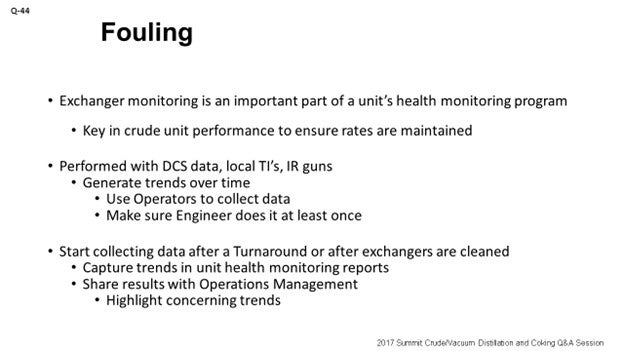
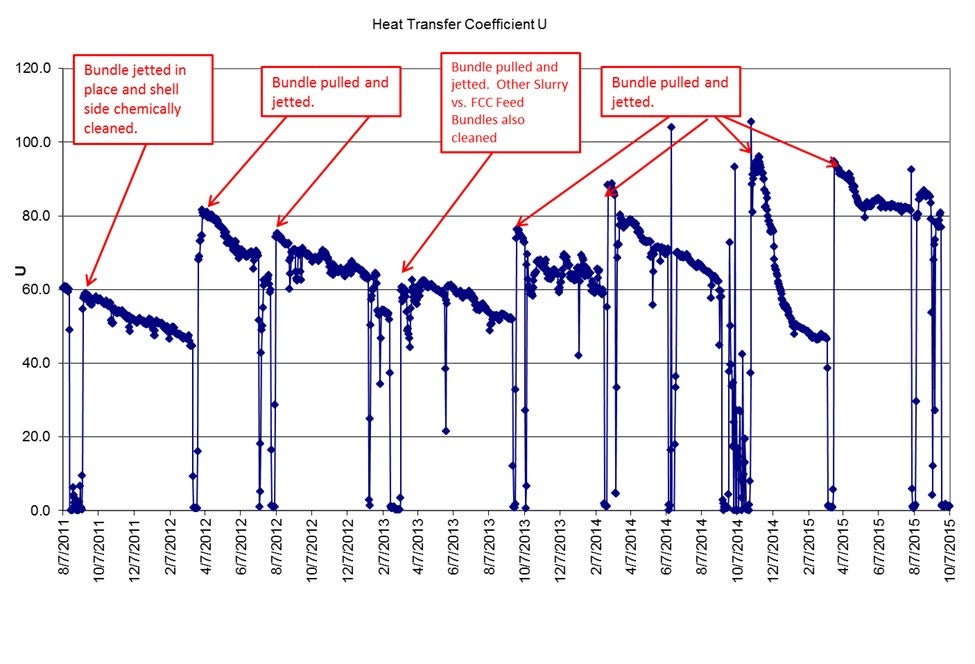
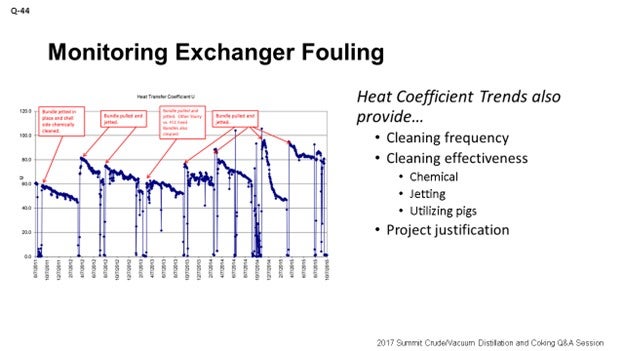
I will just briefly expand upon what Héctor talked about and put it into pictorial form. Monitoring fouling really comes down to good engineering and having good process unit engineers who continue to monitor their data. There are simple spreadsheets or programs available for them to use to do this monitoring. What you see on the slide is an example of a fouling trend which allows you to really provide some insight on developing projects to extend the cleaning cycle, if the economics are there. Potentially establishing a routine frequency at which you are fouling and proactively cleaning exchangers is also an opportunity as long as these processes are being properly monitored. I also want to mention that whether you clean in place, do some sort of online cleaning, pull the bundle, or potentially utilize pigs to clean a bundle, you will see the effectiveness of these different cleaning processes through trending.
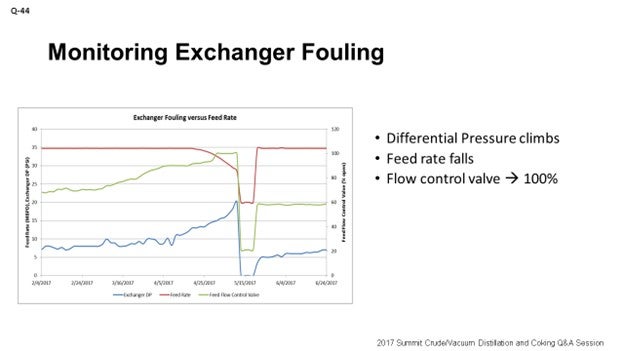
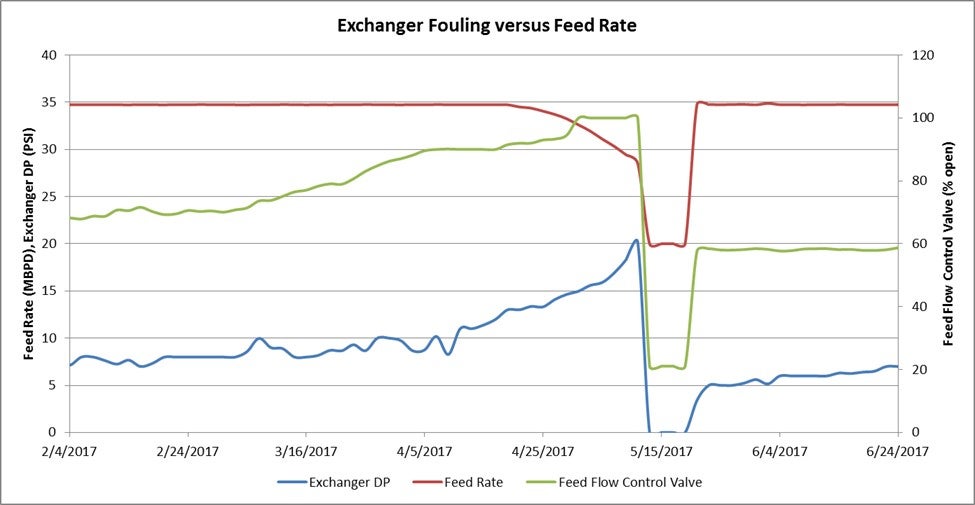
On the next slide, I will go over the other monitoring points. As far as heat exchanger coefficient, it is also important to measure pressure drop. Do some simple trends where you can observe pressure drop over time, translate that to feed rate, and then watch as your flow control valve position responds. The main takeaway is that it is not all about fouling coefficients. There is also pressure drop that could be occurring which demonstrates that it is time to clean your exchanger.
LÉGARÉ (Andeavor Martinez Refinery)
I will add to what Héctor, and Jeremy have said although there is not much left for me to mention. The exchanger performance is really an important part of the unit health monitoring that is done by the unit engineers. The question is: How does that data actually get into the monitoring report? That data does not just magically appear. If you are fortunate, you will have the DCS data from which to generate your trends. But more than likely, this data will be manually gathered on the preheat train of an older crude unit. Make sure you have the right targets identified on inlet and outlet flanges so that the IR (infrared) guns are aiming at the same point every time the data is gathered. It is really important to leverage your operators to gather that data so the engineer can spend time doing his/her analysis. Do not get me wrong. If there are any young engineers in the room, it is important for you to do it at least once yourselves so you understand what the operators are doing for you. This will allow you to respect their time as well.
The data collection should begin right after a turnaround so that you have good start-of-run data. It is important to have that start-of-run baseline as your starting point to measure degradation over time. I cannot stress the point enough that if you want to be successful getting heat exchanger cleanings added to a work list, you need the data and you need to communicate that data to the appropriate audience. If you do not communicate your data and keep it buried in your monitoring report, it will never be seen by the intended audience. So, communicate, and communicate often. Make sure it is in front of the Management team, so they know the degradation that is happening. If there is an opportunity to clean the exchangers, you would not have to start your explanation from the beginning; instead, you can explain to them that you have been monitoring the data for months.
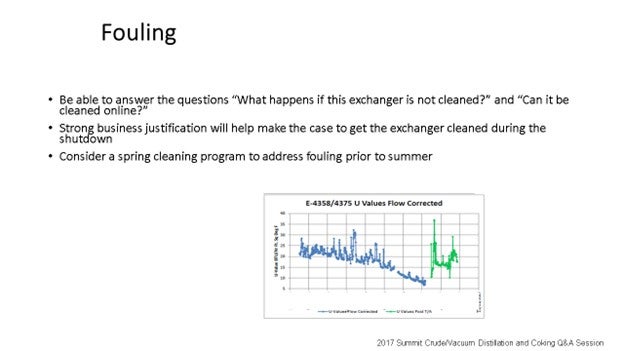
Definitely think about the business case for what you want to add to the work scope. If it is an unplanned event, the TAR planners do not want to add anything unless it is absolutely necessary. Some of the favorite questions we get asked all the time are: “What happens if the exchanger is not cleaned?” and “What is the business impact?” It is best for you to put that in dollars and cents; not just say, “Well, it is better if we clean it.”
Another question is: “Can it be cleaned online?” I cannot tell you how many times I have heard, “Yes, it can be cleaned online.” Then you try to clean it online, and the isolation valves do not hold. You then have to wait for the next shutdown to clean the exchanger. It is important to check the isolation valves to make sure they hold prior to deciding if the work can be done while the unit is online.
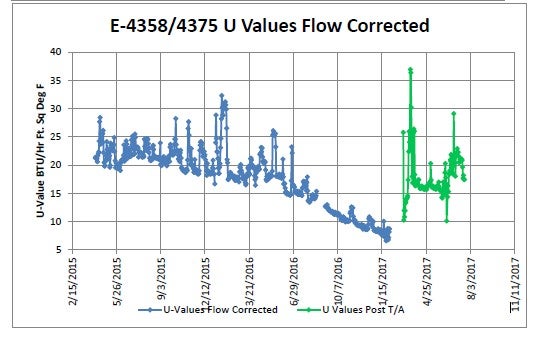
Lastly, consider a spring-cleaning program. Something we do is identify a spring-cleaning list of exchangers that you can go out and clean during the cooler seasons to avoid impacting production rates. Work is also typically done at night; again, to minimize impacts to production and allow us to regain performance as we go into the warmer months. I just tacked on a trend here. It shows you what degradations look like before being cleaned. You can see the spike back up again once the exchanger has been cleaned.
KIP EDGMON (Martin Resource Management Corporation)
We are curious about your frequency. As far as your surveys, what have you found to be effective? Are you talking about collecting that data once a week? Once a month? Once every two months? What do you guys prefer, and what are you using to really see a good trend?
LÉGARÉ (Andeavor Martinez Refinery)
I will say that if we know we have a fouling service, I will go once a week just to get the dataset out there. This frequency gets the operators used to pulling that data on a regular basis. I find that if you go longer than that period, you will run the risk of the data not getting collected. In that case, instead of missing two weeks’ worth of data, you would then be missing two months’ worth of data. So, I would go more frequently rather than less frequently.
DAVE FERGUSON (Tracerco)
I will certainly not dispute anything the panel has said, but I find that the situation is more like Eric said. There are many times when data is not available or people are not getting out to check readings and collect data; so, there are services available, like those offered by Tracerco. We can help you identify how much fouling you have in your exchangers and where it is located, both with tracer and non-tracer techniques. Tracer techniques have been used to determine the total volume of fouling by measuring the residence time and comparing that to the theoretical residence time, based on the volumetric flow. This service has a 5 to 10% error. Non-tracer techniques generally involve the use of a neutron backscatter (NBS) device. This device measures the density of hydrogen atoms (free or in a compound) just inside the vessel wall. For example, a hydrocarbon liquid flowing through the shell side of a horizontal exchanger will have a certain hydrogen density. If there is fouling material laying in the bottom of the shell, it will displace much of the hydrocarbon. The fouling material, even though it is “wet” with the flowing hydrocarbon, will have a different hydrogen density. The interface between the two areas can be measured with the NBS device. These services are available when and where you need them.
THEISS (Marathon Petroleum Corporation)
Just to tackle what Eric said, we probably feel the same, as far as weekly monitoring. In places where you have automated temperature indication, as frequently as possible is recommended to develop good trends. Earlier, we talked about wireless technology. We have utilized that on quite a few of our exchangers to bring in data to the house. It is not really a control point, but it does provide a lot of insight for engineers to develop fouling trends and watch over time. So, wireless technology is a good application that is relatively inexpensive.
DANIEL McGRAW (Marathon Petroleum Corporation)
I want to echo that wireless technology is a great application for collecting fouling data on exchangers, or really any monitoring for that matter. We have used it at my facility in Canton, Ohio. It is a cheap way to get critical information on critical models.
UNIDENTIFIED SPEAKER
Really, I would just like to ask you guys about your wireless to see who you are using and what is working well, because we are looking to doing the same thing: setting up wireless transmitters to avoid going out to collect the data manually. There are a couple of companies out there. So, after the break, can you guys tell us who you are using?
UNIDENTIFIED SPEAKER (CITGO Petroleum Corporation)
My question for the panel and others in the room is: Does anyone have any techniques or success stories that they can share about online or in-situ bundle cleaning?
LÉGARÉ (Andeavor Martinez Refinery)
As far as online cleaning, I talked about a spring-cleaning program. Much of what is in our program are overhead air fin fans, which are done online without any real impact. There are a lot of the exchangers that are pulled, cleaned ex-situ, and then reinstalled. I do not have much to add, as far as in-situ cleaning.
THEISS (Marathon Petroleum Corporation)
We have had some success with some chemical vendors out there, as far as cleaning. They generally do an effective job. Recently, we have been trying a couple of new products and different applications, and they seem to be working well.
JEREMY THEISS (Marathon Petroleum Corporation)
Exchanger monitoring software or spreadsheets that pull in refinery process data can be used to monitor fouling trends. Exchanger trains should be evaluated for fouling on a routine basis to provide historical references and trends to compare pre- and post-cleanings. The definition of routine should take into account the specific exchanger’s impact on the process and the importance of the process unit to the refinery’s profitability. These calculations are necessary to set appropriate cleaning cycles for both planned and unplanned outages.
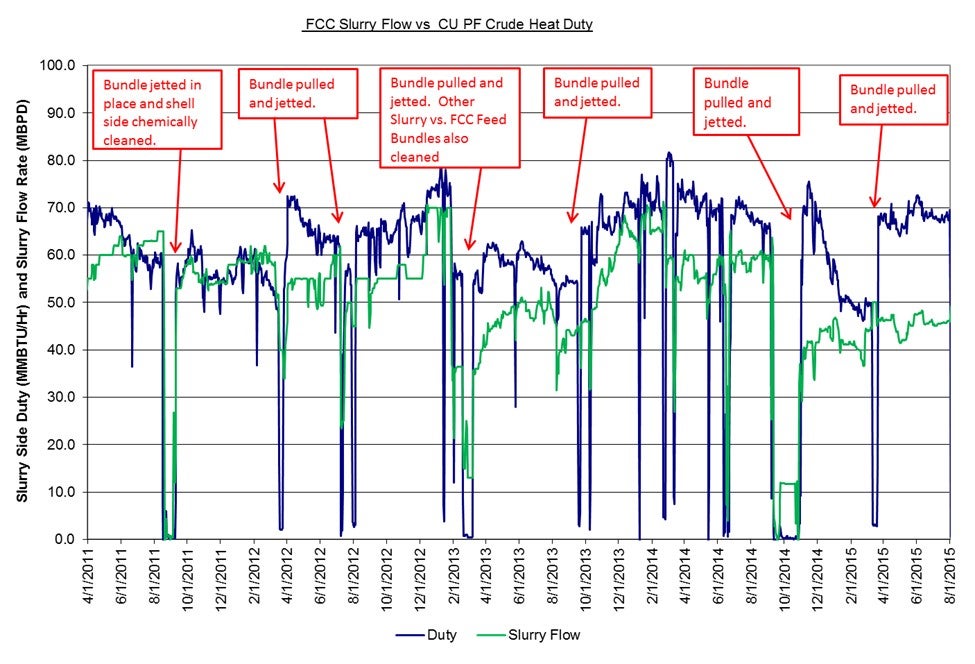
For unplanned outages, an evaluation should take place on the fouled exchanger to determine how much recoverable duty is available and an understanding of the next planned cleaning opportunity. Understanding how the heat transfer impacts unit rate and energy consumption will be essential in determining the economic impact of cleaning the exchanger. The cost of cleaning exchangers is typically small relative to the lost production, if rates have to be held back due to unit limitations. Below are examples of tracking trends used to monitor exchanger duty and heat transfer coefficient. The tracking data allows for post-auditing of cleaning options and the impact of secondary exchangers on the system’s heat balance. In addition to having historical data, having the availability of exchanger design data will provide engineers with more insight on clean operating conditions and design heat transfer coefficients (U).
For opportunistic exchanger cleanings (i.e., when a process unit has reduced rate or has shut down for an unrelated issue), economics are evaluated based on ROI or days to payback. The key points to focus on are estimated cleaning costs, fence line energy savings, and/or throughput increases. Estimating the post-cleaning outlet temperature will allow you to estimate energy savings, subtracting out cleaning costs, and calculate a payback. Estimating a clean outlet temperature can be done based on history or using exchanger design, while understanding unit configuration changes that may have occurred. Any projections?] for throughput increases can be added on to the overall payback while, taking into consideration additional processing costs for those barrels. Once again, if data is collected and analyzed routinely, the engineer will be able to make relatively quick decisions during these opportunistic events.
To ensure that all exchangers are being vetted properly, post-audits are highly encouraged. This [procedure?] allows the engineer to determine the effectiveness of the cleaning and, in some applications, establish a cleaning cycle. Post-audits should include actual energy savings and actual cleaning costs.
If the process unit is hydraulically limited, tracking the exchanger dP over time is critical to determining value lost and gained from cleaning. In the example below, the exchanger dP increased to the point where feed rate was reduced. This reduction in capacity justified a slowdown to clean the exchanger and increase throughput. The justification process is similar to the previous examples of payback periods with the complexity of accounting for lost production for the cleaning period and the increase in production after the cleaning period.
Depending on the service and design of the exchanger, the type of cleaning may impact your decision. Conventional water-lancing will mostly clean straight sections of the tube, while the U-bends may remain dirty. In some instances, this lack of thoroughness could leave about 20% of exchanger area with foulant. Chemical cleanings may also provide heat exchange recovery with minimal lost opportunity. These chemical cleanings may provide a cheaper alternative to the traditional pull-and-jet cleaning option. Once again, an historical reference proves very beneficial in determining the type of cleaning to perform.
ERIC LÉGARÉ (Andeavor Martinez Refinery)
Heat exchanger monitoring is an important part of an effective Unit Health Monitoring plan when used with an accurate preheat train model. It is not only important for the crude unit’s preheat train, but also for other refinery units that count on heat exchange. Poor heat exchange can reduce the inlet temperature to the crude fractionator and/or reduce crude throughput if the unit is already running close to its hydraulic limits.
Online TIs or IR guns/local TIs can all be used to generate trendable data when inputted into your PI system, Excel model, or Simulation software. Ensure that any IR measurements are established using fixed targets in the field. This allows for consistent field measure for reliable long-term trends. Updating the models and sharing the results as part of an ongoing unit health monitoring effort will increase the visibility of this information to the refinery organization.
Having regularly pulled data will make for a more meaningful trend than trying to force a curve through the three or four data points that were pulled just weeks prior to a planned outage.
Engage operators in pulling the data as part of a weekly round so the engineer can spend his/her time analyzing the data. The engineer should personally collect the data at least once to understand the orientation of each TI relative to the exchange inlet/outlet flanges. It is also a good idea for the process engineer to understand the field work being done to support their efforts.
The engineer should have data trends well-populated and clearly indicating a downward trend in heat exchange coefficient for each exchanger they are trying to get cleaned. If possible, use the unit start-of-run (SOR) as a baseline. Let this be a reminder to perform a heat exchanger survey right after a turnaround or maintenance outage when you know your exchangers are at SOR.
Use a spring-cleaning program to identify and clean fouled exchangers prior to the hotter summer months. This program allows for exchangers to be pulled and cleaned while unit rates can be maintained. Having the performance curves available makes it easy to justify adding exchangers to this program.
Make sure the exchanger performance curves are part of your unit monitoring report. Present updates to your leadership so they are aware of the work you are doing on monitoring exchanger performance. Engage your chemical provider if you feel a chemical solution will help improve exchanger performance until the next opportunity. Are the dispersant and antifoulant dosages, correct?
Understand the cause and effect of each fouled exchanger so you can answer the question: “What if we do not clean the exchanger this time?” Will the fouled exchanger limit desalter efficiency or expose a heater limit? Will it reduce gasoil recovery and introduce a new downstream limit? Having this information and relating it to the refinery business case will improve your chances of having your exchanger added to the worklist.
CHRIS CLAESEN (NALCO Champion)
We have developed a sophisticated program called MONITOR™ that allows us to calculate the cost of fouling and help determine the optimum cleaning frequency and fouling control strategy. Heat loss is calculated for each exchanger, and cleaning planning is based on the cost of fouling.
GREG SAVAGE (NALCO Champion)
The MONITOR™ heat transfer simulation program was developed specifically to monitor fouling, as well as economic evaluation of heat exchanger networks for cleaning and treatment. Process conditions – such as temperatures, flow rates, and stream properties – are specified, and the software determines the fouling factors for all exchangers in the network and a normalized furnace inlet temperature utilizing the fouling factors. MONITOR™ performs two-phase flow and flash calculations for complex blends, as well as modeling vaporization rates in heaters. The calculated parameters are then plotted to investigate the rate of fouling and its effect on the network. The economic impact of the fouling is also examined, as are the benefits of cleaning exchangers, by evaluating the maintenance costs, energy, and throughput penalties associated with bypassing and cleaning each exchanger individually, as well as in user established groups, versus the effect of cleaning on the furnace inlet temperature. Optimum cleaning frequency is determined when the costs of fouling control is equal to the fouling costs.
LÉGARÉ (Andeavor Martinez Refinery)
I have the answers split up into three different sections in order of consequences, sources, and then solutions. I want to point out that this is like another throwback question; because in looking at the archives, I found that this topic goes back at least 20 years, if not 30 years. A lot of the answers back then still apply today, so I think we missed an opportunity for a throwback.
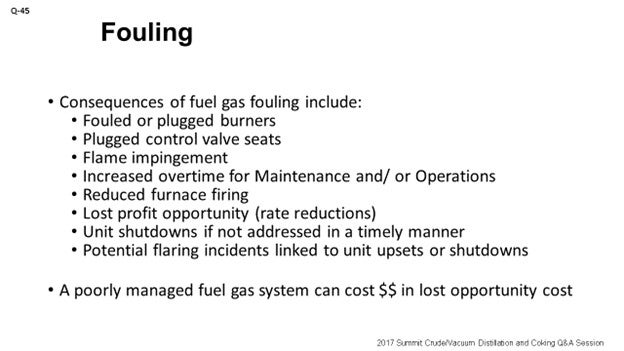
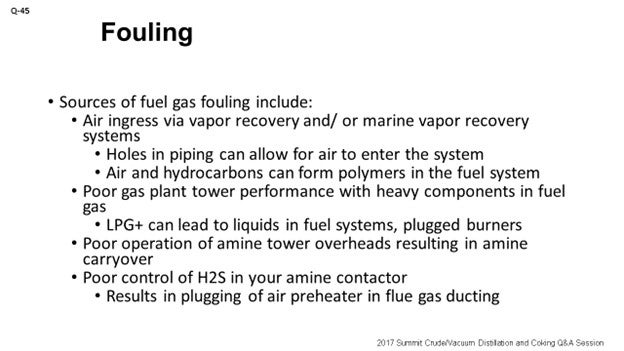
Consequences of fuel gas fouling include fouled or unplugged burners. We have seen plugged control valve seats. Flame impingement has resulted in increased overtime for Maintenance and Operations personnel. Maintenance folks are going to be the ones performing the burner cleaning, which usually increases overtime and operating expense cost. If Operators are responsible for burner maintenance, then it will fall on them.
Reduced furnace firing: As you start to plug your fuel system, you will be firing less; or, you will be trying to fire as hard as you can but transferring less heat to the process as a result. LPO (lost profit opportunity) kicks in if you have to cut rates because your fired duty went down.
Unit shutdowns: If they are not addressed properly, you will obviously have a worst-case scenario of an unplanned shutdown with the risk of associated flaring events. Potential flaring incidents linked to unit upsets or shutdowns are your worst-case scenario. The last situation we want to happen in California is to end up with a flaring incident. So, suffice to say, if you do not manage your burner system properly, it can cost the refiner a lot of money in LPO.
Sources: Where does all of this fouling originate? We have seen air ingress into the vapor recovery system as a source of oxygen that then reacts with hydrocarbons and forms polymers. Some of the system was half-buried as a result of poor inspection over time. This resulted in holes in the piping. The vapor recovery system works under vacuum, so air was pulled into the system. If you are not operating your gas plant properly, the splitters will not be splitting efficiently, and you will start to see C3s or C4s making their way into the fuel gas system until you start to find yourself with appreciable amounts of LPG (liquefied petroleum gas) in the fuel piping and burners.
Poor operation of your amine towers: From a stripping efficiency standpoint, you will have the risk of high H2S (hydrogen sulfide) in your fuel gas system and also amine carryover if the accumulator level is not maintained properly. Amine carryover into the fuel gas system has been a known source of fouling for some time. High amounts of H2S in the cooler portions of a heater’s flue gas train or on a boiler feed water economizer may experience ammonium bisulfite deposits and increased pressure drop in the flue gas system.
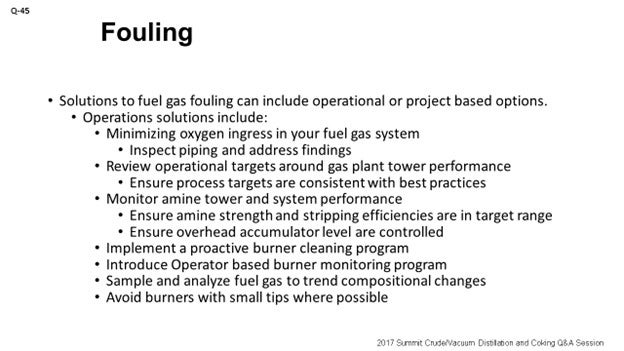
Solutions: I have solutions split up into two categories. One is the low-cost/no-cost operational projects. The second is the capital projects, such as minimizing oxygen ingress where you can start inspecting the system properly, identifying weak points or holes, and being either patching or replacing sections of pipe. The trouble there is that if you are going to start looking at replacing sections of your vapor recovery system, it has to be linked to major events like a turnaround where part of the refinery can be down, or work can be done during the cooler seasons at night when the breathing of the tanks is minimized.
Review gas plant tower performance to make sure that targets are set properly and that those targets are being discussed at Morning Turnover Meetings. Better target attainment on the stripping towers will ensure equipment operates as designed. Confirm the amine tower is meeting its performance objectives. Check the liquid level in the overhead accumulator to ensure that you are visually confirming that the transmitter is operating correctly. Sometimes, installing a coalescer downstream of the accumulator is a good idea if it has not been done already. Verify that the amine strength is in its targeted operating range. Make sure you are reading the Service reports from your amine supplier, because they tend to come in via email and contain valuable information on the quality of your amine.
Implement a proactive burner cleaning program. Instead of a reactive system that requires Maintenance to work on overtime, have an extra set of burners on hand that are already cleaned. This way, you will be looking at swap-outs, which is more efficient and quicker to implement. Also, you will get out of the embarrassing situation of having to explain to Management why you are having to cut rate to remove and clean burners when you could have purchased a few spare burners to have ready for installation.
Introduce an operator-based burner monitoring program. Have the operators inspect the inside of the firebox and notice what the flame patterns look like. In the Answer Book, I mention sending some of your key operators or maybe engineers to Oklahoma to a burner school, because there are some really good opportunities there for folks to get first-hand knowledge about what “good” looks like. They would then bring that information back to your plant. You may end up with a local SME (subject matter expert) or two out of it, so it is a good investment.
Ensure that you have a rigorous sampling program around your fuel gas systems so you can trend it over time. This is handy for looking at tower performance and how changes can impact fuel gas quality. For example, if you are coming out of a turnaround, you put your gas plant back online. When you see a step change in the fuel gas quality, you can potentially correlate it back to a startup of a tower. That helps with troubleshooting. Lastly, avoid burners with small tips if you know you have a problem with fuel gas plugging. Larger tips are going to directionally plug less often.
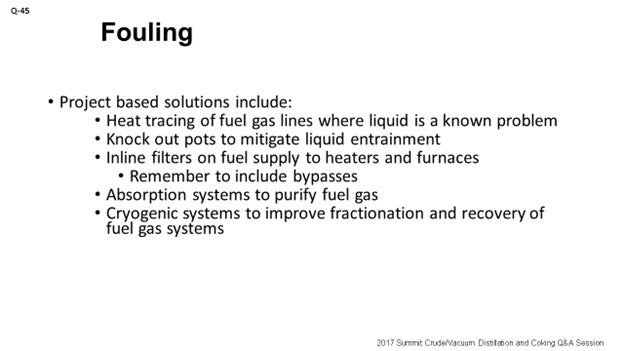
Now I want to talk about the more costly projects. What we have done is look at heat-tracing on systems, keeping heavier hydrocarbons in the vapor phase, and keeping material from condensing. Install knockout pots upstream of heaters to collect whatever liquid will drop out. Inline filters are also a good idea, but make sure you have the bypass in place so you can perform online cleaning of the filters. Installing an absorption system to purify fuel gas is a newer technology we are starting to consider, because it allows you to take out the sulfur, recover the LPGs, and cleanup your fuel gas system. Lastly, from my experience, cryogenic systems are also a potential solution. Although they are quite expensive, you also get to see the benefit of improved fractionation and recovery of hydrocarbons.
GAMBOA-ARIZPE (CITGO Refining & Chemicals, L.P.)
Eric’s answer is fairly complete. I will just add some minor comments. Again, the three-pronged nature of the question was consequences of the fuel gas fouling problem source, where they originate, and solutions. I just want to add a point about each.
Another consequence, based on the descriptions that Eric gave, is the flame length consideration for furnace burners. You can end up with process tube flame impingement if you do not clean the burner tips at an adequate frequency.
Here, we also recently started looking at the flare gas recovery system and found out that several of our refining neighbors were having a very similar corrosion problem to the particular problem we were experiencing. Upon some investigation, we discovered that oxygen incursion is a dramatic contaminant to the fuel gas system, particularly on the flare gas recovery line which ends up being routed to the fuel gas system. What oxygen does is lead to accelerated wet H2S corrosion mechanisms with very high hydrogen permeation rates.
What we observed was that oxygen incursion into the flare recovery system was creating corrosion rates as high as 200 mils per year; specifically on carbon steel piping and equipment. Accelerated growth of iron sulfide scale (the primary byproduct of wet-H2S corrosion mechanisms) can lead to not only hydraulic restrictions that back out the capacity of your flare gas recovery system, but also to containment problems with the line itself and to an increased risk for leaks. So, after much convincing, as well as after minimizing oxygen incursion into the flare header system wherever possible, a practical but pricey solution for managing the high corrosion rates observed in the flare gas recovery systems (promoted by oxygen) was to address it with an alloy upgrade, which we, at CITGO, were forced to do. Many of the vapor lines on the flare gas recovery systems tend to be very long. They are systems that are located close to the flare itself (which, themselves, are typically located far enough away from the process units); so, you are talking about a very long linear piping lengths.
PHILLIP NICCUM (KP Engineering, LP)
I researched this question a little when looking for something I did not find, so I have a question. Did any of you find any correlation between the olefin content and diolefin content in the fuel gas, such as propadiene being in the fuel gas and being a contributor to fouling within the fuel gas system? That had been my own experience, in particular on smaller orifices for purging pressure taps on FCC units.
LÉGARÉ (Andeavor Martinez Refinery)
My answer is no; but also, it is becoming increasingly important to us in the Bay Area. The local regulators are starting to look at fuel gas quality. It is one of the issues they want to regulate, in addition to what crudes we buy. So, we will start looking at this topic in more detail. We have folks assigned to do just that.
I want to address that last comment about Merox™ systems. What we have been doing in the last years is taking those Merox™ systems out of the flare system.
CHRIS STEVES (Norton Engineering Consultants, Inc.)
I agree with everything Eric said about the fouling, as well as with what Héctor added. Just also keep in mind that, many times, the fuel gas systems in refineries are very old – ridiculously old, in some cases – and that you are dealing with many of the sins of the past, in terms of the fouling. It would be great to keep low-orifice burner tips out of the heaters. But the regulators, as you know, are pushing more towards ultra low-NOx (nitrogen oxide) burners which have those very small tips. In many cases, if you have to go with ultra low-NOx burners, your only solutions will be adding filters or coalescers directly upstream of those particular heaters, and even looking at replacing the piping downstream of those new filters and coalescers with stainless steel to avoid corrosion issues.
GAMBOA-ARIZPE (CITGO Refining & Chemicals, L.P.)
I want to address other fuel gas quality points which are salient to this conversation. The gentleman asked about diolefins or olefins. Yes, they are known foulants. They tend to polymerize and cause problems related to the buildup of polymers, but there are other constituents that need monitoring. Most refiners tend to have some sort of online analyzer for their fuel gas, but it is supplemented by lab information, probably on the order of once or twice a day. The purpose of the lab analysis is to obtain the mercaptan information. Mercaptans, even in low concentrations (0-5 ppm) are corrosion promoters on the line. Again, a lot of these systems are carbon steel. So, it is just another consideration that you have to take into account.
ERIC LÉGARÉ (Andeavor Martinez Refinery)
Fuel gas fouling is not a new problem for refineries and has been covered in this forum for decades, literally. Consequences of fuel gas plugging include:
Plugged burners.
Erratic flame patterns.
Flame impingement.
Plugged control valve seats.
Increased overtime for Maintenance and/or Operations.
Reduced furnace firing.
Lost profit opportunity (rate reductions).
Unit shutdowns, if not addressed in a timely manner; and/or,
Potential flaring incidents linked to unit upsets or shutdowns.
In summary, a poorly managed refinery fuel system can easily lead to lost opportunity costs in the millions of dollars.
Sources would be:
Air ingress into your refinery fuel gas system, if there are holes on the vacuum side of the fuel gas system, including your marine vapor recovery (if applicable) or tank vapor recovery, as examples. Air ingress can occur in piping that is partial buried, poorly maintained, and/or partially submerged, leading to pitting corrosion and eventually air ingress. Oxygen and hydrocarbon can result in polymers formation, which will lead to plugged burner piping and/or burners.
Poor refinery gas plant tower operations could result in LPG+ in the fuel system, which could lead to burner fouling by coking of condensed hydrocarbons in your fuel system.
Poor control of H2S in your amine contactors could result in high levels of H2S in your fuel system. High amounts of H2S in the fuel system can result in fouling air preheaters or economizers in furnace ducting.
Poor operation of the amine contactor overhead system can result in carryover of amine into your fuel system. This problem has resulted in downstream fouling of the fuel system.
Solutions include:
Minimizing oxygen in your fuel system by sealing any holes on the vacuum side. This activity may require parts of the system to be taken offline or TAR opportunities when the system requirements will be minimized. Work with the Inspection Department to inspect existing piping for pitting. Have Maintenance ready to replace suspect sections of pipe if the system will be down.
Monitoring gas plant tower performance to ensure that the proper data points are being monitored and alarms are highlighted in Operations meetings.
To ensure that fuel gas quality is maintained, confirm that the amine system strength is in the target range specified by your supplier to ensure that H2S /CO2 is being absorbed. Lower H2S concentrations will help reduce fouling in the cooler sections of your furnace ducting.
Proactive burner monitoring and cleaning programs to move towards a proactive solution and not a reactive one. Have spare burners built, tested, and ready to swap out is preferred over having to cut unit rates while investigating reduced furnace firing.
Visual inspection of flame patters can indicate a fouling burner. Use third parties to help or send some engineers and/or Operations personnel to Oklahoma for burner school so they can help provide local troubleshooting.
Testing your fuel gas system on a regular basis can also help with trouble shooting as it may indicate a change in quality that could be a precursor to future fouling.
Monitor the amine contactors for potential carryover into the fuel system. Ensure that accumulator levels are kept low or look at installing a coalescer.
Burner tip sizing: avoiding burners with too-small tips that may lead to increased plugging.
Projects that help mitigate fuel system fouling include:
Heat-tracing on problematic fuel system piping can help heavier compounds stay in the gas phase.
KO pots can also be utilized, if warranted, with two-phase fuel gas systems.
Inline fuel gas filters upstream of each furnace. Ensure that bypasses with appropriate isolation valves are installed to allow for online cleaning.
Larger investments, such as solvent-based absorption, can help remove sulfur while recovering hydrocarbons. Cryogenic systems could also help improve fuel gas quality. High investment costs associated with these solutions usually require other economic or regulatory justification for investment to be justified.
RICHARD TODD (Norton Engineering Consultants, Inc.)
Fuel gas fouling in refineries is an ongoing problem and is typically the result of many years of corrosion due to moisture in the fuel gas system. These systems are typically saturated with water vapor due to the amine scrubbing that is used to remove H2S, and water may drop out as a liquid in low velocity areas or in areas with inadequate insulation. The largest problem associated with fouling of fuel gas systems is in the fouling of burner tips, many of which have become smaller with the move to ultra-low-NOx burners (ULNBs).
Many refiners who have heaters with new ULNBs installed have also tried to mitigate the impact of fouling on the tips by adding filter/coalescers to the fuel gas piping upstream of the heater to remove scale and liquid water, and then replacing the fuel gas piping with stainless steel from the coalescer to the burner to prevent corrosion downstream of the coalescer.
GREG SAVAGE (NALCO Champion)
Burner tip plugging preempts efficient burner operation and causes unit operators to fire the furnace with excess air to improve combustion. This process leads to poor furnace efficiency and greater energy costs, as well as possible throughput limitations. Plugging is often a result of either solids buildup – such as iron sulfide – from upstream corrosion or entrained aerosols from poor vapor liquid separation. Filtration and coalescers are typically used in fuel gas lines by most refiners to very effectively mitigate the issue. However, there are chemistries available to unplug burner tips and keep them clean; but caution must be exercised, as application methodology is critical to program success and minimizing fuel gas line corrosion from the use of these chemicals.
RAÚL ROMERO (NALCO Champion)
Fuel gas systems have different approaches regarding sources and applications. It is possible to find fuel gas configurations from a well-integrated and uniform composition fuel gas system to a very-segmented system with varying compositions, even within the same refinery. Therefore, fuel gas varies from dry, clean, relatively constant molecular weight streams to dirty, wet mixtures of process waste gases that can fluctuate significantly in composition and molecular weight. In the first case, the fuel should cause very few problems; but for the latter, safety and maintenance problems can occur unless the gas is thoroughly cleaned and dried. Both inorganic and organic sources – such as iron oxide, iron sulfide, and polymers – can plug fuel ports in the burner gun, thus restricting burner capacity and causing poor combustion and possible flame impingement. Some burner designs – like staged fuel low NOx – are particularly susceptible to fuel orifice blockages due to the very small sizes necessary to provide the fuel staging.
To protect against wet or dirty gas, knockout drums are a minimum requirement for all fuel gas systems. However, in some instances where the fuel is very dirty or wet, more efficient gas cleaning equipment – such as coalescing filters – should be specified downstream of the knockout drum if liquid and solid particulate removal is required.
Knockout (KO) drums should be located as close to the heater as allowed. The intent of the knockout drum is to provide an opportunity for vapor to condense; therefore, it and piping supplying gas should not be heat-traced. Piping downstream of the knockout facilities should be steam-traced, insulated, and drained if condensation of the gas is possible (inclined to the KO drum).
Fuel gases from the FCCU and DCU processes can have higher olefin content, increasing potential for polymerization if heat-traced piping is in use. Increasing the fuel gas mixture to have a more uniform composition mitigates the effect of composition variation from different sources. Special attention should be given to the fuel gas system with the potential for high H2 concentration since tip material must be reviewed to avoid high temperature and oxidation deterioration process.
McDANIEL (KP Engineering, LP)
I will try to keep it quick because I know it is almost 11:00 now. Everyone is already starting to think about lunch, and we have not even started our Town Hall.
The quick answer is that if I am going to look to design or spec out a new exchanger, I will design for 10 to 15 years. The second part of that question is: How does that relate to what actually happens in the field? Well, we all know that does not happen a lot. If it does, then you should be really proud.
Really, that turns out to be “sometimes” for a lot of operators. Sometimes there are as little as two years, or even less than one year, that they are getting out of their overhead exchangers before they have to take them out and clean them due to fouling. So, what you can do? Well, it depends on how your unit is set up. There are lots of factors that impact what introduces possible corrosion and different ways you can mitigate it.
One of the variables to think about at your current unit is the type of overhead product you are producing. Are you producing a full-range naphtha? Are you producing a light straight-run that will affect your overhead temperatures? That type of naphtha could affect how close you will get to that dew point of water and HCl (hydrogen chloride), which will create that strong acid and introduce that corrosion.
Then, do you have a one-stage or two-stage overhead system? Obviously, which one is better is open for debate. Everyone has a different opinion, but more important is understanding how that choice will impact your overhead system. Where you would introduce treating is based on whether it is a one- or a two-stage system. Also, if you have a well-optimized unit, you will likely go against raw crude charge. That exchange is usually up towards the front of the preheat train, so then you would be introducing the possibility for low tube wall temperatures and corrosion situations there.
The third part of that question is: What can we do to mitigate it? A normal mode of mitigation is pH control. This pH control gets tricky because caustic can introduce its own troubles – as we can all attest – to certain situations. Then on top of that, where should it be introduced? Do we introduce it before the desalter? After the desalter? Just before the heater? Regardless of where you introduce it, solid pH control is one way to protect against corrosion.
Overhead washwater injection, again, goes back to what type of system you have. Whether you have a one-stage or two-stage will determine where you introduce that waterwash. The key is to target that 30 to 50% excess water and avoid getting to the dew point on HCl in the overhead around 230°F. So, you should introduce that water injection before you get to that point.
Desalter operation: Obviously, that is a whole topic in and of itself. Good, solid, steady desalter operation is ideal. If you are running heavy sour crudes, you will already be doing all of these mitigation modes; however, you will still have corrosion. The question is: At what rate is it happening? If you are experiencing high rates of corrosion, the next step is metallurgy: stainless steel, alloy, or even titanium. When reaching out to operators, I was told by many of them that they have experienced this problem, chose to go to use titanium, and have not had any problems since. That methodology has worked well for them. But then, some Operations folks may just decide that they do not want to spend that money; rather, they would choose to invest in a new bundle every turnaround.
The last variable is a good chemical vendor. I am not a chemical vendor, so this is not my sales pitch; that will be Kevin’s job next. However, I can attest to the value of having a good chemical vendor in-house, one who can introduce you to a good desalter program and a good overhead chemical protection program. These in-house chemical vendors become invaluable.
McDANIEL (KP Engineering, LP)
That was interesting. There was a study conducted a few years ago that said that the average is just around seven years, so those results seem to be consistent. We usually see that lifespan of the overhead bundle.
GAMBOA-ARIZPE (CITGO Refining & Chemicals, L.P.)
So, no one should go buying titanium stock just yet.
SAM LORDO (NALCO Champion)
Metallurgies are not the final solution in a lot of cases. I have seen people go through titanium bundles in less than a year. I have seen them go through Alloy 925 in less than a year. Then what they do? They put 925 back in to repeat the process. So, pick your metallurgy appropriately. Not all of them are the best solution.
TARIQ MALIK (CITGO Petroleum Corporation)
On design service life, we go turnaround to turnaround without any leaks. I have been at this facility for a long time. We have never seen an overhead exchanger leak; or at least, I have not seen an overhead exchanger leak. We have had that bundle in there probably since 1991, and it is carbon steel. It is a different design from others because we have the overhead in the tubes, not on the condensing (shell) side. It is the overhead condenser versus crude, and the crude is on the shell side. So, that is one little difference in this exchanger. We do have an overhead waterwash of the system, so we force the dew point before the overhead gets into the exchanger.
All of our other facilities have given up carbon steel and gone to Alloy 2205 Duplex. You would not put in just any stainless steel because chlorides in the overhead would eat it up. It has to be a Duplex 2205 or another variety of Duplex stainless steel, such as 2507, I think is the number.
TARIQ MALIK (CITGO PETROLEUM CORPORATION)
I think one of the facilities I have seen also has Hastelloy C, and that will also probably survive. What do you do to better manage the overhead? We use the program that has a filmer and a neutralizer on the overhead system. I think the other exchanger is a fin fan before it gets to the reflux drum. We have two drum cooling systems, and the fin fan does suffer a lot of corrosion. We do get bundle leaks on the fin fan; but they have individual isolation valves, so they never hold us up. That is my experience.
ANDREW SLOLEY (Advisian WorleyParsons Group)
I think you need to use some caution when interpreting the survey results. They are not surprising, but I believe what you are seeing is a multipart effort by the refiners to make sure that the overhead condensers do not shut down the unit or that they will try to run it five to seven years or four to seven years, which are the run-lengths you are seeing. They do whatever is needed – in terms of materials, corrosion control, operating conditions, and feedstocks – to maximize the possibility that the unit will achieve a target run-length. That is the economic breakpoint. As long as you can make the run, replacing the exchanger is actually a relatively low-cost item compared to shutting down. It is not that we are using a design point that results in five to seven years. We are seeing an experience result of a combined series of actions to not shut down during the run.
JOEL LACK (Baker Hughes, a GE Company)
I want to echo that each situation will be different, depending on your goals. Some places look for more than 10 years; some places are happy if they could just make it five. It just depends on what you are processing. Often when asset life is long, there can be pressure to increase risk to drive profitability.
When it comes to controlling corrosion in the overhead, most places have a good handle on general acid corrosion. As long as they are maintaining the pH control, that mechanism is usually quashed.
The salt formation is usually the culprit, when it comes to a failure in crude distillation overheads. I do not know if we will get to talk about it in the Town Hall. These contaminant amines are what are really giving refiners trouble, not just in the overhead exchangers but also in the top of the tower. The key to meeting your operational and financial targets is being able to stay on top of what is going on in the plant, understanding how the level of your contaminant amines contribute to the risk of salt corrosion, and managing your process to where that risk is understood and controlled. Even with the contaminants present, it is possible to manage corrosion risk by either applying methods of contaminant removal or applying chemistries that can slow down the corrosion rates of those salts. Those technologies exist today where we can significantly reduce salt corrosion rates to, hopefully, avoid an unplanned shut down and get you to the end-of-run time you are targeting.
SOLOMON (Athlon Solutions)
Very good job, Ross. You gave a complete answer. All I want to add is that we need to make sure we are getting good contact with the wash water and that our vapor velocities are somewhere around 60 to 80 feet per second for most of the units. Also, we often see – and I am sure you are very aware of it –the need to avoid MEA-based (monoethanolamine-based) triazines that are coming through in the crude and which are also finding their way through stripping steam. So, being conscious of and on the lookout for contamination is essential. And obviously, on the chemical side, be sure to properly select neutralizers and filmers, and then apply them in the correct manner.
KEVIN SOLOMON (Athlon Solutions)
Heat exchangers are designed for heat recovery and only rarely for corrosion control. The designer’s tool for reliability is to use upgraded materials of construction. Over the years, those on our team have seen even Hastelloy C276 and titanium being used. One risk from titanium is that it can be brittle, but the higher grades have somewhat mitigated that for exchangers. It is also a flammable metal; and with improper shutdown procedures, the titanium exchangers can catch on fire and turn a shell into a blow torch. The cause is usually improper cleaning ahead of opening.
Some years ago, NACE did a survey of crude units and found that the average life of an overhead exchanger – many with multiple tubes plugged – was seven years before replacement. That timeframe was considered, by the members, to be the acceptable life for a bundle at that time. In practicality, bundles are designed to make it through two turnarounds but will be changed with a shorter life, based on an inspection during an opening and length of time to next scheduled outage.
Keys to reliability are:
A good waterwash,
Vapor velocity of 60 to 80 fps for most units,
Avoidance of MEA-based triazine in the crude feed,
Proper amine selection for boiler and steam condensate treatment programs, and
Properly selected neutralizers and filmers.
W. ROSS McDANIEL (KP Engineering)
The quick answer to the original question is that the typical design life of an overhead crude exchanger is probably between 10 and 15 years from when it is originally designed and specified. How this compares to actual service life becomes a bit harder to determine because the answer depends on what has been done to mitigate corrosion. Some operators experience bundle lives of less than two years, or even less than one year.
Corrosion control starts with understanding your current system and the variables that directly affect the overhead corrosion rate. Some operational questions to ask yourself about your unit are:
What is your crude overhead product?
Crude overhead product being made is important because it can affect the crude tower top tray and overhead temperature. It is possible that a light naphtha overhead product can lead to a lower OH temperatures and possible temperature below the dew point of hydrochloric acid (HCl) – typically around 230°F – where corrosion begins in the OH system.
Do you have a one-stage or two-stage overhead system?
There are mixed opinions on whether a one-stage or two-stage system is best for preventing corrosion. It is important to understand the impact having one or the other has on your overhead system. One point of interest is that one-stage systems can introduce the possibility of “shock” corrosion on your top tray where cold reflux enters the tower.
Does the crude overhead exchange against raw crude?
Well-optimized and heat-integrated units usually have crude tower overhead go against crude charge to recover the overhead heat, but they yield low tube wall temperatures at the outlet of the crude versus OH exchange.
Regarding how to better manage corrosion and increase reliability, there are multiple options to consider, including:
Proper pH Control
Caustic (sodium hydroxide) injection in the front end of the crude unit is a way to mitigate hydrochloric (HCl) attack, resulting from unstable chloride carryover. The point of injection is another debate and could be its own discussion. Some people choose to inject before the desalters, some just after desalters, and others just before the charge heater. Regardless, replacing concentrations of unstable calcium and magnesium chlorides for stable sodium chlorides is a way to help mitigate the formation of HCl. However, implementing the proper design is essential for avoiding further damage from concentrated caustic.
Also, if atmospheric residue is processed in the FCCU, caustic injection is not a preferred practice.
Overhead Wash water Systems
Overhead wash water systems, also known as “forced condensation,” employ the practice of adding more water to the process to ensure that the overhead process stream has 30 to 50% excess water where temperatures fall below the dew point of HCl at the point where the strong acid forms and causes corrosion.
Desalter Operation
Obviously, steady and efficient desalter operation is essential to the crude tower overhead fouling and failure.
Metallurgy Upgrades
If desalter operation is steady, good pH control is in place, and a good waterwash system is in service, carbon steel overhead exchangers should last a long time. However, even with all these steps in place, corrosion will still take place; but hopefully, only at a controlled rate. Another step to take to prolong the life of overhead exchangers is to choose to upgrade in tube metallurgy to stainless steel, alloy, or even titanium bundles. Operators running very heavy sour crudes with well-controlled overheads that come down frequently due to overhead fouling from corrosion may see the incentive to go up in metallurgy. Multiple clients have experienced exchangers needing cleaning every couple month and with very short bundle life; but after going back with a titanium bundle, they have had no issues with corrosion in the overhead exchangers or with the CS shells.
Working with your Chemical Vendor
I can attest to the value of finding a good chemical vendor who understands desalting and overhead corrosion control. Please understand, I am not a chemical vendor; so, this is not a sales pitch, but rather a recommendation to find one you trust and who understands desalting and overhead treatment and work with that vendor to help implement the best control plan for your unit.
CHRIS CLAESEN (NALCO Champion)
The design service life will depend on the operating conditions such as temperature, having a waterwash or not, chloride and salt levels, and the metallurgy and exchanger design. In some cases, the design can be based on a 10-year lifetime and the real lifetime can vary significantly from that. Using Pathfinder ionic modelling and proper corrosion control with filmers and neutralizers will help control corrosion. Proper control of dew point conditions and salt formation with the control of OVHD chlorides, tramp amines, and NH3, in addition to the implementation of a good waterwash, can significantly reduce corrosion and extend lifetime.
GREG SAVAGE (NALCO Champion)
Given the inherent tradeoffs between mitigation strategies used to accomplish multiple goals, a systematic approach should be used to evaluate options for overhead reliability control. Identification, collection, and analysis of the risks versus rewards for each strategy and program performance should be evaluated so that the optimum program decision can be made, even as conditions change. The following concerns are all interconnected and highly affected by changes in crude slate:
Equipment limitations such as undersized overhead receivers,
Desalter performance,
Crude overhead corrosion,
Amine and ammonium chloride salt formation,
Jet and diesel production optimization,
Top and jet pumparound heat transfer limitations, and/or
Wet reflux.
The principal concerns are that some of the tools used to reduce salting potential and increase distillate production can increase corrosion potential in the overhead system and potentially effect water content in the reflux, as well as add significant operational costs. Therefore, accurate measuring and modeling of the overhead salt points/potential, total acid content in the condensate water, and corrosivity measurements associated with the use of differing strategies is recommended.
NALCO’s Best Practice is to monitor systems to identify and address asset risks using a combination of laboratory testing, automated monitoring, simulation, and corrosion probe readings. Routine samples and tests of the overhead receiver boot water for pH, ammonia, sulfide, and iron are recommended. Additionally, measuring all of the acid species is strongly recommended to determine overall corrosion potential and neutralizer demand, which is accomplished with a field test: the Strong and Weak Acid Test (SWAT). These acids, along with other strong acid contributors, are important to understanding the overall overhead condensate acidity. Organic acids in the overhead buffer the overhead pH in the acidic range and can drive up neutralizer demand, increasing neutralizer salt potential.
Along with the SWAT, a periodic comprehensive speciation of all the acids and bases should be performed. In order to assess the risks of tramp amine salting, a field test for MEA and MMA should be tested routinely. Periodic total amine speciation is recommended to inventory all of the base's present in the overhead condensate water. Utilizing the analytical results, along with process data, the NALCO Pathfinder simulator can calculate water dew point, wash water requirements, salting temperatures points, and salt deposition potential for these systems. This simulator is used to identify asset reliability risks, as well as recommend potential operational and chemical solutions. Salt deposition temperature and potential is calculated through partial pressures of the reactants and other vapors and liquids. A salt deposition temperature greater than water dew point indicates the beginning of salt lay down that will continue to form until water condenses at the water dew point, whereupon the ionic species that form the salt will migrate to the water and continue to the receiver water boot. Both kinetics and thermodynamics play an important role in the rate of salt deposition: the higher the reactants measured in the water boot, the greater the partial pressures of the reactants; and therefore, the higher the salt deposition temperature. Ammonium chloride salts deposited close to the water dew point are hydroscopic and can absorb water, forming wet deposits which greatly accelerate the corrosion rate. Consequently, waterwash is an important part of controlling overhead corrosion risks.
However, measurement of iron in the boot water and simulation of the corrosion risks do not provide a full picture and should be routinely confirmed through direct measurements. So, the use of E/R probes on the outlet of the fin fan banks and overhead exchangers at a minimum, or on both the inlet and outlet of the banks, can provide valuable information as to changes in the corrosivity of the fluid processed through the air coolers. Additionally, the use of an overhead corrosion simulator (OCS) can provide valuable information on changes in corrosive conditions inside the fin fan banks, as well as the top pumparound. The OCS is a patented miniature heat exchanger consisting of two passes and eight cells allowing corrosivity measurements in both the liquid and vapor phases throughout the temperature profile of the overhead or measure salting and corrosion risks in the top pumparound circuit.
Increased corrosion rate in the overhead system, necessitates an increase in corrosion inhibitor, which both increases operational costs as well as the risk of water content in the reflux. Wet reflux can carry salts into the tower and the top pumparound. The use of an alternative corrosion inhibitor designed for high organic acid loading with a reduced risk of water emulsification would reduce the risk of both corrosion and wet reflux. Additionally, the use of caustic can lower salt point without the added risk of overhead corrosion, but it can contribute to downstream heater fouling rates.
The evaluation methodology above can be simplified, and the chemical programs optimized through new automation technology where desalter brine pH levels are measured on a continuous basis, as well as crude overhead pH, iron, chloride, and ammonia. These data points can be collected and processed through the Pathfinder model, which is then used to set chemical injection limits in response to changes in analytical results. Automation in the brine can be used to pick up pH increases indicating an increase in tramp amines, oily solids events, monitor changes in corrosion or scaling risks, and automate chemical injection rates. Online measurements can provide an understanding of operational or crude changes in order to make proactive operational or chemical adjustments, thereby improving system reliability. Fluctuations in the number of acids present in the overhead system vary the neutralizer and filming amine demand. The 3D TRASAR for Crude Overhead Systems (3D TRASAR for COS) enables real-time measurements of key parameters that promote corrosion in the overhead system and is a recommended tool for identifying mechanical, operational, and chemical root causes of corrosion, especially for refineries concerned with routine changes in salting and corrosion potential.
DENNIS HAYNES (NALCO Champion)
Crude unit distillation column overhead corrosion management is founded in minimization of the causes (contaminants) coming into the process. Crude tankage treatment – including dehydration, desalting for contaminant removal (acids and bases), and caustic utilization, where possible – are primary areas to optimize. In the overhead system, waterwash use and optimization where possible and the application of appropriate neutralizer and filmer technologies with appropriate monitoring are methods used to manage corrosion in overhead heat exchangers.
PHILLIP THORNTHWAITE (NALCO Champion)
The service life of overhead heat exchangers can vary significantly from crude unit to crude unit, and their longevity is reliant on a continuous, well managed, and comprehensive corrosion control strategy that considers all the associated risks. Upgraded metallurgies are increasingly used to reduce the threat to the crude unit; however, these do not eliminate the risks completely.
The major issue centers around the levels of contaminants in crude unit feed streams, the degree to which they vary, and the difficulty in monitoring and eliminating them. All of these contaminants can end up in the top of the crude tower or its overhead system where effectively controlling corrosion can be a major challenge. The problem with the variability of the process is exacerbated by the low frequency of measurement of key corrosion overhead control variables like pH, chlorides, and iron levels. The reality is that it is very difficult to catch the right sample at the moment of an upset. By utilizing innovative analyzers like NALCO Champion’s 3DTrasar for Crude Overhead Systems, the refiner can increase the frequency of measurement of these key variables, with the increased volume of data providing a clearer operational picture. With the potential to catch unit variation with little time lag in results, it allows the possibility of automating the control of key corrosion control chemistries such as caustic, neutralizer, and filmer, adjusting dose rates at the actual moment of demand.
By applying the appropriate chemistries at the moment of demand, corrosion rates can be more effectively controlled thus increasing the lifespan of overhead condensers.
GLENN SCATTERGOOD (NALCO Champion)
We have increased the frequency of overhead analysis with an emphasis on chloride concentration of the atmospheric and vacuum overhead waters which allow us to control overhead corrosion. With more frequent overhead chloride data, our caustic injection is more tightly controlled, which results in lower and less variable overhead chloride, finally resulting in lower overhead corrosion rates.
McDANIEL (KP Engineering, LP)
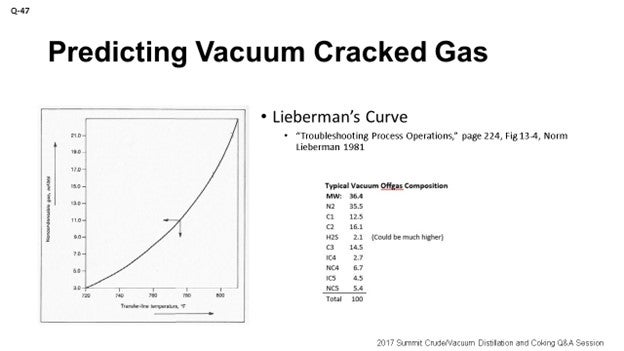
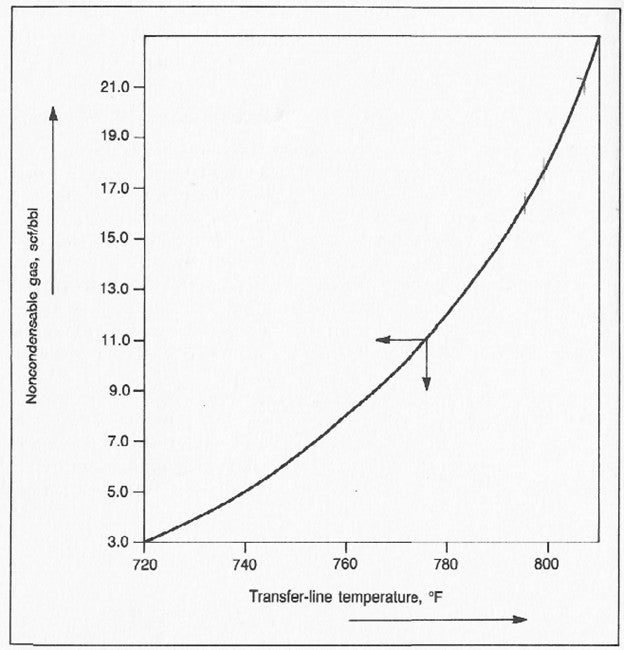
My direct response is that one of the tools I utilize when I am looking at either modeling an existing unit or a new design is Lieberman’s Curve. It is readily available in Norman Lieberman’s book, Troubleshooting Process Operations, as well as several other books. Most everyone here is probably familiar with the curve. It is a representation of the number of scuffs of off gas per feed to the vacuum unit. Mind you, this is total off-gas of non-condensable off the hot well. It is a general curve that works well when trying to determine how much off-gas you will have, and it fits well to a 13 API typical vacuum charge.
If you are running a light sweet crude, then, yes, you tend to trend below the line. If you are running a heavy sour crude, you tend to trend above the curve. One of the solutions I suggest is one that I have seen some folks do and which is what I heard from the Operations folks to whom I spoke when I was researching my response. This solution is actually to take some of the empirical data from your plant, get your off-gas compositions and off-gas rates, and then chart them on the same curve. Be sure that you are doing it for applicable similar crude slates. If you do use comparable data, then you will be able to create a similar set of curves – on this same Lieberman’s Curve – that address different crude slates and API vacuum charge rates. When I have used this curve, my results tend to go along well with the refineries with which I am working, regarding what I am modeling versus what I am actually seeing in the base case data.
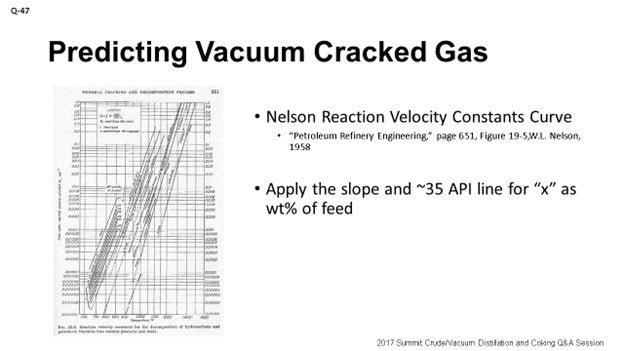
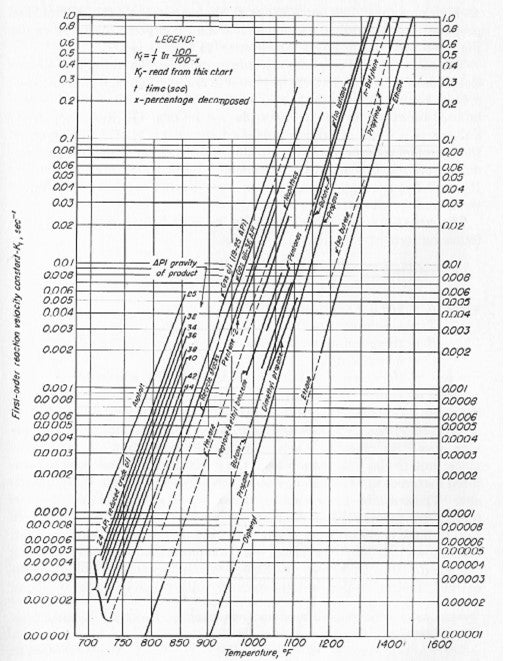
Another option that you can consider, as did one of my co-workers, is actually to look at the Nelson’s Reaction Velocity Constant Curve which deals more with direct cracking for specific products. My co-worker was trying to find a way to apply something that Lieberman’s Curve does not address – that is, time. Because what are the two key parameters of cracking? Time and temperature. This Nelson Reaction Velocity Constants curve takes into account both time and temperature. Through trial and error, my co-worker found that when using the slope of the curve, most of these products (lines) were very similar, with all of them going along about the 35 API line, as shown on the slide. It the line second to the left. Doug could follow along in line with a typical vacuum unit charge, which allowed him to then back-calculate the equation shown on the Nelson Reaction Velocity Constants curves for the case of T and actually solve for X as a weight percent of vacuum charge. That calculation actually allowed us to break up the transfer line into segments, so we could see how much cracking was happening as we were progressing and feeding into the vacuum column. It is a unique application which is a little out of the box, but it has worked well and is just another option. I know there are lots of correlations or options of which you guys may be aware as well, and I would love to hear about them.
SOLOMON (Athlon Solutions)
Ross gave a very complete answer. In the essence of time here, since we are getting close to 11:30 already, let’s just leave it there.
GRANT NICCUM (Process Consulting Services Inc.)
I just want to point out that the risk associated with underestimating the cracked gas rate is much higher than the risk when overestimating it. If you have some extra capacity in your vacuum system, then utilities consumption cooling water and steam will be a bit higher than optimum. However, the system should still work well. If you underestimate the cracked gas rate in your vacuum system design, you will run with broken ejectors, have high tower operating pressure, and miss your vacuum resid cutpoint. Therefore, underestimating the cracked gas rate has a large downside.
In a modern wet vacuum system, the first-stage ejector and first stage intercondenser are responsible for the majority of the total system cost. The majority of the load to the first-stage ejector and intercondenser is made up of stripping steam, heater velocity steam, and condensable hydrocarbons. Cracked gas comprises a small percentage – maybe 10% – of the first-stage load and therefore has a small impact on total system cost. The cracked gas rate becomes significant in the downstream second- and third-stage ejectors and condensers where higher-than-design cracked gas rates can cause instabilities that ultimately affect the first-stage ejectors and the tower pressure. The second- and third-stage ejectors and condensers are small compared to the first-stage equipment, so the extra capacity that results from moderately overestimating the cracked gas rate does not cost a lot but does contribute significantly to overall system stability.
McDANIEL (KP Engineering, LP)
Grant made a good point. Operators have to understand that if you are using these curves to get the overall off gas. Then, if you are trying to determine what your loads are to your jets, you will have to take into account the rest of the vacuum system. If the vacuum column has significant gas production, stripping steam, or velocity steam in the heater, it will increase the jet sizing.
KEVIN SOLOMON (Athlon Solutions)
In the past, vacuum towers’ flash zones have operating at or below atmospheric tower flash zone temperatures. These units relied on the vacuum to increase heavy gasoil yields from the atmospheric resid without running the risk of thermal cracking associated with higher temperatures. The new design “deep cut” vacuum units have reduced the potential for coking in the furnace and tower bottoms; and now, flash zone temperatures are in the range of thermal cracking. Some units see vacuum unit flash temperatures 100 to 150°F higher than the atmospheric tower. This elevated temperature creates unique problems in the overhead water. You can see increased levels of chlorides in the vacuum overhead water since the increased temperature allows for increased chloride hydrolysis. We also see higher levels of ammonia be produced in-situ from nitrogen compounds in the reduced crude.
W. ROSS McDANIEL (KP Engineering)
A well-known and widely available correlation is Norman Lieberman’s curve, which is shown here presented in Troubleshooting Process Operations as Figure 13-4. Norm gives a relationship of the amount of full-range vacuum off-gas [in scf/bbl (standard cubic foot per barrel) of vacuum charge] to heater outlet transfer line temperature [in degrees Fahrenheit].
Lieberman’s Curve2
The curve represents empirical data from multiple units with common crude slate feeds. This scf/bbl value of non-condensables represents the full range of vacuum off-gas. It can be converted to a total wt% of vacuum charge and then a typical off-gas component breakdown, or the breakdown supplied by the specific refinery sample can be applied to the total off-gas. This is how I typically do vacuum simulations. Below is a typical component breakdown for an off gas with a 36.4 MW.
|
TYPICAL VACUUM OFF-GAS COMPOSITION |
|||
|
|
MW: |
36.4 |
|
|
|
N2 |
35.5 |
|
|
|
C1 |
12.5 |
|
|
|
C2 |
16.1 |
|
|
|
H2S |
2.1 |
(Could be much higher) |
|
|
C3 |
14.5 |
|
|
|
IC4 |
2.7 |
|
|
|
NC4 |
6.7 |
|
|
|
IC5 |
4.5 |
|
|
|
NC5 |
5.4 |
|
|
|
Total |
100 |
|
It has been shown that this curve fits well to a typical API 13 vacuum tower charge, but opportunity light sweet crudes fall below the curve and more heavy sour crudes trend above the Lieberman’s Curve. One way to improve this curve for your facility is to take the curve and apply your facility’s own historical data on the curve for a similar crude diet. Another reference for cracking is “Nelson’s Reaction Velocity Constants Curve”3.
The Nelson curve is applied more to cracking for specific products, but it does consider the relationship not addressed in Lieberman’s curve, which is time. The two key parameters to cracking are both the temperature and time that are applied to the feedstock. My coworker, Doug McDaniel, used the approximate slope of these curves to develop an applicable curve for typical vacuum feed, which happens to fall at around 35 API product gravity on this graph. Rearrange the y-axis formula to solve for x, in terms of wt%. The equation can could then be applied to vacuum heater and transfer line segments to determine a total cumulative wt% cracked of the original vacuum feed.
I am sure others can point you to different correlations, but the key is to make sure you are considering your desired feedstock and other conditions on your vacuum column – such as whether the column is dry or wet – when using your results to size or rate your overhead vacuum system.