
Cooper Ericksen
Senior Vice President, Product, BEV and Mobility Planning and Strategy
SRIVATSAN (Foster Wheeler USA Corporation)
Damages to the top section of the coker trays could be due to process-related reasons or mechanical or operational issues. One process-related reason is salt deposition. Usually, the salt is ammonium chloride. It is water-soluble, corrosive, and rapidly deposits at the right conditions, leading to severe loss of tray capacity and efficiency. The deposition is accelerated at low overhead temperatures, which may happen when you have too low of a reflux temperature or water coming in with your reflux stream. Low overhead temperatures could also result if you have too low a naphtha-LCGO (light coker gas oil) cut point. If you want to maximize your diesel fraction and are operating in a maximum diesel mode, the lower naphtha endpoints could lead to lower top section temperatures in the fractionator which accelerate the deposition of ammonium chloride. Normally the deposition is between LCGO draw and the column overhead. Some operations have also experienced salt deposition due to the presence of organic chlorides. Also, if you are adding slops directly to the fractionator, you must be careful to watch for the free water and salt content. We normally recommend having an external heater to dewater the oily slops before they are introduced into the fractionator.
Considerations for proper design include identification of the chlorides in both the crude and VR feeds and improving desalter operation. While this may help avoid deposition of inorganic chlorides, organic chlorides are not removed in the desalter. By introducing water intermittently though the reflux line, your ability to wash the top section of the trays will also help mitigate salt formation. The water is drawn off of several trays below and disposed.
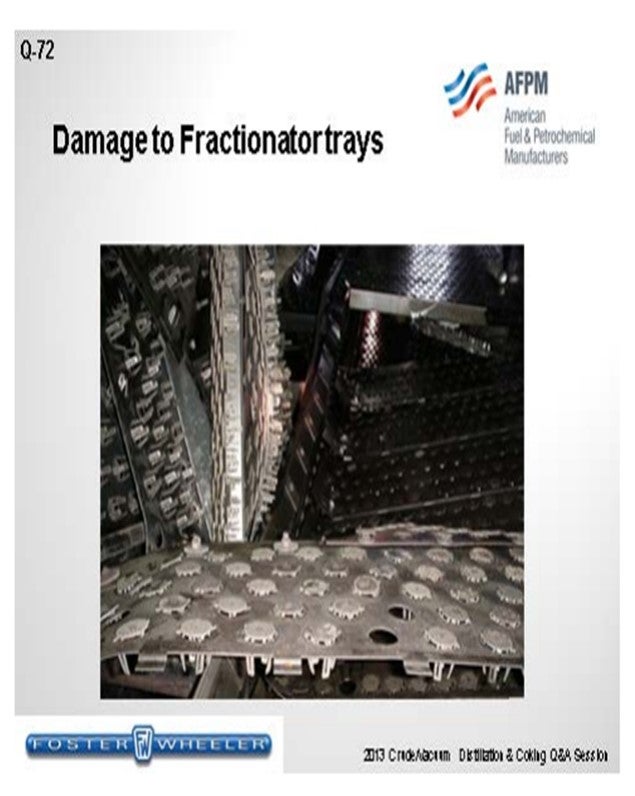
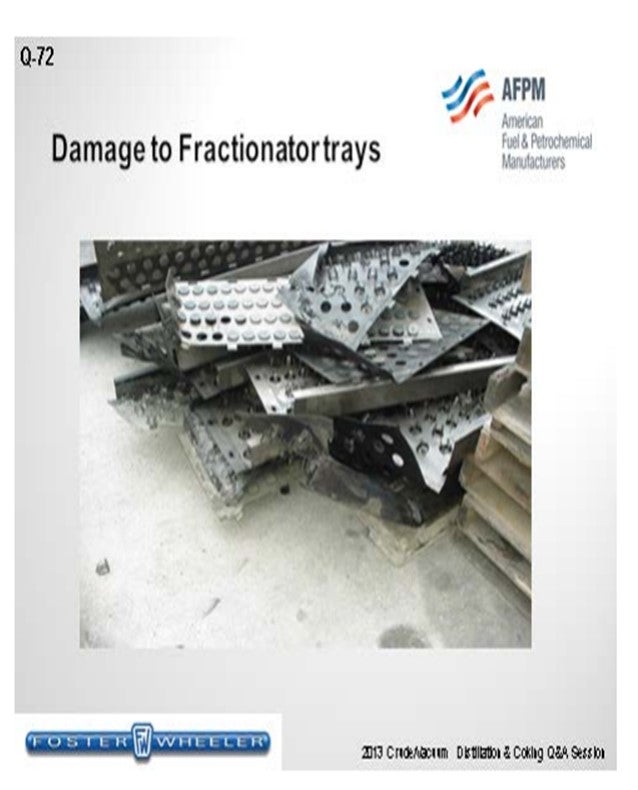
Increasing the overhead temperatures is probably one of the better ways to control salt deposition and prevent the salts from precipitating in the trays. You could also balance the heat removal between your overhead condenser and the pumparound streams. If you have a low naphtha endpoint, a backend naphtha splitter could be used. Finally, the fractionator overhead drum has to be designed for adequate hydrocarbon and water separation. Operational issues can occur when water is introduced into the fractionator, which then causes a blowout of the vaporized water. We know of one instance during a startup operation when the spare LCGO pumparound pump, which had not been completely drained of water, was started. The rapid expansion of the vaporized water caused by the high temperature in the fractionator blew the top section of the trays between the LCGO section and the overheads. These slides show that event.
Incorrect metallurgy in the top section could also result in damage to the fractionator top section. The correct metallurgy depends on the feed stock and contaminants. Normally, the material of construction – if you are processing, say, an Arab medium-type feed – is killed carbon steel from the bottoms up to the LCGO draw with 1/8-inch corrosion allowance and 410 stainless clad. Above the LCGO, it is normalized carbon steel with a 1/8-inch corrosion allowance. The trays are 410 stainless, and the distributor pipe and spray nozzles are 304L stainless. Foster Wheeler designs the overhead piping, fractionator condenser tubes, and the water boot in the reflux drum for a much higher corrosion allowance.
SLOLEY (CH2M Hill)
I want to reiterate that the occurrence of chlorides in most delayed cokers is nearly inevitable. Nearly everyone with a delayed coker will eventually end up waterwashing it, at least intermittently, in the top. When we have put the water back in the tower in the reflux, we have seen relatively few events of it causing tray damage because of that operation. If you look at the mechanical design limits that are standard in the industry for trays, you will see that trays are designed for a 60-pound per square foot distributed load on top and 300-pound point load for installation purposes. The key point is that all of the load is on top pushing down, and the tray rests on the tray ring. When you have an incident, as Srini just discussed, where water is being put in the tower lower down in a hotter section, the stress load is coming up the tower and trays are inherently extremely weak for a load coming up beneath them.
That is the real risk of tray damage comes from pressure surges from below Risks from water wash introduced in the naphtha are relatively modest to low You should not let that perception of risk prevent you from waterwashing the tower. If you damage trays more than once during water washing, you should really investigate your procedures around how you are adding the water. You should also look at mechanical solutions that make the trays much stronger. These are relatively inexpensive. However, the procedures and operational issues count as well.
SRINI SRIVATSAN (Foster Wheeler USA Corporation)
Damages to the top section of the coker main fractionator trays mainly occur due to Process related issues or Operational/Mechanical issues. Process related causes include:
• Salt deposition in the upper section of the trays, accelerated by low operating temperatures in the section. Usually the salt is ammonium chloride (NH4Cl) formed when chlorides in the VR feed, carried as a result of improper desalting, react with NH3 formed as a byproduct of thermal cracking. The ammonium chloride salt is water-soluble, corrosive, and deposits rapidly leading to severe loss of tray capacity and efficiency. Deposition is normally between the LCGO draw and the column overhead. If the overhead temperature in the fractionator approaches the salt deposition temperature, there is an increased risk of salt deposition and corrosion.
• We have also observed that some operations are prone to salt deposition in the top section of the fractionator due to the unexpected presence of organic chloride species. The temperature at the heater outlet is high enough to break the C-Cl bonds forming HCl as a result of hydrolysis, which then reacts with NH3.
• Introduction of slops straight into the fractionator also increases the risk of fractionator fouling if the slops contain free water and chlorides.
• Too low of a reflux temperature or too much water entrained with reflux can cause salt deposition and subsequent corrosion. Considerations for proper design include:
• Identification of chlorides in both crude and VR feeds.
•Improvements in desalter operation: While this may help avoid deposition of inorganic chlorides, organic chlorides are not removed in the desalters.
• Water-washing tower online: Foster Wheeler fractionator designs now include the ability to wash the top section of the trays by introducing water intermittently through the reflux line. The water is drawn off several trays below using draw-off pans to a flow-through waterwash coalescer, followed by their disposal.
• Increasing overhead temperature to ensure sublimation of salts, thus preventing the salts from precipitating in the trays: The salts are carried with the overhead vapor from the fractionator. Intermittent waterwash and condensation of the overhead vapor results in the salts dissolving in water and being drawn out as sour water. Low overhead temperatures can also occur when you have a low naphtha-LCGO cutpoint. A backend naphtha splitter could be used if lower naphtha cutpoint is desired.
• Balance heat removal between overhead condenser and pumparound streams: Optimizing the heat removal between the overhead condenser and LCGO/HCGO pumparound streams will lead to more desirable top tray temperatures
• Fractionator Overhead Drum: Design these drums for adequate HC-water separation.
• Fractionator Overhead Drum: Design these drums for adequate HC-water separation.
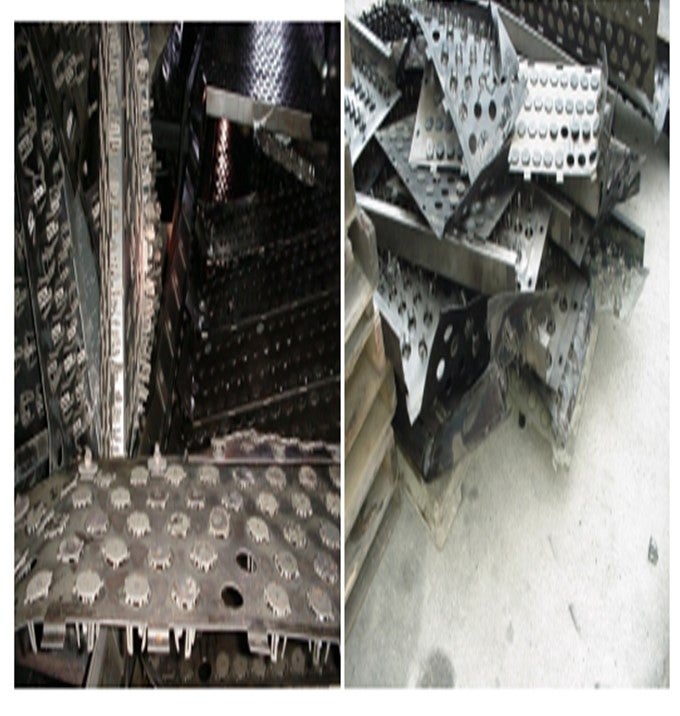
Operational issues occur when water is introduced into the fractionator causing a blowout of the vaporized water. We know of one instance during a startup operation when the spare LCGO pumparound pump, which had not been drained completely of water, was started. The rapid expansion of the vaporized water caused by the high temperature in the fractionator blew the top section of the trays between the naphtha and LCGO sections in the fractionator. Below are photographs showing the damage.
Incorrect metallurgy in the top section could also result in damage to the fractionator top section. The correct metallurgy depends on the feedstock and contaminants. Typical material for the construction of a coker main fractionator processing typical Arab medium feed is as follows: - Bottom-up to LCGO Stripper Draw-Off: normalized KCS clad with 1/8” 410S SS - Above LCGO Stripper Draw-Off: normalized KCS: 1/8” Corrosion Allowance - Trays: 410-S stainless steel (SS) - Distributor Pipe and Spray Nozzles: 304L SS Foster Wheeler also designs the overhead piping, fractionator condenser tubes, and water boot in the overhead reflux drum for a higher corrosion allowance.
DENNIS HAYNES (Nalco Champion Energy Services)
One potential cause of damage is the deposition of ammonium chloride salts plugging the top section and also causing underdeposit corrosion. This type of deposit can form due to hydrogen chloride and ammonia partial pressure levels and temperature requirements for the system. Therefore, feed quality is another consideration. In systems where this becomes a concern, salt dispersant additives have been applied to minimize ammonium chloride deposition, plugging, and corrosion.
SRIVATSAN (Foster Wheeler USA Corporation)
The main objective is to keep the coke fines agitated and then efficiently remove them from the bottom of the fractionator. A properly designed coke drum with low vapor velocity helps minimize the coke fines carryover to the fractionator. Proper C factor for tower sizing is critical to achieving the HCGO quality in low pressure cokers.
Now from a licensee standpoint, I am going to discuss the Foster Wheeler design illustrated on the slide. The DCU feed in our design is introduced directly into the fractionator, and the residence time is built into the fractionator. The feed is introduced through two rings: an outer ring and an inner ring which has holes in the bottom. It also has open ends directed towards the standpipe that is above the heater charge nozzle. What is happening is continuous agitation of the fractionator bottoms. We also provide an effective fines removal system that consists of a bar cage inside the fractionator, an external basket strainer, and a fines removal pump. On the slide, the bar cage is shown next to the standpipe. The objective of the bar cage is to remove relatively large particles out of the fractionator and trap them in the basket strainer that is outside. A fines removal pump takes a slipstream of the heater charge and then pumps it to the heater suction and out of the fractionator. The standpipe itself prevents particles – one-half inch and larger – from entering the heater. So, it is all filtered within the fractionator itself. The heater charge pump also has a coke-crushing impeller that can remove particles that are one-half to three-quarter inch in size.

The coke drum overhead vapor enters below the shed trays. We employ shed trays for a couple of reasons: 1) They distribute the vapor, and 2) they serve as entrainment trays for the coke and tar particles. One could do away with the sheds, but there would be a slight effect on your HCGO quality. As the coke drum overhead vapor rises, it is contacted with a wash oil stream above. Since the cokers that are designed for maximum liquid yields operate under the lowest recycle possible, we employ an open wash zone. We do not have trays or sheds. It is an open wash zone using spray headers and full cone nozzles. The wash zone sprays help maintain the HCGO quality and also provide good control of the recycle. We also have a heat shield to prevent contact of the flash zone vapor with the pool of liquid. Again, this is an effective way to control your recycle operation. Further, for the HCGO and LCGO draws, we employ total draw pans in the fractionator. The two pictures on the slide show the fractionator internals. On the left is the standpipe, and on the right is the bar cage. You can also see the ring.

SLOLEY (CH2M Hill)
I will focus mainly on the section above the bottom boot. Different licenses have different approaches in this area depending on their balancing capacity, reliability, and performance. There is no real clear-cut answer for this, but there are various combinations that are more common. The bottom section typically includes some type of recirculation system along with the coke catcher design and coke crusher pumps in the bottoms.
Two major purposes of the area above the feed entry are the entrainment of coke fines and the control of the recycle at the heavy ends of the coke drum. The overall product yields and unit capacity favors minimum recycle. This creates a severe combination of operating conditions and mechanical design criteria. Within these constraints, what is most common are (1) spray chambers and (2) baffle trays which may be either disc-and-donut trays in smaller units or shed trays in larger units.
In some older units, you saw conventional sieve trays. In modern units, spray chambers or spray chambers combined with baffle trays are the most commonly used configuration. High recycle rate units, however, make a grid wash more attractive.
Spray chambers have the major benefit of maximum reliability. There is nothing in the area underneath the sprays for coke to form onto, thus minimizing coking. Nevertheless, coke stalactites can form from the spray header itself; so the spray header needs to be strong enough to support this weight without collapsing.
Overall, spray chambers work well because they operate at low liquid rates. Against these benefits, spray chambers have a relatively low capacity for the same product quality because they are not as effective in the entrainment.
Baffles, either shed trays or disc-and-donut trays, require high liquid rates to be truly effective for de-entrainment. Few delayed cokers really have recycle liquid rates high enough for the trays to create a liquid curtain that makes them truly effective for entrainment removal. At low liquid rates, the trays also tend to coke because even small issues with installation of the trays out-of-level lead to zones on them where they have very low liquid at one end and high liquid rate at the other.
However, even when coked, the baffles rarely shut down the unit because of the large spacing between the baffles gives lots of space for coke to form without imposing pressure drop or flooding of the unit. A few units have used fresh feed to the unit going onto the shed trays to create the liquid curtain. However, this has a dramatic effect on the fractionator’s heat balance because it is cooling the vapors as they go up the tower and reduces total liquid yield.
The overall best approach tends to be a mixture of baffles and sprays. It gives better performance than a simple spray chamber. However, the baffles are still not completely effective. Grid washes are typically used in units that have high liquid recycle rates for process reasons. They are very effective in entrainment removal. However, they still have a risk of coking that is more significant. It is seen as an overall risky operation.
Conventional trays are rarely used below the heavy coke or gas oil for new units. If you look at the figures, highlighting a point previously mentioned, you will see that the first three designs all use a total collector tray above the spray, baffle trays, or grid wash. This gives better overall control of the low liquid recycle rate. Most units with trays in them have a partial draw of liquid which gives relatively poor control of the liquid rate, and one reason that makes them truly only suitable for high recycle units.

Equipment cost differences between these are fairly limited. You should never let equipment cost between these configurations drive the selection process criteria, unless it significantly affects tower diameter. It should be the selection driver.
HERLEVICH (Marathon Petroleum Corporation)
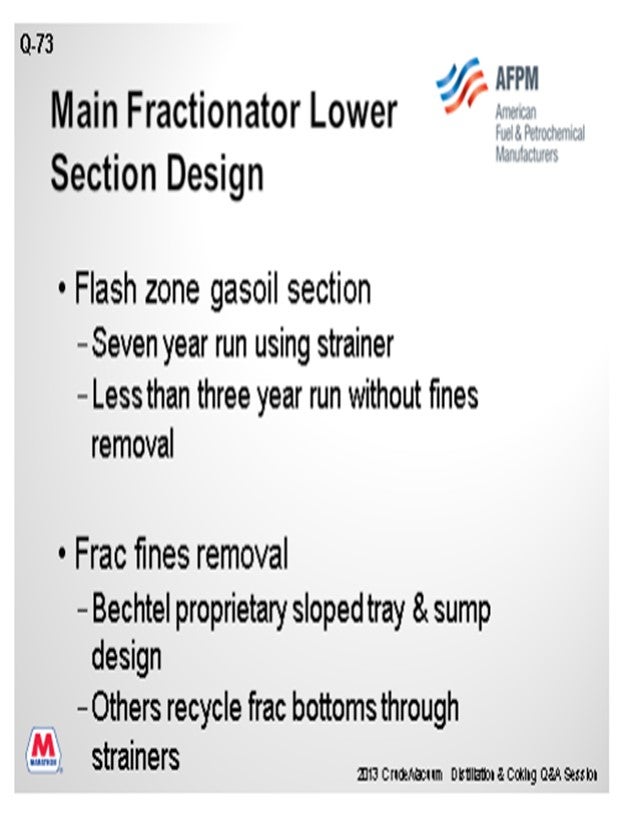
I want to share some experiences from our cokers. We were able to achieve a seven-year run on our main fractionator when employing the flash zone gas oil strainer system, and we also have experiences from other cokers that only made a three-year run. In the area of fines removal, I would point out that there is also a proprietary design being used which employs sloped trays and a sump as another alternative to the method that Srini discussed. So, there are a few ways to design these systems.
JOHN GORDON (The Dow Chemical Company)
What kind of monitoring methods does the industry use to track the accumulation of solids in the bottom of the coker fractionator?
PRIBNOW (CITGO Petroleum Corporation)
I think we ran 10 years on our coker for the turnaround cycle. You saw the pictures of the standpipes and how plugged they can get, so we monitor delta P on the standpipes. We also did thermal scans on the bottom where we pulled insulation from the bottom of the tower. We could often see how high the coke level was in the bottom of the tower relative to the location of the nozzles and the standpipes. It is not perfect, but at least it gave us some idea of whether we could make a 10-year run or if we would have to take it down in a year.
SRIVATSAN (Foster Wheeler USA Corporation)
You also have the nuclear level gauges at the bottom of the fractionator which should give you an indication of the coke level.
SRINI SRIVATSAN (Foster Wheeler USA Corporation)
The main objective is to keep the coke fines agitated and efficiently remove them from the fractionator. A properly designed coke drum with low vapor velocity helps minimize coke fines carryover to the fractionator. Proper C factor for tower sizing is critical for achieving HCGO quality in low pressure cokers.
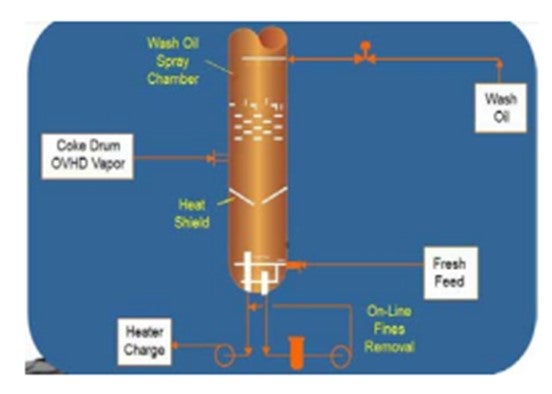
In Foster Wheeler designs, the bottom section of the fractionator is kept agitated by bringing the entire feed through an inner and outer ring with rightly oriented holes in the bottom and open ends. The bottom section of the fractionator also has a tall standpipe and a bar cage with a fines removal system that serve as internal “filters” for coke fines removal.
The heater charge pump is equipped with a coke crushing impeller.
Coke drum overhead vapor flows to the coker fractionator and enters below the shed section. The sheds serve to distribute the vapor and as de-entrainment trays for coke and tar particles that could be entrained with the coke drum overhead vapor. Eliminating the shed trays could lead to slightly increased contaminant levels in the HCGO.
As the coke drum vapor passes upwards through the shed section, it is “washed” by an induced reflux, and a recycle stream is condensed. For ultra-low recycle designs, in order to optimize yields, we employ an open wash zone below the HCGO pumparound draw and above the shed decks. Wash oil is sprayed using spray headers with full cones ensuring full coverage. The wash oil serves to maintain HCGO quality in terms of asphaltene, metals and CCR.
Low recycle control is facilitated by segregating the feed liquid pool from the hot flash zone vapors utilizing a heat shield and feed arrangement that eliminates splashing.
Above the wash section of the coker fractionator, heavy coker gas oil (HCGO) pumparound and product are withdrawn from a total draw pan.
The schematic below illustrates the Foster Wheeler fractionator internals.
EBERHARD LUCKE (CH2M Hill)
As far as I know, the fractionator bottom design has not changed much over the last years. The bottom draw (heater feed) has a slotted standpipe to keep coke particles in the tower, protect the heater charge pumps, and maintain a decent heater runtime between decoking shutdowns. Most heater charge pumps are also protected by suction strainers and/or a coke-crushing impeller design. The tower should also have a carefully designed bottom circulation system that takes the bottom product and routes it through a filter system before returning back to the tower bottom. If designed properly, a big portion of the coke fines will be caught in those filters and be removed from the system. Between drum vapor inlet and HCGO draw, the gas oil recycle system in the wash zone not only quenches the drum vapors to condense part of the stream, it also removes coke fines from the vapor stream and washes those down into the bottom. Wash zone designs vary from open spray chambers to disk and donut sections. Both can work if the required wash oil flow rate is maintained. In many cases, coker economics and ultra-low wash oil rates allow more coke fines to move up into the HCGO section. I would like to add that the same careful consideration needs to be given to the source of the coke fines, coke drum vapor outlet, and vapor velocities in the coke drum and in the vapor outlet nozzle, as well as any foaming issues observed in the coke drums.