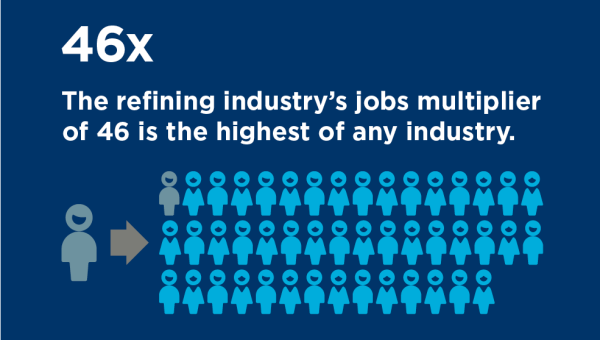
The U.S. refining industry has a widespread economic impact on our nation. It supports millions of American jobs and pumps billions of dollars into the economy, as documented by the new AFPM report Economic Contributions of U.S. Petroleum Refineries. Report highlights, based on the latest full year of data available through IMPLAN (2022), are featured in this blog.
Panel:
John Durnin, Marathon Petroleum Corporation
Steve Gill, HF Sinclair
Yangdong Pan, Delek US
Patrick Robinson, PBF Energy Inc.
Operation of a complex refinery process involves keeping the process within varous types of limits. These include safe operating limits, integrity operating windows, machine protection or other reliability limits, and product quality limits. This diverse background panel session from process controls and process safety management explores how to effectively identify these parameters and keep the limits in front of operators using instrumented shutdowns, alarm systems, and other monitoring and alerting software.
Facilitator:
Tim Olsen, Emerson Automation Solutions
Speakers:
Jerry Isch, Marathon Petroleum Corporation
Dave Lee, User Centered Design Services Inc.
Christi Mezzic, Emerson Automation Solutions
Johnny Serafin, Phillips 66
This is a panel session follow-on based on the recent AFPM webinar by Phillips 66 Bayway that discussed HMI and alarming enhancements during a control room modernization project. Key components discussed in the webinar were alarm rationalization and the development of HMI graphics based on human-centered design principles with the goal to improve safe reliable operation at the facility. Key design considerations come from industry standards and good shared practices, along with valuable input from key stakeholders across departments. This panel session will also discuss operator development to improve situation awareness as part of a control room modernization.
Come prepared with your questions by viewing the pre-session.
WASHINGTON, D.C. — American Fuel & Petrochemical Manufacturers (AFPM) President and CEO Chet Thompson issued the following statement on the final results of the 2024 general election.
A well implemented alarm management program can deliver results that not only improves the operator’s situational awareness, decreases the potential of a safety related incident, and enhances environmental compliance but also reduces unplanned downtime, helps prevent equipment damage, lessens production losses due to off-spec production, and improves overall plant profitability. The alarm philosophy and rationalization efforts are key to establishing an effective alarm management program and sustaining it long-term.
Participants will:
Learn how Motiva improved their alarm management program.
Understand the need to have an alarm philosophy before beginning an alarm management program.
Understand the basics of alarm rationalization with a focus on quality alarms rather than quantity.
See related presentations on alarm management on the AFPM Safety Portal at https://safetyportal.afpm.org/File/2265/1
Moderator:
Tim Olsen, Emerson Automation Solutions
Hurricane Michael, currently graded as a Category 4 storm, made landfall on the Gulf Coast today, directly hitting the Florida Panhandle and potentially impacting more than 300 miles in the region.
BAYTOWN, TEXAS – A decade ago, when Mike Zamora ran ExxonMobil’s Baytown petrochemical plant, his vision to expand the facility and boost its capacity was nothing but a pipe dream.
WASHINGTON, D.C. – The American Fuel & Petrochemical Manufacturers (AFPM) released “The Fuel & Petrochemical Supply Chains: Moving the Fuels & Products That Power Progress.”