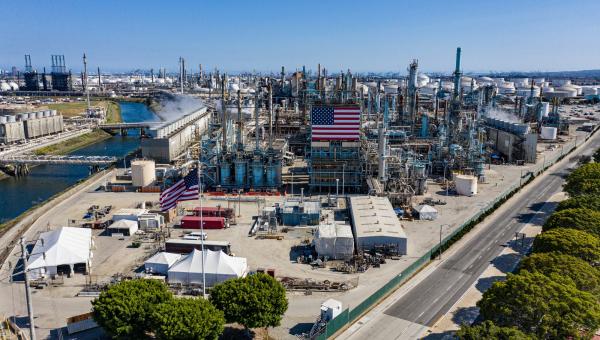
America’s refining and petrochemical community employs and supports over three million people, hiring individuals from all education levels to fill a wide range of positions (such as welders, electricians, chemists, and engineers).
Behind government “moonshots” and corporate sustainability pledges lie multitudes of technological innovations required to make these aspirations possible. The fuel and petrochemical industries play critical roles in advancing and scaling the new technologies that will help us address the dual challenge of providing the products the world needs to thrive while operating in an increasingly sustainable way.
In 2019, Chevron Phillips Chemical (CPChem)’s Sustainability Technical Manager Ron Abbott was given a seemingly insurmountable challenge: by 2020, make CPChem the first company in the U.S. to announce commercial production of a circular polymer made by converting plastic waste into the chemical building blocks for new plastic. A cross-functional team was launched and started chipping away at the goal.
WASHINGTON, D.C. – "Federal policy is discouraging supply by shutting down pipelines, putting future production off limits, talking down the future of the petroleum business, and imposing expensive requirements on refineries, chief among them a burdensome Renewable Fuel Standard. The Administration is blaming others when it ought to take a sober look at its own energy policy."
WASHINGTON, D.C. – This is a commonsense administration decision. We’re still waiting for EPA to make a call on 2019 and 2020 relief petitions and there remains no 2021 or 2022 proposals, much less final rules, from the Agency to guide business decisions for refineries. We all know RIN scarcity is real and clarity about future obligations is needed in order for facilities to align around their individual compliance strategies.
March is Women’s History Month, and the American Fuel & Petrochemical Manufacturers (AFPM) has two upcoming opportunities for the women in our industry to network and connect with their peers. Women...
A new campaign from the American Fuel & Petrochemical Manufacturers (AFPM) spotlights the surging costs and unprecedented impact of biofuel mandates on U.S. refineries and the need for immediate action to get RFS costs under control.
Polyester soccer jerseys, polyethylene swim lane dividers, carbon track shoe insoles, and the jet fuel that moves athletes all over the world. These are just a few examples of the and fuels and petrochemical-based materials that play an irreplaceable role in summer sports.