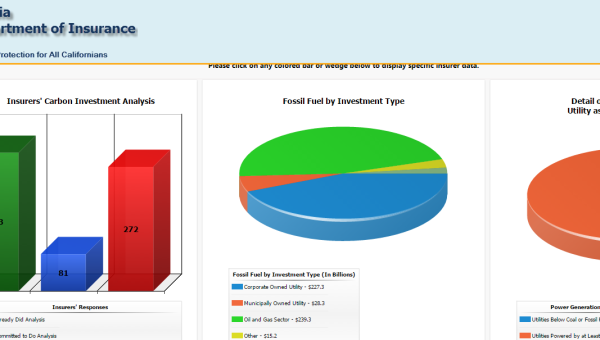
Last week, California Insurance Commissioner Dave Jones launched the latest salvo in his relentless crusade to coerce the nation’s leading insurance companies to divest from oil and natural gas company holdings.
As we approach the 2022 hurricane season, experts are predicting yet another severe year, with some saying it will compare to last year. No one knows how accurate these predictions will be, but we can...
The California Air Resources Board (CARB) adopted its Advanced Clean Cars II (ACCII) regulation. ACCII requires 35% of light-duty vehicle sales to qualify as “zero emission” by 2026 and 100% by 2035. Essentially, this amounts to a ban on new sales of traditional gasoline and diesel-powered cars and trucks. To implement the policy, California will need a Clean Air Act waiver from the Environmental Protection Agency (EPA). If EPA grants the waiver, millions of Americans—including many outside of California—could lose the option to buy the car or truck THEY want.
All eyes are on Hurricane Ian, which is expected to approach Florida’s west coast later Wednesday and into Thursday bringing high winds and massive amounts of rain. Although our nation’s refiners and petrochemical manufacturers do not have facilities in the affected region, we’d like to urge the people in the area to prepare for the storm and heed all evacuation notices. Florida residents can get critical preparedness and evacuation information here.
“Our country has seen time and again that major storms and often-correlated runs on gas stations can have a swift impact on prices. Already in Florida, some key areas are functioning with roughly 20 percent of retail stations either out of gas or out of power. That means there is less supply overall and some temporary inability to access supplies in certain Florida communities where there is, at present, heightened local demand. The market is resilient and will work to fix this imbalance swiftly, but a return to normalcy will likely not be immediate as the supply chain is complex and buyers will need to return to their normal purchasing habits."
AFPM opposes the Inflation Reduction Act as written. We evaluated the bill against our core principles, specifically whether the legislation would support strong U.S. refining and petrochemical industries and whether it pursued emissions reductions in a market-based and cost-effective manner. Unfortunately, the IRA falls short of these goals.
AFPM Senior Director of Fuels and Vehicle Policy, Patrick Kelly, testified during the Environmental Protection Agency’s (EPA’s) public hearing on the proposed Renewable Fuel Standard (RFS) “Set” Rule. EPA’s proposal will stifle advanced biofuels, promote first generation biofuels beyond the market’s ability to absorb them and shift overall RFS growth away from liquid biofuels and into the power electricity sector. This is completely contrary to how congress envisioned EPA’s handling of the program.
AFPM's Geoff Moody issued the following statement responding to the EPA's 2023-2025 proposal for RFS blending obligations: “Congress provided EPA the ability to modernize the RFS and set it on a more sustainable course for all stakeholders. Sadly, EPA’s proposal is a missed opportunity..."
AFPM President and CEO Chet Thompson issued the following statement on the Environmental Protection Agency’s (EPA’s) proposal of light- and heavy-duty vehicle GHG emission standards: "EPA's proposal to effectively ban gasoline and diesel vehicles is bad for consumers, the environment, our freedom of mobility and U.S. national security. It’s unconscionable that the Administration would propose this knowing full well that China controls 80% of global battery production capacity..."
The House of Representatives will soon vote on three pieces of legislation to rein in the federal Environmental Protection Agency (EPA) from (1) imposing and enabling de facto bans on new cars and trucks that run on liquid fuels and (2) from radically transforming the Renewable Fuel Standard (RFS) into a new nine-figure-government subsidy program for electric vehicles (EVs).