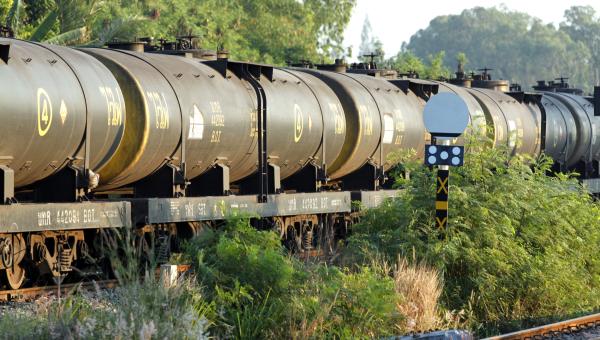
WASHINGTON, D.C – American Fuel & Petrochemical Manufacturers (AFPM) yesterday filed comments with the Surface Transportation Board (STB) in response to their proposed rule that would require railroads to report service metrics and require the use of reciprocal switching agreements to address insufficient rail service.
Today, Rob Benedict, AFPM Vice President of Petrochemicals and Midstream, issued the following statement in response to a unanimous proposal from the U.S. Surface Transportation Board that would allow for reciprocal switching within the U.S. freight rail system in order to address inadequate service.
Governor Gavin Newsom continues to blame fuel refiners for California’s highest-in-the-nation fuel prices. He couldn't be more wrong. The problem and solution to much of California’s fuel price challenge can be found in Sacramento policy. Take a look to better understand the role of policy in regional price differences, why it’s inaccurate to equate “margins” or “refinery cracks” with “profits,” and why windfall profit taxes are a known policy failure.
Restricting exports would be a major unforced error for the President, tightening global fuel supplies, throttling U.S. fuel production and increasing costs for American consumers. Likewise, imposing product inventory requirements boils down to siphoning gasoline and diesel into storage, and away from consumers.
AFPM Senior Director of Fuels and Vehicle Policy, Patrick Kelly, testified during the Environmental Protection Agency’s (EPA’s) public hearing on the proposed Renewable Fuel Standard (RFS) “Set” Rule. EPA’s proposal will stifle advanced biofuels, promote first generation biofuels beyond the market’s ability to absorb them and shift overall RFS growth away from liquid biofuels and into the power electricity sector. This is completely contrary to how congress envisioned EPA’s handling of the program.
AFPM's Geoff Moody issued the following statement responding to the EPA's 2023-2025 proposal for RFS blending obligations: “Congress provided EPA the ability to modernize the RFS and set it on a more sustainable course for all stakeholders. Sadly, EPA’s proposal is a missed opportunity..."
Rob Benedict, AFPM’s Vice President of Midstream and Petrochemicals, issued the following statement after Congress passed, and President Biden signed, a resolution to avoid a nationwide rail strike.
AFPM President and CEO Chet Thompson issued the following statement on the Environmental Protection Agency’s (EPA’s) proposal of light- and heavy-duty vehicle GHG emission standards: "EPA's proposal to effectively ban gasoline and diesel vehicles is bad for consumers, the environment, our freedom of mobility and U.S. national security. It’s unconscionable that the Administration would propose this knowing full well that China controls 80% of global battery production capacity..."
The House of Representatives will soon vote on three pieces of legislation to rein in the federal Environmental Protection Agency (EPA) from (1) imposing and enabling de facto bans on new cars and trucks that run on liquid fuels and (2) from radically transforming the Renewable Fuel Standard (RFS) into a new nine-figure-government subsidy program for electric vehicles (EVs).
Eight midwestern governors have petitioned the EPA seeking to opt their states out of the federal 1-pound Reid Vapor Pressure (RVP) waiver which is a requirement to sell the current summertime blend of E10 gasoline. If these requests are granted, the E10 gasoline currently sold in most of the country during summer months will no longer be offered for sale in these states and annual costs to introduce a new gasoline bend will range from $500-$800 million each year.