Air and Hydrocarbon Session
Session Start End
-
KOONTZ (HollyFrontier)
My first slide shows a little background. The EPA administers the Renewable Fuel Standard program that has volume requirements for renewable fuels. They established these volume requirements under the Energy Independence and Security Act of 2007. The EPA tracks compliance with the Renewable Identification Number (RIN) system, and they assigned a RIN to each gallon of renewable fuel.

HollyFrontier satisfies much of its requirement for conventional biofuel, which is essentially corn ethanol, by blending E10 gasoline at many of its terminals. Most of HollyFrontier’s gasoline is sold via pipeline to terminals owned by others; therefore, we are not able to supply our full mandated volume. HollyFrontier does purchase RINs from others. The decision to purchase ethanol to blend or the RINs is based on the economics of the cost of the RINs.

Ethanol blending for the refiner does have a significant impact on two critical gasoline properties: namely, octane and RVP. The hydrocarbon blend stock used for 90% of the E10product, which HollyFrontier calls sub-grade, has an octane rating of about 84. After blending with the 10% ethanol, the resulting octane is the regular 87. So being a refinery that adjusts total octane with its reformer severity, this allows us to run a lower severity, which is especially beneficial to those refineries with semi-regen reformers that operate at relatively high pressures and relatively low liquid volume product yield.

RVP is the other critical property affected by blending. When ethanol is blended with naphtha at a low concentration, the RVP of the gasoline is increased. Pure ethanol does have a low RVP; but when it is blended with hydrocarbon, it behaves more like a light hydrocarbon and actually raises the RVP. For example, with E10 for naphtha having an RVP of 9, the resultantE10 product has an RVP of about 10. So, to encourage ethanol blending, in 1990, the U.S. Congress passed a waiver known as the “One-Pound Waiver” which allows E10 gasoline to be sold at one psi (pound per square inch) higher than that normally required.
For the refinery, E15 would allow lower octane severity reformer operation, which would be beneficial. However, the EPA regulation implementing the “One-Pound Waiver” specifically references gasoline containing between 9% and 10% ethanol. The EPA has refused to extend this One Pounder Waiver to E15. Therefore, marketing E15 requires a sub-grade blendstock that has an RVP approximately 1 psi lower than normal gasoline sub-grade blendstock used for E10.

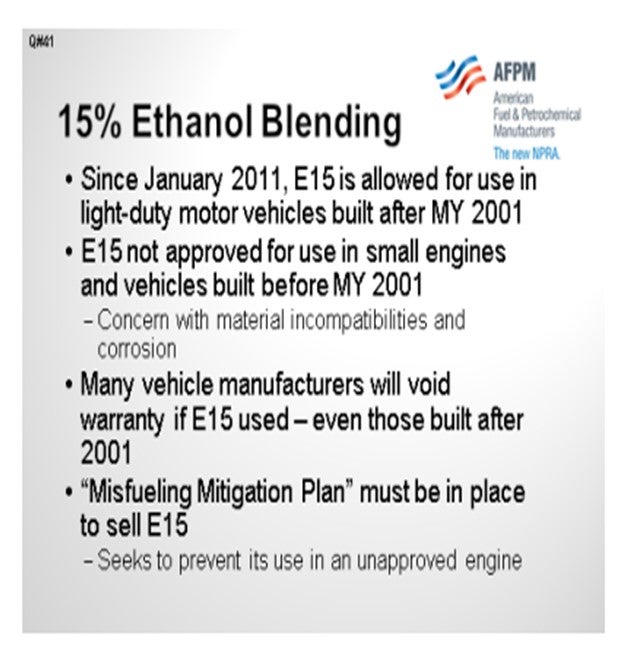
In addition, since January 2011, E15 has been permitted for use in light-duty motor vehicles manufactured after 2001. It was not approved to be used in small gasoline engines or other vehicles built before that due to concerns of material incompatibilities and corrosion. Furthermore, I have seen several places where current automobile manufacturers will not honor their warranties if the person used E15, even if the vehicle was manufactured after 2001. Also, the EPA requires that in order to sell E15 gasoline, a Misfuelling Mitigation Plan must be in place to prevent consumers from using the product in an unapproved engine. Today, there are very few retailers who have chosen to go through the additional trouble in order to sell the E15.
In conclusion, due to the absence of the “One-Pound Waiver” and the legal risk of corrosion or voiding the warranties of customers’ cars, HollyFrontier has chosen not to produce or blend E15.
SUBHASH SINGHAL (Kuwait National Petroleum Company)
Does the 15% have to do with the oxygen in the ethanol and other oxygenate like MTBE, or it is just because of the RVP limitations and other issues that you explained? From safety point of view, is there oxygen contained in the old oxygenate like ethanol? Is that one of the criteria for limiting the blending from 15% or 10%? Does this have to do with the oxygen
attached even though it is oxygenate?
KOONTZ (HollyFrontier)
My understanding, from reading, is that the E15 decision is not really based on logic. I think it was more of a U.S. Congress action. I do not really understand why they have not extended the “One-Pound Waiver” to E15. I do not think it is based on science.
KOONTZ (HollyFrontier Corporation)
The Environmental Protection Agency (EPA) administers the Renewable Fuel Standard (RFS) program with volume requirements for several categories of renewable fuels. EPA establishes the volume requirements for each category based on EISA (Energy Independence and Security Act of 2007) legislated volumes and fuel availability. EPA tracks compliance through the Renewable Identification Number (RIN) system, which assigns a RIN to each gallon of renewable fuel.
HollyFrontier satisfies much of its requirement for Conventional Biofuel (essentially corn ethanol) usage within RFS by selling E10 (10% ethanol) at many of its terminals. Most of HFs’ gasoline is sold via pipeline to terminals owned by others; therefore, to fully satisfy its mandated volume, HF purchases RINs from others. The decision to purchase ethanol from others and blend to E10 or to purchase RINs from others is based on economics.
Ethanol blending has a significant impact on two critical gasoline properties controlled by the refiner: octane and RVP. The hydrocarbon blendstock used for 90% of the E10 product (termed sub-grade by HF) has an octane rating of ~84. After blending with 10% ethanol (octane ~114) the resultant E10 octane is “regular” 87. For a refinery that normally adjusts reformer severity to satisfy the total gasoline pool octane, producing sub-grade allows for lower reformer severity and higher liquid yield. This improved yield is more pronounced for a semi-regeneration reformer that operates at relatively high pressure.
RVP is the other critical gasoline property affected by ethanol blending. When ethanol is blended with naphtha at low concentration, the RVP of the gasoline is increased. Even though pure ethanol has a low RVP [about 2 psia (pounds per square inch absolute)] due to O-H bonding, it behaves more like a hydrocarbon with a molecular weight of 46 when mixed with naphtha at low concentration. If ethanol is blended to 10% with 84 octane naphtha having an RVP of 9, the resultant E10 gasoline has an RVP of ~10. In order to encourage ethanol blending, the U.S. Congress passed the One-Pound Waiver in 1990 allowing E10 gasoline RVP to be 1 psi higher than that normally required by the EPA (One-Pound Waiver).
E15 would allow a refiner to produce an even lower octane sub-grade to blend with the ethanol and the RVP effect would be similar. However, the EPA regulation implementing the One-Pound Waiver specifically references gasoline containing between 9% and 10% ethanol. The EPA has refused to extend the one-pound waiver to E15. Therefore, to market E15 requires a sub-grade blendstock having an RVP over 1 psi lower than that required for E10.
Since January 2011, E15 has been permitted for use in light-duty motor vehicles manufactured after 2001. However, it is not approved for use in small engines and older vehicles due to concerns with material incompatibilities and corrosion. Furthermore, several automobile manufacturers will not honor their warranties if E15 gasoline was used in the vehicle (even for those manufactured after 2001). The EPA requires that in order to sell E15 gasoline, a Misfueling Mitigation Plan must be in place to prevent consumers from using the product in an unapproved engine. There are very few retailers who have chosen to get approval to sell E15.
Due to the absence of the One-Pound Waiver for RVP, the significant legal risk in selling a controversial product, and the minimal market demand HF has decided that it would be unwise to enter the E15 market at this time.
PIZZINI (Phillips 66)
Regarding the conventional hydrotreating, I do not think high TAN would be an issue; but if you try to caustic-treat high TAN material, you will end up with what amounts to be the equivalent of lye soap. So anywhere you want oil and water separation to take place, the soap components may cause rag layers and carryover. We have to employ periodic waterwashes of
solid bed processes or sufficient purge and makeup water to prevent the buildup of the soaps before they cause separation issues.
KOONTZ (HollyFrontier)
Four out of five HollyFrontier refineries treat the kerosene fraction in a hydrotreater, so the TAN of the crude does not matter. The fifth, our Tulsa refinery, does utilize the Merox process to produce jet fuel. However, the crude to this unit is relatively sweet. The kerosene fraction averages 0.002 mg (milligram) of KOH per gram of kerosene and has ranged as high as 0.06; but at these low TANs, they have not experienced problems.
NATHAN KEEN (Merichem Company)
The naphthenic acids that produce stable emulsions, to which this discussion refers, tend to concentrate up in the jet fuel and diesel cuts. Merichem has developed the NAPFINING™ HiTAN technology that treats the kerosene and diesel fractions. Merichem considers any jet fuel or kerosene feed with 0.1 TAN or above as high TAN. To date, Merichem has customers who have successfully processed jet fuel fractions above 1.0 TAN in commercial units without getting the uncontrollable rag layers to which you are referring.
KOONTZ (HollyFrontier Corporation)
HollyFrontier processes crude primarily from Texas, Canada and the Mid-Continent. Of these, certain heavy and synthetic crudes from Canada have the highest TANs. Four of the five HF refineries utilize hydrotreating to desulfurize the kerosene fraction and have not noted a significant jet/kero (kerosene) impact from processing these high TAN crudes. The HF Tulsa refinery utilizes the Merox process to produce jet fuel. The crude input to this refinery is relatively sweet. The kerosene fraction averages ~0.002 mg KOH/g kerosene, but has ranged as high as 0.060 mg KOH/g kerosene. At these low TANs, they have not experienced problems maintaining acceptable jet quality.
KOONTZ (HollyFrontier)
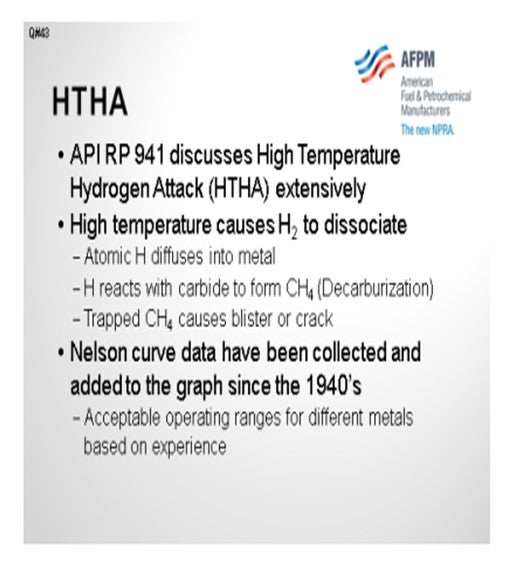
First, a little background: API 941 discusses high temperature hydrogen attack. At low temperatures, less than about 430°F, carbon steel has been used successfully up to 10,000 psi. But with elevated temperatures, the molecular hydrogen will dissociate into atomic hydrogen, which can readily enter and diffuse into the steel. The hydrogen reacts with the carbide in the steel to form methane, which is trapped inside the steel and will eventually form a crack or blister. The addition of carbide stabilizers to the steels – such as chromium, molybdenum, tungsten, and vanadium – can resist the decarburization reaction within the steel.
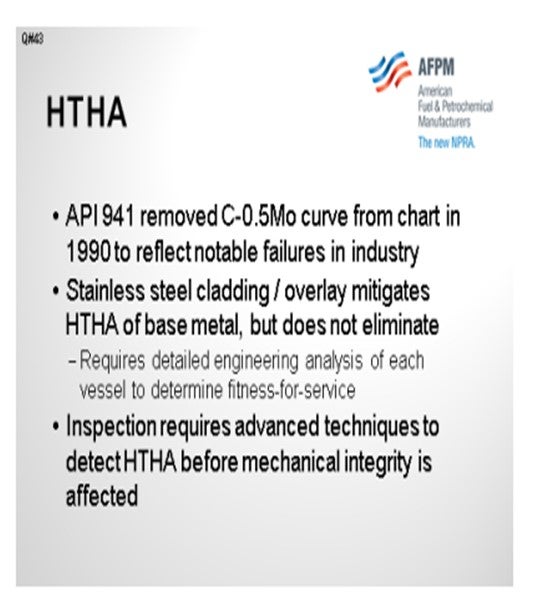
Beginning in the 1940s, G.A. Nelson collected and published empirical curve data to demonstrate the conditions at which high temperature hydrogen attack is expected for specific metallurgy and operating conditions. These data are known as the Nelson Curves and have been continuously updated over the years to include additional failures due to HTHA. The Nelson chart originally included a curve for carbon-0.5 moly (molybdenum), which was midway between the carbon steel curve and the 0.25 chrome-0.5 moly curve. Ever since 1970, a series of unfavorable service experiences with carbon-0.5 moly steels have reduced confidence in the position of its curve on the chart. Data indicate that how the metal is fabricated does have a strong correlation to its susceptibility to HTHA. In 1990, API removed the carbon-0.5 moly curve completely from the Nelson chart.
HollyFrontier generally uses the carbon steel curve on the Nelson chart to evaluate carbon-half moly steels in its process units. Some process equipment has utilized stainless steel cladding or weld overlay to mitigate the concern with HTHA of the base metal. However, this does not completely eliminate the risk. Hydrogen will still diffuse through the cladding and affect the base metal. The partial pressure of the hydrogen at the base metal will be lower than without the cladding, but it must be carefully evaluated to assure that HTHA would not be expected. Real-world experiences have also demonstrated that no cladding or weld overlay is perfect. It only takes one small imperfection for the hydrogen to find the base metal and attack it. API says that it is not advisable to take credit for the presence of a stainless-steel cladding overlay when selecting the base metal for a new vessel.
HollyFrontier has performed a full review of its process units to identify the risk for HTHA, especially for carbon-0.5 moly steels. The review indicated concerns in the reaction section of some of the units. The general strategy for HollyFrontier for carbon-0.5 moly steel operating above the carbon steel Nelson Curve is to remove it from service. If the carbon-0.5
moly steel is clad or overlaid with 300 series stainless steel, a Fitness for Service Evaluation is performed to ensure that the equipment is safe for operation.
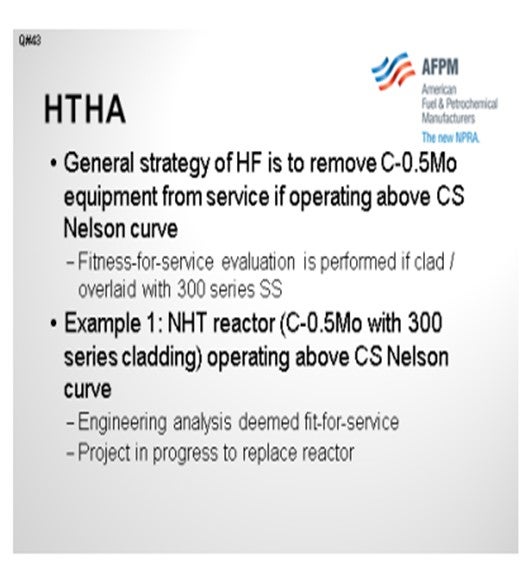
One example is of a naphtha hydrotreater that was operating slightly above the carbon steel Nelson Curves. Based on a detailed analysis of the cladding, it was deemed acceptable for continued operation. We are, though, in the process of a project to replace that reactor.
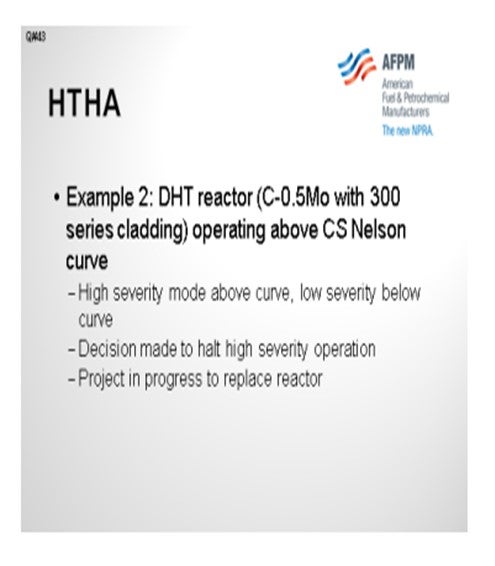
In another example, a kerosene hydrotreater operates in two distinct regimes. It makes ULSK (ultra-low sulfur kerosene) part of the time and jet the rest of the time. While operating in the jet regime, the operating point is below the carbon steel Nelson Curve and is, therefore, not a problem. However, when we operated in the high severity mode, it did go above the carbon steel curve. Since the analysis was performed, we no longer run the high severity operation, and there is a project underway to replace that reactor.
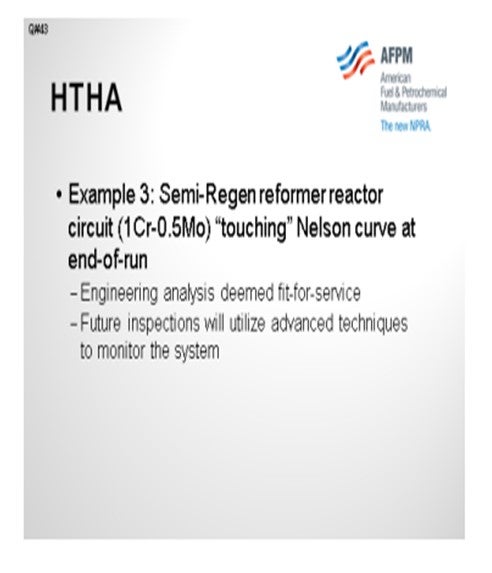
The original question asked about reformers. Older semi-regen reformers are especially of concern since they operate at much higher hydrogen partial pressure than does a modern CCR. HollyFrontier operates two semi-regen reformers in El Dorado and Woods Cross. These reformers have unusually high reactor pressures for reducing coking. Of course, there is concern about both the feed effluent and the reactor circuits. The review did not indicate any carbon-0.5 moly steel in the reformers. However, in one case, it was found that at end-of-run conditions, the operating points were touching the 1.0 chrome-0.5 moly curve for a particular vessel. Historical data was used to determine how much time had been spent touching the “curve.” This data was then used to perform a detailed Fitness for Service Evaluation, and the reactor was deemed “fit for service”. Future inspections will utilize advanced nondestructive evaluation (NDE) on these areas to increase our confidence that HTHA is not impacting the integrity of the vessel.
KOONTZ (HollyFrontier Corporation)
High temperature hydrogen attack (HTHA) is discussed extensively in API Recommended Practice 941. At low temperatures (less than ~430ºF), carbon steel has been used successfully at pressures up to 10,000 psi. However, at elevated temperatures, molecular hydrogen will dissociate into atomic hydrogen which can readily enter and diffuse through steel. The hydrogen reacts with the carbide in the steel to form methane, a process termed decarburization. The methane is too large to diffuse out of the steel and eventually the internal pressure is high enough to cause a blister or fissure in the steel. These cracks eventually result in a significant deterioration of mechanical properties which can cause a loss of containment. The addition of carbide stabilizers to the steel such as chromium, molybdenum, tungsten, vanadium
and titanium resist the decarburization reaction within the steel.
G.A. Nelson collected and published empirical data for API beginning in the 1940s to demonstrate the conditions at which HTHA is expected for specific metallurgy and operating conditions (temperature and hydrogen partial pressure). These data are known as the Nelson curves and have been continually updated over the years to include additional failures due to HTHA. The Nelson chart originally included a curve for C-0.5 Mo (carbon-0.5 moly) that was midway between the CS (carbon steel) curve and the 1.25 Cr (chrome)-0.5 Mo curve. Since1970, a series of unfavorable service experiences with C-0.5 Mo steels has reduced confidence in the position of its curve on the chart. Data indicate that how the metal is fabricated has a strong correlation to its susceptibility to HTHA. In 1990, API removed the C-0.5 Mo curve completely from the Nelson chart. HollyFrontier generally uses the CS curve on the Nelson chart to evaluate C-0.5 Mo steel in its process units.
Some process equipment has utilized stainless steel cladding or weld overlay to mitigate the concern with HTHA of the base metal. However, this does not eliminate the risk completely. Hydrogen will still diffuse through the cladding and affect the base metal. The partial pressure of hydrogen at the base metal will be lower than without the cladding, but it must be carefully evaluated to assure that HTHA would not be expected. Real world experience has also demonstrated that no cladding or weld overlay is perfect; it just takes one small imperfection in the cladding/overlay to allow full hydrogen pressure to impact the base metal. Furthermore, inspection of the base metal is difficult as it is hard to find the damage below the cladding/overlay before enough damage has been done to decrease the mechanical strength. API says that it is not advisable to take credit for the presence of a stainless-steel cladding/overlay when selecting the base metal for a new vessel (i.e., overlay/cladding would be used to resist other corrosion attacks, but not HTHA).
HF has performed a full review of its process units to identify risks for HTHA (especially for C-0.5 Mo steel). The review indicated concerns in the reaction section of some of the units. The general strategy of HF for C-0.5 Mo steel operating above the CS Nelson curve is to remove it from service. If the C-0.5 Mo steel is clad overlaid with 300 series stainless, a fitness-for-service evaluation is performed to ensure that the equipment is safe for operation. In one example, a naphtha hydrotreater is operating slightly above the CS Nelson curve. Based on a detailed analysis of the cladding it was deemed acceptable to continue operation. However, HF is in the process of replacing the reactor and part of the feed/effluent circuit to assure long term reliability.
In another example, a kerosene hydrotreater operates in two distinct regimes when its product switches between jet and ULSK/ULSD (ultra-low sulfur diesel). It is below the CS Nelson curve when producing jet, but it passes above the curve when producing product at 10 ppm sulfur. Since the HTHA analysis has been completed HF no longer runs the unit in high severity mode. A project is underway to restore the ability to operate in high severity mode. The original question asked about reformers. Older semi-regeneration reformers are especially of concern since they operate at much higher hydrogen partial pressures than a modern CCR. HF operates two semi-regeneration reformers in El Dorado and Woods Cross that have unusually high reactor pressures to reduce coking. Of course the main areas of concern are from
the feed/effluent exchanger(s) through the reactors and furnaces. The review did not indicate any C-0.5 Mo steel in HF reformers. However, in one case it was found that at end-of-run conditions the operating points were “touching” the 1 Cr-0.5 Mo Nelson curve. Historical data was used to determine how much time has been spent “touching” the curve. This data was used to perform a detailed fitness-for-service evaluation. Future inspection will utilize advanced NDE on these areas to increase confidence that HTHA is not impacting mechanical integrity.

