

Question 33: Are there any new technologies to control bromine index in aromatics streams? Do clay towers still provide the best operating value?
Michael Windham (UOP)
UOP has commercialized a selective hydrogenation for this application and Exxon Mobil offers an alternative catalyst that appears to be a direct replacement for clay. Our selective hydrogenation technology is meant to improve yield of aromatics as a result of avoiding the alkylation reaction which clay and other acid-based catalysts utilize. So far, we are encouraged but it is difficult to quantify the yield difference since so many species are involved. We do have one customer operating the selective hydrogenation that has asked to replace the existing C8+ clay treaters with the selective hydrogenation technology. We do not have solid data from their first unit to explain why they support this project, but it has been promised to us. The technology isn’t free, so it has to be reviewed on a case-by-case basis and it is the yield of aromatics that determines the economics.
As some of our customers dig deeper into the aromatic stream to recover more rings into the BTX products the heavies produced by the clay acid catalyst are a nuisance as the temperatures at the bottom of the column recovering the heaviest cut of aromatics is higher. It’s a minor effect but if you have an equipment limit you’d have to calculate the economics to see if it makes sense. We are aware of some operators using the Exxon-Mobil Olgone material but for obvious reasons we do not have information on that.
Brad Palmer (ConocoPhillips)
Clay treaters are the primary technology used to control bromine index in ConocoPhillips aromatic streams. Some units have installed a hydrocarbon recycle “drag” stream to route part of the Stripper overhead recycle stream further up the Extractor. This allows olefins and other light hydrocarbons to exit the Extractor overhead. Reformer severity and operation (water/chloride balance) can affect olefin concentration in the Aromatic Extraction Unit (AEU) feed through increased cracking. High severity units such as CCRs and Cyclic units produce more olefins than Semi-Regen units; over-chlorided catalyst increases olefin production.
Year
2011
Process
Question 34: What is your best practice for minimizing octane losses based on unit operating parameters and/or catalyst types in FCC gasoline post-treat units?
Olivier Le-Coz (Axens)
Minimizing octane loss while hydro desulfurizing FCC gasoline implies minimizing olefins saturation with hydrogen. This is all about selecting the right operating conditions (temperature, pressure and H2/HC) so that the hydrodesulfurization reactions are fast enough, but the kinetics of the olefin's saturation reactions remain low.
One also mostly need a highly active but selective catalyst in those conditions. Axens has developed a series of non-noble metal-based catalysts which are extremely well responding to those objectives.
Another challenge is to meet cycle length in sync with the FCCU and therefore identify and eliminate contaminants that would affect the catalysts, such as arsenic. Unlike conventional hydrotreaters (DHT, CFHT) which may also experience arsenic contamination, arsenic removal must be achieved without olefin saturation to minimize octane loss. Such catalysts have been developed and are successfully operating in many Prime-G+ units.
Process scheme optimization is very important to minimize octane loss. Axens’ PrimeG+ addresses this problem. It has many references worldwide and in the US. PrimeG+ scheme is customized for each feed’s quality, it usually involves a selective pre-treatment reactor to remove diolefins and then a selective hydrodesulfurization reactor. Pre-treatment is performed at low H2/HC and low temperature, HDS at higher H2/HC and temperature.
Depending on the distillation range of the FCC gasoline to treat, the scheme may involve differentiated treatments on split cuts. PrimeG+ can desulfurize the full range FCC gasoline down to 10 wppm Sulfur while minimizing octane loss and achieving extremely long cycle lengths (more than five years).
Over-desulfurization should be avoided to minimize octane loss. Several refiners have successfully used a combination of inferential developed by Axens along with APC to achieve this goal and also to minimize utility consumption.
Ujjal Roy (Indian Oil Corporation)
In our refineries, FCC gasoline is treated for sulphur removal targeting minimum octane loss. Our target gasoline sulphur is 50 ppm and 350 ppm in two grades. We process normally high sulphur crudes. The general configuration adopted in our refineries is first FCC gasoline with sulphur varying from 300 to 500 ppm and RON of about 92 goes for selective hydrogenation for di-olefins conversion to olefins and for conversion of light sulphur species to heavier ones. The outlet from selective hydrogenation unit is split in three cuts (a) LCN i.e. IBP-65°C with low sulphur content sent directly to gasoline pool, (b) MCN i.e. 65-85°C with sulphur content of less than 100 ppm is either taken to Isom unit or directly routed to gasoline pool depending upon margin available in benzene and sulphur limit, (c) the heavy cut i.e. HCN (85°C – FBP) with high sulphur content goes for hydro-desulphurization. Some typical balance across selective hydrogenation is given in table below:
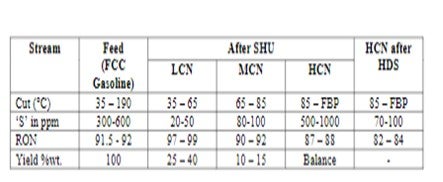
Selective hydrogenation inlet temperatures are maintained at about 120°C with temperature rise of about 16-18°C. The pressure is maintained at about 16-18 kg/cm2 with H2/HC ratio of 7-9 Nm3/M3. With loss in catalyst activity, temperature can be increased up to about 150°C. SHU catalyst is Ni-Mo based. HDS is operated at a pressure of about 17-18 kg/cm2 and at inlet temperature of 230-250°C. HDS catalyst is Co-Mo. Depending upon the feedstock quality and by adjusting operating conditions, we are able to contain RON loss between 0.8 to 2.0 across SHU and HDS (FCC Gasoline post treat block). In case of higher severity operation, RON loss can go as high as 3.0.
Minimizing RON loss in FCC gasoline post-treat units, in our configuration, depends on how good we are splitting the gasoline after SHU and adjusting blending proportion in finished gasoline pool. We try to operate SHU at minimum possible severity to minimize RON loss. The RON loss across SHU is nominal when operated at optimum just to convert di-olefins and light sulphur species. Depending upon the sulphur content in HCN, HDS severity needs adjustment. The loss of RON across HDS can be as high as 5-6 units. However, through appropriate splitting after SHU, stream properties can be optimized to ensure minimum RON loss. In one of our units, we have discontinued MCN draw as benzene content in gasoline pool is in control. After discontinuation of MCN, the split between LCN and HCN was 46 : 54 wt. ratio initially. At this split, the RON loss in HCN across HDS was 3.0 units. We reduced HCN draw to 50 wt.%. This reduced the space velocity across HDS reactors, and we could reduce RIT by about 15°C. The RON loss came down by about 1.5 units after these adjustments due to shift of lighter olefins to LCN thereby reducing hydrogenation potential in HDS. But such adjustment is again limited by olefin specification in finished gasoline. Currently, we are implementing APC in one of our FCC gasoline post treat units to minimize RON loss.
Brad Palmer (ConocoPhillips)
ConocoPhillips has almost all of the available technologies for FCC naphtha post-treating in service within our system. The technologies we apply include Prime G, Scanfining, CDTech, S-Zorb, and conventional hydrotreating at mild conditions. Most of these processes use proprietary catalysts operated at relatively mild conditions to avoid olefin saturation while still removing residual sulfur. We follow licensor guidelines for the operating conditions. In some of our refineries, we actually pretreat the FCC feed sufficiently to avoid post-treatment. This avoids the whole octane loss issue, but is expensive. The severe treatment is driven by other factors. As we are considering moving to < 10 ppm sulfur in gasoline, we will be able to modify some of these systems to meet the new spec fairly easily, while others will probably not be capable of meeting the 10 ppm spec without major work. In all cases, additional octane loss is unavoidable. Fortunately, most of our refineries are not short octane.
Year
2011
Process
Question 35: How far can the hydrogen to hydrocarbon ratios be decrease in gasoline hydrotreating units before experiencing high reactor pressure drops? Please provide some details of your experience with reference to the run length limitations and operating performance.
Ujjal Roy (Indian Oil Corporation)
We have number of naphtha hydrotreatment units in our refineries, some operating with straight-run naphtha as feed and others in mix mode with significant cracked feedstock varying from 10% to 40%, to produce feedstock for catalytic reformers. I suppose, the question here is for hydrotreating units processing cracked components.
Straight-run naphtha hydrotreatment units, in our case, are designed for low pressure (i.e. 20-25 kg/cm2.g) and with 40-75 Nm3/M3 of gas to oil ratio depending on feedstock characteristics and desired product quality. In case of hydrotreaters designed to process FCC gasoline, designed gas to oil ratio is about 400 – 500 Nm3/M3 of feed operating at about 50 kg/cm2. The designers recommend the partial pressure of hydrogen through gas oil ratio and system pressure based on the given feed characteristics and target product w.r.t. olefin, sulphur and nitrogen content. Difficult feedstocks with higher nitrogen content require higher hydrogen partial pressure. Reduced gas to oil ratio can only be compensated partially through higher RIT for equivalent nitrogen removal. But running at higher RIT compensating for lower gas to oil ratio with cracked component in feed will accelerate the coking rate on catalyst leading to high pressure drop. Coke formed on the top of catalyst bed can lead to excessive pressure drop and channeling within reactor which will reflect in radial temperature spread. Delta T across the first bed of the reactor will increase due to less availability of hydrogen as heat sink. Also, lower gas to oil ratio aggravates coke formation in the preheat exchangers resulting in high pressure drop. All these would finally lead to slippage of sulphur and nitrogen in product apart from reduced cycle length. This phenomena has been experienced in one of our hydrotreaters with cracked component in feed due to problem in RGC resulting in low flow over days. We normally do not practice lower gas to oil ratio below recommended value as the penalty is large over the time period as compared to pushing extra capacity or reduced energy consumption.
However, in one of our units, we have optimized gas to oil ratio to nearly 90% of recommended value with the advice of licensor, by shifting some reaction from Bed-1 to Bed-2 through reduced reactor inlet temperature in Bed-1 and reduced quench rate in Bed-2. This in turn has led to ascending temperature profile i.e. drop in Bed-1 peak temperature as compared to that of Bed-2 peak temperature. By doing so, we could maintain uniform radial temperature and no appreciable increase in reactor Delta P since about two years of operation inferring no appreciable reduction in run length due to these adjustments.
In case of coking or fouling, pressure drop across reactor will increase steadily over operation and spikes are not expected. Despite maintaining design gas to oil ratio in many of the hydrotreaters, we have experienced high pressure drop leading to frequent skimming of catalyst bed. The reasons for these incidents have been identified to be caustic carry over from upstream caustic wash units, dissolved oxygen in tank wagon while being transported from one refinery to another and carryover of foulant from feed tanks.
The decrease in run length on account of lower gas to oil ratio operation on continuous basis is a factor of type of feedstock i.e., olefin, sulphur and nitrogen contents and target product specifications. In case of margin available in the feedstock quality, gas to oil ratio can be optimized based on adjustment in reactor severity and conversions.
Praveen Gunaseelan (Vantage Point Consulting)
It is assumed that the question pertains to FCC gasoline hydrotreating. Due to the variability in unit designs, process configurations, feed compositions, contaminant levels, product quality targets, etc., a specific answer to the question cannot be provided. For site-specific guidance, refiners are advised to consult with the gasoline hydrotreating process licensor or a qualified engineering contractor.
Maintaining adequate partial pressure of hydrogen is a critical element of hydrotreater operation, as it minimizes coke formation on the catalyst. An adequate feed gas to oil ratio is also essential as the gas plays a critical role in heat removal from the reactor. For these reasons, hydrotreating process licensors often require a minimum gas to oil ratio during operation to prevent premature catalyst deactivation and reactor overheating. While a common rule of thumb is that the minimum gas to oil ratio should be at least 4 times the hydrogen consumption per barrel of feed, it is critical to recognize that this ratio is inherently unit-specific, and the licensor or designer’s operating recommendations should be strictly followed.
Other potential complications of operating at low hydrogen to hydrocarbon ratios include reactor fouling due to incomplete saturation of diolefins, accelerated catalyst deactivation due to higher temperature operation, and unsatisfactory product quality.
The chapter on Hydrotreating by A. Gruia in the Handbook of Petroleum Processing (D.S.J. Jones, P.R. Pujadó, eds., Springer, 2008) has useful information pertaining to this question.
Olivier Le-Coz (Axens)
As a general guideline, in viewpoint of catalytic performances and cycle length it always recommended to operate naphtha HDS reactors at maximum recycle gas rate. Because those reactors operate in gas phase Hydrogen partial pressure is significantly affected when the recycle gas rate varies. Maximized recycle has rate and thus Hydrogen partial pressure, allows minimizing catalyst temperature and maximizing cycle length. In the case selectivity towards HDS versus olefins saturation is targeted, maximizing recycle gas rate to maximize hydrogen partial pressure and minimize catalyst temperature is crucial.
Brad Palmer (ConocoPhillips)
COP sets the lower limit on gas/oil ratio at 300 scf/b (with a minimum of 70% hydrogen in the treat gas). Remember that the hydrogen is diluted by vaporized hydrocarbon, especially in a naphtha unit. Hydrogen partial pressures are actually very low. We also set a minimum of 3:1 treat gas hydrogen to chemical hydrogen consumption, i.e., the treat gas hydrogen rate per barrel must be at least 3 times the per-barrel hydrogen consumption. Both of these criteria are supposed to be met. In practice, some units do not meet the minimum rates.
Once the minimum is met, there are many other factors that are more critical than the hydrogen/oil ratio. These factors include the operating pressure, LHSV, feed composition, feed contaminants and percent cracked stock.
With respect to hydrogen gas/oil ratios, we can offer direct comparisons where two units feed essentially the same feedstock and operate at primarily the same conditions, except for the gas/oil ratio. The best comparison basis is barrels of oil processed per lb catalyst because in this case the units do not have exactly the same catalyst volumes.
•Case 1: Straight-run naphtha feed at about 360 psig. One unit has more catalyst in it, but the cycle lengths are the same at 18 months. One unit has 140 scf/bbl hydrogen and the other has 270 scf/bbl. The oil amounts processed in 18 months in these units are 195 and 241 Bbls/Lb catalyst, respectively. The unit with the higher gas rate processes about 24% more oil per pound with a gas/oil ratio about 93% higher.
•Case 2: Straight-run naphtha feed at about 450 psig. Again, the amounts of catalyst in the units differ, with the cycle lengths the same at 48 months. Gas/oil ratios are 570 scf/bbl and 710 scf/bbl. The barrels per pound catalyst processed are 571 and 740, respectively. The unit with the 25% higher gas rate can process about 25-30% more oil.
Year
2011
Process


Vasileios Komvokis
Global Innovation & Evaluation Manager - BASF Refining Catalysts
BASF Corporation
