Question 60: How does the mercury in crude distribute in your refinery (e.g., what units are affected)? What operating procedures or technology are you using to mitigate this issue?
Year
2014
Process
Dennis Haynes (NALCO Champion)
Various methods exist to determine blend compatibility; one method would be a comparative asphaltene instability point determination via an anti-solvent titration, or another method used is the Wiehe insolubility number to solubility blend number method. The methods available have a wide range of uses yet are not universally applicable to all crude blend scenarios.
Greg Savage (NALCO Champion)
The crude contaminants that cause fouling are frequently not identified in conventional crude assays. Some refiners observe that when two crudes are blended together, they will cause fouling and yet will not cause fouling when each crude is processed individually or blended with other crudes. Mixing a crude, or multiple crudes, containing asphaltenes with another crude can cause the asphaltenes to be destabilized and agglomerate to form solid foulant particles. This is caused by the second crude solvating the resins that were present to disperse the asphaltenes, leading to asphaltene agglomeration. Typically, this is observed when a heavy asphaltic crude is mixed with a more paraffinic crude. The proportions of each crude type and the order in which they are mixed also strongly determine the potential for asphaltene destabilization.
Resins in crude oil are bound to the large asphaltene structures and serve to keep them suspended and dispersed in the crude. The strength of the resin-asphaltene interaction decreases upon heating and the resins are removed from the asphaltenes. This allows the asphaltenes to agglomerate and form particles of foulant. The extent to which the asphaltenes are stabilized at higher temperatures depends upon the strength of the asphaltene-resin interaction. The more strongly the resins are bound to the asphaltenes, the less prone the asphaltenes are to agglomeration and fouling.
The NALCO Crude Stability Index (CSI) is used to determine the stability of fouling precursors in the crude (predominantly the asphaltenes) by titration with an aliphatic solvent. The ‘peak’ in the titration curve (the so-called ‘flocculation point’) is indicative of their stability. The amount of solvent added at the peak minimum is noted and converted to a ‘CSI Value’. This allows a direct comparison of crudes and refinery slates and indicates the fouling tendency due to asphaltene destabilization of the crude prior to refinery processing. The test is done on raw crude samples and can determine relative crude stability.
Additionally, the CSI can be used to measure intrinsic stability by testing two dilutions of the oil, low and high concentration, in toluene solvent. This method correlates very well with the Intrinsic Stability as determined by ASTM D7157 – 05.
Chris Claesen (NALCO Champion)
The main source seems to be crystalline salt. A relatively new method to determine total chlorides is the Chlora instrument, desaltable chlorides can be determined by the extraction method, and the difference is taken as un-desaltable chlorides. Crystalline salts can be seen as solids and any means to reduce solids can have an impact on the crystalline salt content, of course the particle size will have an influence. Adding water as far upstream as possible is also a technique that has been used with some success.
Phil Thornthwaite (NALCO Champion)
Another potential source can be chlorides that are bound within an asphaltene matrix, sometimes termed as asphaltene hydrochlorides. Contamination with these species can occur immediately after well acidizing activities upstream. These chloride species are in effect organic chlorides and the chlorine will be released when the oil has passed through the crude of vacuum furnace.
Chris Claesen (NALCO Champion)
The advantage is a reduction of freshwater use and sometimes a reduction in the load of contaminants(phenols) to the WTP. We have developed desalter washwater specs to prevent negative effects on desalter performance, fouling and corrosion. Oxygen, Ammonia, Hardness, TDS and Filterable are solids, the most obvious ones.
Phil Thornthwaite (NALCO Champion) The quality of desalter wash water can have a big impact not only on desalting but also other aspects of refinery operation. Good quality recycled process water is ideal such as recycled overhead sour water from the crude unit and / or stripper sour water bottoms. However, these streams have to meet certain quality standard to ensure they are low in impurities such as ammonia and / or amine contents.
Wash water volume is of paramount importance so blending with other water sources is a common practice. However, care should be taken so that the quality of the wash water is not compromised.
The use of water sources containing oxygen, hardness and solids are not recommended.
Chris Claesen (NALCO Champion)
The main influence is on level controllers, the most sensitive are the float type controllers but other instruments are also somewhat influenced by the crude Sulphur content.
Glenn Scattergood (NALCO Champion)
Increase in Amps, decrease in Voltage due to:
1.Heavy crude is more conductive, higher in metals content.
2.Heavy crude provides less naphtha used to preheat raw crude, desalter temperature is decreased, and dehydration efficiency may be decreased.
To determine which or both is occurring good monitoring of water in desalted crude along with chloride in both atmospheric and vacuum tower overheads is required.
Phil Thornthwait (NALCO Champion)
Float and differential level controllers are sensitive to changes in feed densities; operating in block modes between fuels and bitumen crudes for example can introduce difficulties in controlling the level. Heavier crudes also increase contaminants in the crude such as solids and metals and these can interfere with other types of level control. Also, these contaminants can influence the conductivity of crude, increasing amps and reducing volts.
Chris Claesen (NALCO Champion)
Some naphthenic acids will not partition into the water phase and normally do not create a wastewater issue. In case of washwater and brine pH’s above 8.5 the naphthenic acids can form a soap, and this can cause severe emulsion formation and oil carry-under to the WTP. At high temperatures, in VDU, VBU and DCU units, the naphthenic acids can break down and generate light organic acids, these will concentrate in the sour water and end up in the WTP, that will give increased COD but the organic acids are easy to digest in the bio treatment provided DO levels can be maintained to ensure optimal operation so that septicity can be avoided that may promote the growth of filamentous bacteria.
Dennis Haynes (NALCO Champion)
The top causes of fouling with tight oil are asphaltene, destabilization on blending with asphaltene bearing crudes and also the potential for thermal production of foulant material. Operational changes due to processing a higher degree of light tight oil may also impact fouling trends in crude unit preheat systems. Modification of blending strategies or use of antifoulant additives have both been used to control fouling in the preheat train.
Greg Savage (NALCO Champion)
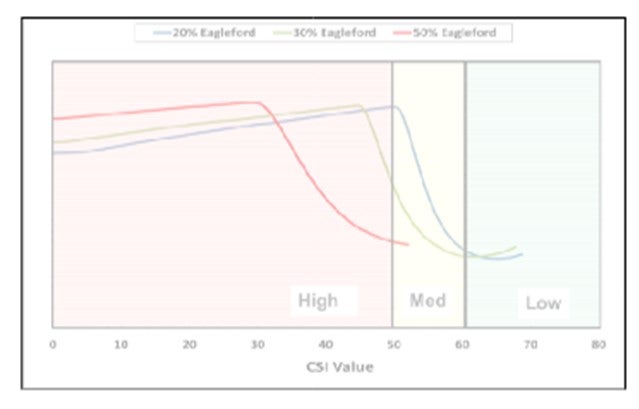
Crude preheats and furnace fouling is an observed problem in processing price advantage crudes like light tight oils (LTO) and heavy Western Canadian crudes. Tight oils blended with asphaltenic crudes (like Western Canadian Crudes) can reduce crude stability and precipitate asphaltenes. The higher the proportion of LTO in the crude feed slate the greater the potential for fouling (as seen below).
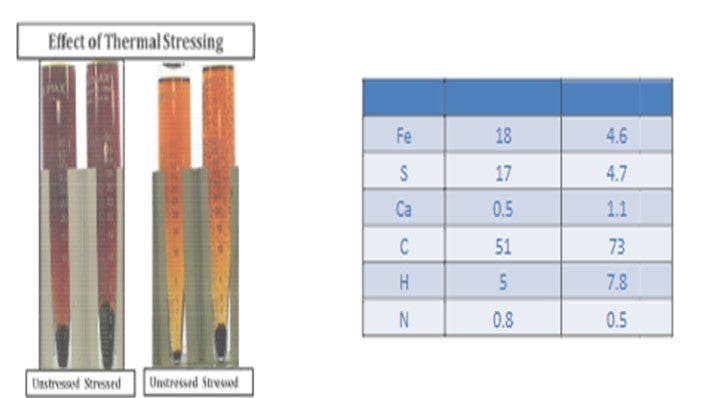
In addition to reduced stability due to blending, when thermally stressed, tight oil forms polar aromatic particles that are unstable in the bulk fluid (pictured below). It is theorized, the aromatic portion of light tight oils dehydrogenates and undergoes condensation reactions to form polynuclear aromatic particles that are unstable in the bulk oil due to the tight oil’s poor oil solvency power. These polar aromatic particles have been observed in the ALCOR Hot Liquid Process Simulator (HLPS) as well as in field deposits. Also, high inorganic solids levels have bound with organic foulants deposit on heat transfer surfaces.
Waxes from tight oils frequently foul cold exchanger trains. A number of refiners have identified crude column fouling from upstream phosphorous additives or amine salts. Consequently, crude preheat, furnace, and tower fouling are increasing problems in processing tight oil/Canadian crudes.
Contaminants that cause fouling are frequently not identified in conventional crude assays, crude diets frequently change, and unit operations can be very dynamic. Crude heater fouling can be very challenging to diagnose. Fouling of the crude preheat and the crude heater could be caused by:
•Poor tube cleaning
•Slops processing
•Poor desalter operation
•Chemical additive treatment
•Over fired tubes
•Flow imbalance between passes
•Locally high heat fluxes due to poor heat distribution or burner tip plugging
•Inadequate mass velocity
•High heat flux
•High fluid bulk temperature
•Excessive vaporization in the crude preheats and heater
•Destabilization and agglomeration of asphaltenes
•Deposition of inorganic salts such as iron sulfide, sand, as well as alkali and alkaline earth metal salts present in the feed
When troubleshooting crude preheat and heater fouling problems, the mechanical and operational conditions of the unit should be evaluated from the tank farm to the boundary limits using a unit audit assessment, temperature and pressure survey, as well as rigorous heat transfer simulation using software such as NALCO MONITOR™. The evaluation of mechanical and operational conditions includes but is not limited to:
•Tank farm mechanical capabilities and limitations as well as blending operation
•Desalter operational and mechanical capabilities and limitations
•Desalter optimization
•Mud wash study
•Evaluation of caustic injection systems
•Exchanger and heater velocity calculations
•Heat flux profile for exchangers and heater comparison to design
•Exchanger train splitter optimization
•Evaluation of cleaning effectiveness with optimum cleaning schedule recommendations
•Heater fireside evaluation with thermography survey
•Vaporization evaluation in exchangers and the heater
•To evaluate the chemical fouling risks the crude slate is initially evaluated using a crude operating experience data base. Additionally, samples should be collected, and chemical analysis performed including deposit analyses, crude characterization, and laboratory fouling simulation in order to determine fouling mechanisms and evaluate solutions. Proper monitoring of preheats and furnaces is essential to success of any fouling control program as the system is complex and extremely dynamic.
Refiners have reduced fouling rates when processing light tight oils through improving furnace heat distribution, minimizing furnace vaporization, increasing desalter solids removal through optimization and chemistries, optimizing caustic addition, online exchanger cleanings, and the use of antifoulants. Recent antifoulant trials have demonstrated reduced furnace fouling rates from 3 - 5°F/day to less than 1°F/day.