

Question 2: What are the operating constraints in co-processing coker naphtha in a ULSD (ultra-low sulfur diesel) and/or a gas oil hydrotreater unit?
BODOLUS (CVR Energy)
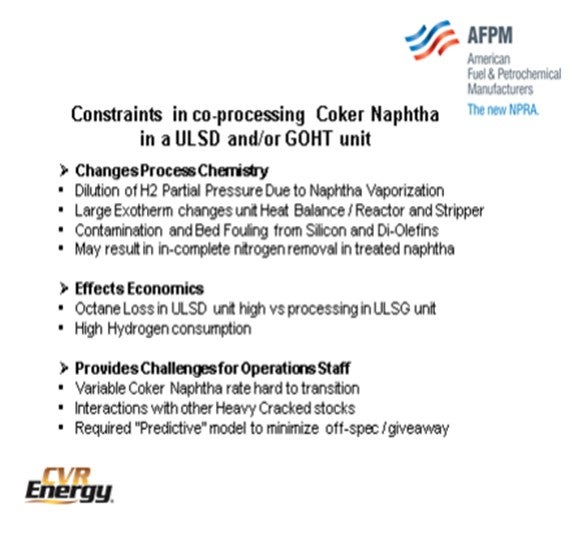
There are some constraints relative to processing coker naphtha. I have outlined a few of them on the slide. Key with coker naphtha are the changes in the process chemistry that occur starting, perhaps, with the dilution of the hydrogen partial pressure due to the vaporization of the naphtha. Vaporization of the naphtha dilutes that vapor space. There is also coker naphtha having a large exotherm. I refer to it a lot with the Operations staff as it is almost like a match for your process. The coker naphtha starts the exotherm off very early at the topmost parts of the bed, and you have to control that exotherm through the rest of the reactor. The exotherm imposes changes in reactor dynamics, in terms of temperature control and any of the other peripheral equipment that might be heat-integrated with the reactor. It also recovers the naphtha material that has been processed in the stripper tower. One issue associated with contamination is bed fouling due to silicon and diolefins. There is a liability with the coker naphtha if the naphtha is routed to the reformer pool because it might not get out all of the nitrogen. You may wind up looking at enhanced nitrogen levels in your reformer area.
Our economic effects: Octane loss in a distillate hydrotreater is high due to saturation of all of the olefins. Coker naphtha processed in an ultra low sulfur gasoline unit will preserve those olefins and result in less octane degradation. Processing coker naphtha comes at a liability of high hydrogen. It takes a lot of hydrogen to process the coker naphtha. In particular, though, in our unit on which we did a revamp in 2008, the rates of the coker naphtha and of other cracked stocks in the unit presented some interesting challenges to the operators. We found that the interaction with other heavy cracked stocks was complicated, so to speak. We look forward to trying to get a predictive model to help the Operations staff run the unit.
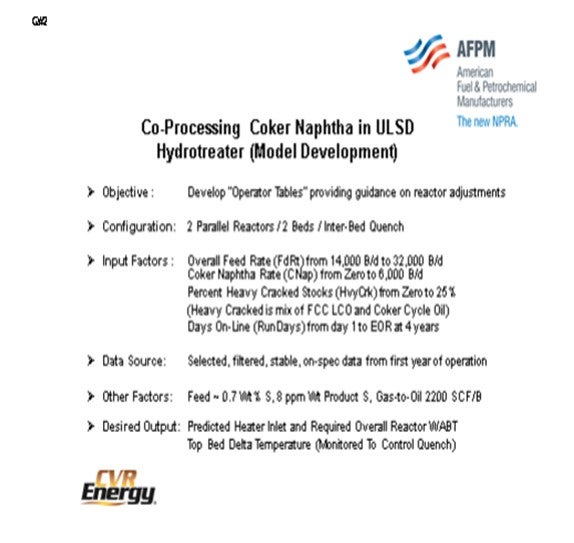
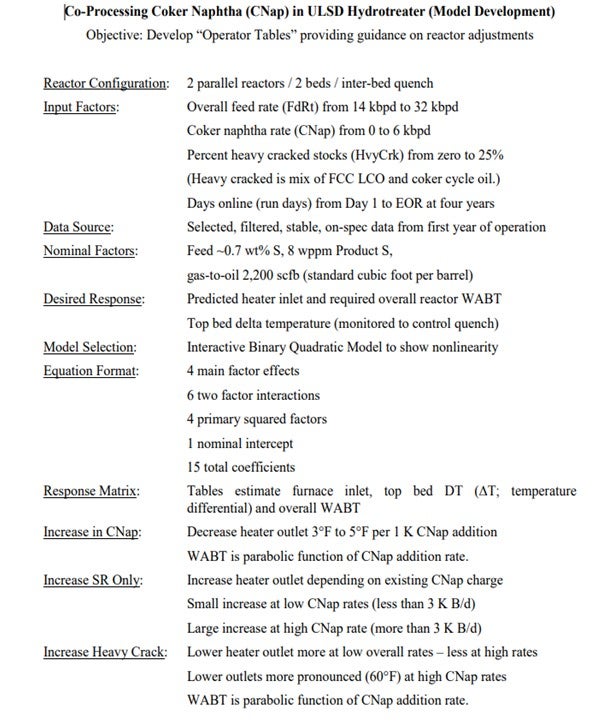
This slide shows our model covering the two parallel reactors with two beds in each reactor and an inter-bed quench. We had multiple feedstocks coming from multiple sources: some cracked and some straight run, including coker cycle oils and light cycle oils. Of course, the coker naphtha varied in many proportions. I do not want to say on a daily basis; but when we had a lot of different cracked stocks in a unit and the units going up and down were changing the rates, the operators had to jockey all of these particular variables. It is somewhat difficult for them to understand how to change all of the conditions.
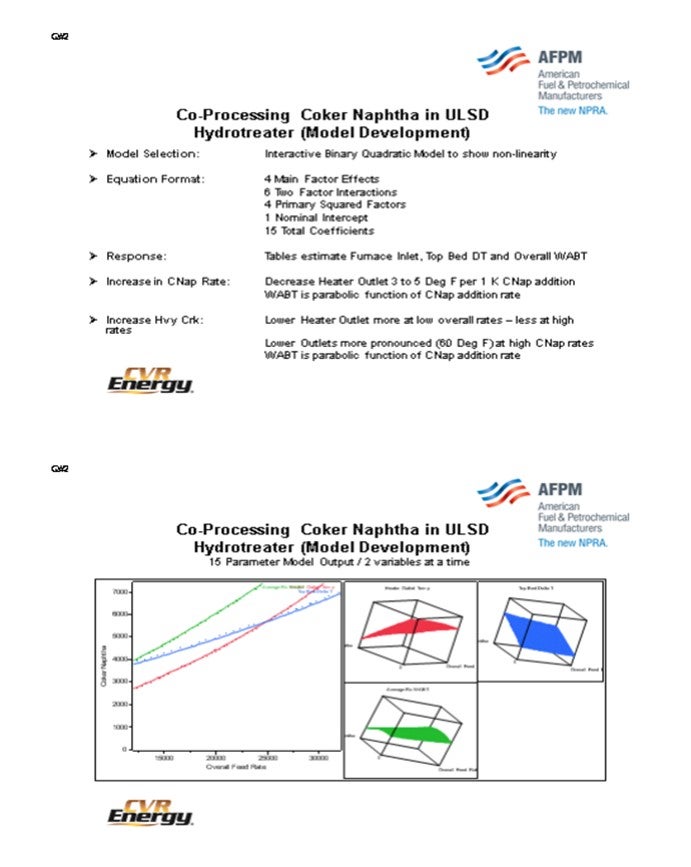
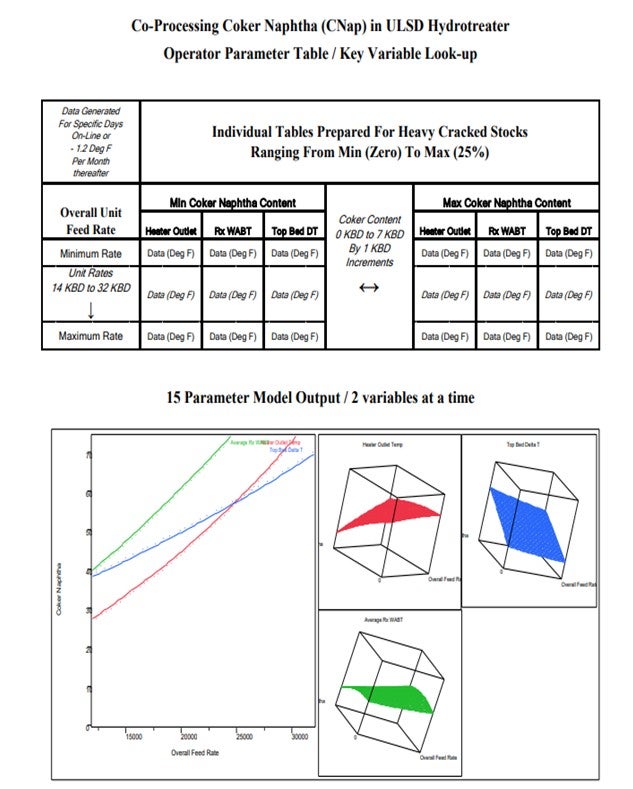
We were looking for an attainable response. In order to cover all of the interactive parameters, we elected to cover those with at least six interactive factors and four primaries squared. When we had about 15 different coefficients in the model, we looked at what the operators monitor. It was a limited slate of furnace inlet, top bed ΔT (temperature differential), and overall WABT (weighted average bed temperature) on the unit to get to spec. The modeling more or less showed quite a few interactive variables and quadratic surface responses. We found that it was not necessarily a linear function of the addition of some of these variables. Over the years, my experience has been that your typical board operator can handle two, three, or four variables at a time. But when you have multiple variables with multiple nonlinear interactions, it is difficult for him to perceive how to change the unit ahead of time preemptively, so a tool is required.
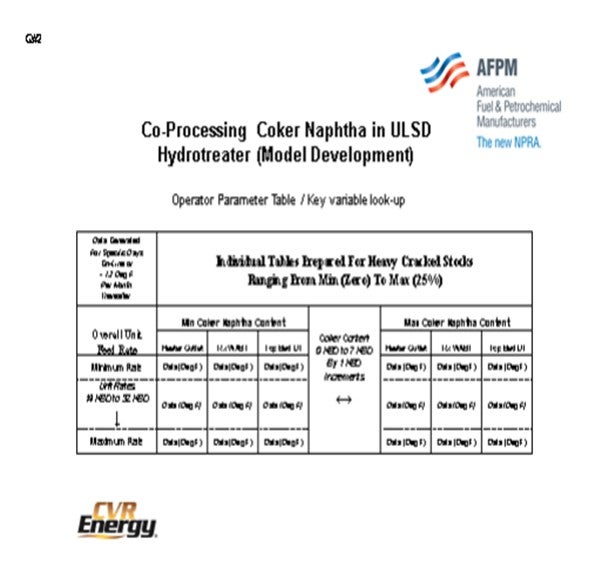
These types of graphs are not what you would share with the Operations staff, so we boiled them down to a set of tables. It is an old-school look-up. I mean, if people would say, “Well, just plug the numbers into the computer; it will tell the operators what to do,” that would cut the amount of the long-term understanding of the variables and their interactions. So we prepared tables with a date stamp, and then the tables got up periodically. The tables contained most of the variables, so the operators were able to page through and read across on the table. It seemed to help them adjust the unit proactively to be on spec.
LEICHTY (Chevron USA, Inc.)
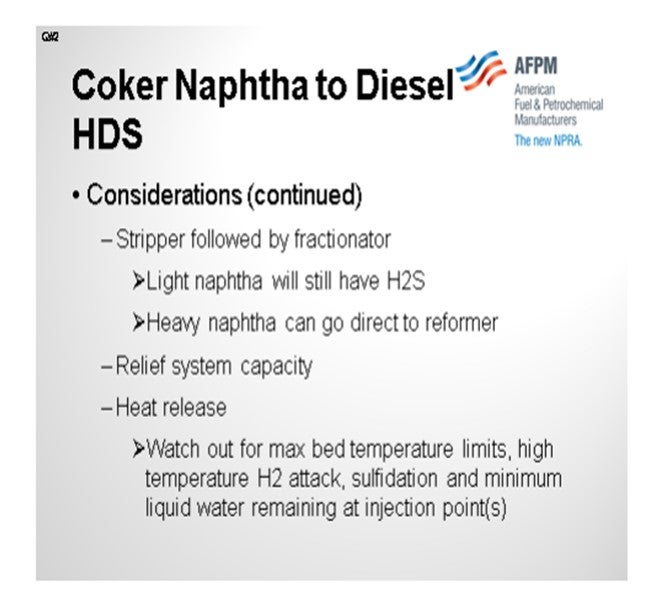
Chevron has two high pressure hydrotreaters that co-process coker naphtha in a diesel service. The other feedstocks are coker light gas oil and FCC (fluid catalytic cracking) light cycle oil. Both units feed 100% cracked feed stocks.
Considerations: Beginning with the feed pump, the addition of coker naphtha must not create a mixture at the feed pump suction conditions such that the vapor pressure results in cavitation. Moving on to the preheat train, we find that diolefins in the feed can result in polymerization fouling. In some cases, an antioxidant injected into the coker naphtha rundown, combined with an antifoulant in the total unit feed, can mitigate the fouling. Also, we found that if the naphtha content is too high in the feed, accelerated fouling can result. We monitor this fouling by calculating the degrees below dew point in the preheat exchangers. This fouling may be due to lower stability or solubility of gums as the mixture partially vaporizes through the exchangers. We have also determined that the presence of LCO (light cycle oil) in the feed can sometimes help keep gums and other polymerization products soluble, thereby mitigating furnace and/or exchanger fouling. In the reactor, silica poisoning of the catalyst can be mitigated through the use of some of the newer generation coker antifoams containing lower silica content. If the silica is from another source, a guard bed may be necessary to achieve the desired run length. With respect to desulfurization of the diesel, there may be a negative space velocity impact if the naphtha feed is added to the existing diesel range feed.
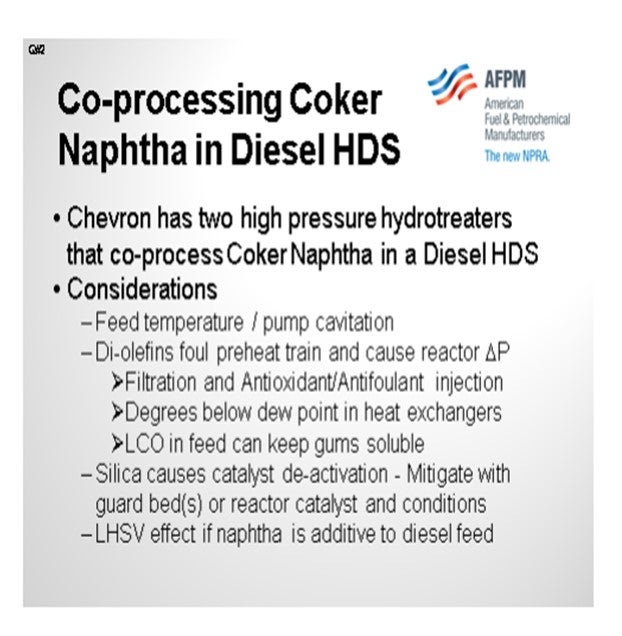
Additional Considerations: In order to effectively strip H2S (hydrogen sulfide) from the product and separate the naphtha from distillate, a stripper column followed by a fractionator is an effective configuration. Note that even with this configuration, the naphtha will still contain some H2S; but, the H2S content can be made low enough to feed directly to a reformer. Another important aspect to consider is the ability of the relief system to handle the addition of coker naphtha. A relief system study should be performed to ensure adequate capacity. Lastly, but most importantly, the olefins in the coker naphtha cause high heat release in the reactor, temperature control challenges, and high hydrogen consumption. If not properly managed, the effluent train temperature profile could change such that the location of the metallurgy switch between carbon and stainless steel is no longer adequate to protect against high temperature hydrogen attack and high temperature sulfidation. These two corrosion mechanisms can lead to catastrophic failure. In addition, the higher temperature in the effluent train may reduce the percent liquid water remaining at the continuous water injection point, which can lead to a failure in the reactor effluent air cooler below the 25% minimum guideline.
JEFF JOHNS (Chevron Products Company)
I think we are letting the panelists off a little too easy, so I will ask a question. Does the coker naphtha that you mentioned include the C5/C6 portion, sometimes called PenHex? If it does, can you comment on a specific experience you have had with that portion of the naphtha?
LEICHTY (Chevron USA, Inc.)
We do have coker C5 and C6s (coker PenHex) contained in the coker naphtha that is fed to our distillate hydrotreaters. These low boiling point molecules contain a higher percentage of olefins and are the most reactive; therefore, they are more challenging, from a fouling and reactor heat-release perspective.
BODOLUS (CVR Energy)
Our coke naphtha contains it as well. We process it as we get it.
ALAN WELDON (Hunt Refining Company)
What do you consider a high percentage of cracked coker naphtha versus just diesel?
BODOLUS (CVR Energy)
High would be on the order of 20%, perhaps.
LEICHTY (Chevron USA, Inc.)
Limits could be encountered in several sections of the unit, as discussed in the considerations mentioned previously. If the maximum reactor bed/total temperature rise is the only limiting factor, then 35% coker naphtha can be achievable.
BODOLUS (CVR Energy)
The primary operating constraints in co-processing coker naphtha in a heavy oil hydrotreaters concern dilution of hydrogen partial pressure (due to naphtha vaporization) and the effect that the exotherm has on the unit heat balance. Inclusion of coker naphtha increases the top bed exotherm, often reducing heater duty. Simultaneously, there may be an increase in stripper section duty to lift the product naphtha into the overhead stream.
Primary contamination constraints in coker naphtha include silicon resulting from the decomposition of antifoams used during the coking process. The silicon contamination deposits on the hydrotreating catalyst leading to deactivation and has a severe negative impact on the prospects of regenerating the spent catalyst. Top bed fouling, due to diolefin content of coker naphtha, can also limit run length due to differential pressure build. If the unit is expected to have a steady diet of coker naphtha, catalyst loading options in the top bed can include a silicon trap and/or a layer of controlled diolefin saturation catalyst along with enhanced void bed grading. Note that coker naphtha holding tanks should be protected from oxygen ingress, which produces peroxy free radicals, and long-term storage at elevated temperatures due to olefin/diolefin content.
From an economic standpoint, coker naphtha processing in a distillate hydrotreaters also causes a loss of octane due to saturation of olefins. Consumption of hydrogen will be high and resulting treated naphtha may have residual nitrogen liability. Other processing options, such as co-processing in an ultra-low sulfur gasoline hydrotreater, can preserve octane values and allow treated coker naphtha to enter the gasoline pool (preventing nitrogen liability on the reformer).
Balancing the heat duty and overall rate changes in heavy oil hydrotreaters with variable coker naphtha is not always intuitive to the operations staff. After a more than a year of operations it was decided to develop a transition tool to assist operators in “Predicting” what new heater setting would be required with a rate change in any of the feedstocks (coker naphtha, FCC light cycle oil, coker cycle oil and straight run diesel).
The following slides and tables show how selected process variables were chosen to develop a model for the operator to “Predict” reactor parameters necessary to minimize off-spec product and reduce giveaway.
KASPAR VOGT and STEVE MAYO (Albemarle Corporation)
Coker naphtha is typically high in sulfur, nitrogen, diolefins and silicon. It often also contains significant amounts of arsenic and in some cases particulates from the coker and iron scale. Treating coker naphtha is much more challenging than straight run naphtha, even when it is blended with straight run naphtha. For these reasons, refiners are sometimes tempted to treat coker naphtha in higher pressure units with a heavier feedstock such as diesel or VGO (vacuum gas oil). This can be done successfully, but there are caveats to consider before embarking down such a path:
• The addition of a lighter feed component that fully vaporizes will reduce hydrogen partial pressure, potentially reducing the unit’s performance with regard to its primary feedstock.
• The introduction of olefins and diolefins may result in higher exotherms, as well as increased hydrogen consumption. As a consequence, hydrogen partial pressure will be reduced and potentially also the operating window for the unit. When possible, coker naphtha used as a liquid quench can alleviate its exotherm by heat of vaporization. A downside is introduction of catalyst poisons in the lower beds of the hydrotreater.
• Poisons such as As (arsenic) and Si (silicon) will be introduced to the unit and may require a more extensive guard bed system to handle them. A larger portion of the reactor devoted to guard bed catalyst will reduce the volume available for main bed catalyst and could impact cycle length.
• In particular for ULSD, the most difficult sulfur compounds require hydrogenation before they can be desulfurized. Adding coker naphtha, with its typically high N (nitrogen) content, increases organic nitrogen into the reactor and may increase the level of nitrogen inhibition of catalyst active sites. This disproportionately affects hydrogenation sites and effectively reduces the rate of removal of the most difficult sulfur compounds.
• VGO units, with their typically lower LHSV (liquid hourly space velocity) and higher hydrogen partial pressure, are better equipped to handle the introduction of coker naphtha. However, the naphtha will operate in the vapor phase and may encounter diffusion issues with the VGO operating in liquid phase, reducing the rate of sulfur and nitrogen removal.
• The fractionated naphtha stream will be too high in mercaptans (due to recombination) to send directly to the reformer and will need to be post-treated
MEREDITH LANSDOWN, BRIAN WATKINS, and BRIAN SLEMP (Advanced Refining Technologies)
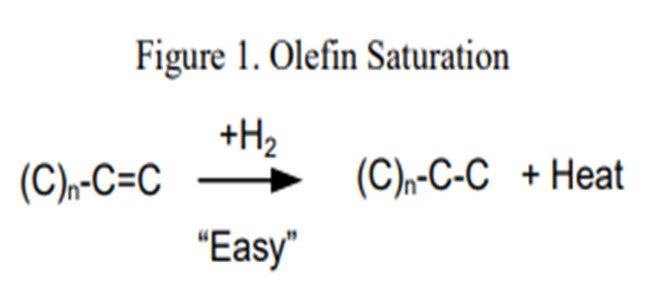
Co-processing coker naphtha in ULSD service can have several undesirable effects on the performance of the hydrotreater and the catalyst if the system was not properly designed to handle it. In general, coker stocks have a higher level of olefins present from the coking process. Once in the hydrotreater these olefins will quickly get saturated (Figure 1) consuming additional hydrogen and generating extra heat. As a general rule of thumb, one mole of hydrogen is required per mole of carbon/carbon double bond, or between five and 10 times the bromine number reduction in standard cubic feet of hydrogen per barrel (scfb). This additional heat (130 BTU/scf (British thermal unit per standard cubic foot) to 160 BTU/scf hydrogen consumed), if not spread out through a decent portion of the catalyst bed, will initiate the subsequent reactions creating a much higher temperature rise than expected. This excess temperature can also speed up the coking or polymerization mechanism which will lead to an increase in pressure drop. This can set an upper limit as to how much coker naphtha can be processed either by a need to limit the heat rise, or from too much hydrogen consumption that could starve the downstream catalysts.
A system that is properly size and activity graded will be extremely important when co-processing coker naphtha in a diesel unit. ART utilizes a grading system to help mitigate pressure drop build-up. ART’s GSK-19 is a 19-mm inert ring with a very high void fraction used for trapping large particulates and is placed at the top of the reactor. GSK-9 is loaded next and is a 9-mm macro-porous ring that traps iron, as well as other finer particulates that can increase pressure drop. ART also utilizes two other types of active grading, GSK-6A and GSK-3A, which are smaller rings with a small number of active metals present in order to begin any olefin saturation reaction, as well as provide additional void space at the top of the reactor. Underneath the grading options, it is recommended to use a layer of ART’s AT724G or AT734G which can provide both additional olefin saturation, additional void fraction for pressure drop mitigation, as well as a trapping mechanism for silicon (and arsenic), which is another concern with co-processing coker naphtha in a ULSD unit.
Another major concern is that coker naphtha can also bring silicon into the unit which is a permanent poison for hydrotreating catalyst. A silicon guard, such as ART’s AT724G or AT734G, should be loaded in the reactor to mitigate silicon poisoning. Silicon pickup is temperature dependent, and at the higher temperatures ULSD units are operating at, silicon pickup in the order of 16 wt% to 25 wt% could be expected with AT724G or AT734G. If arsenic is present in the coker stocks, the use of AT734G is preferred as it will have the same silicon pickup as AT724G and will also protect the active catalyst against arsenic poisoning.
A third concern is the high degree of vaporization of the coker naphtha. ULSD hydrotreaters are typically designed such that their feed distribution system will contain liquid, and the additional gas present from the coker naphtha may cause some systems to perform poorly giving rise to maldistribution. In order to minimize feed vaporization and poor distribution tray utilization, the coker naphtha should be mixed with the other feed streams at a temperature where it is still liquid before feeding to the charge heater. The recovery system should also be evaluated for the increase in naphtha that will be present so that the downstream equipment is not overloaded.
A final consideration would be that additional coker naphtha in a diesel can generate incremental dry gas products such as methane and ethane. These products will increase in concentration in the recycle gas loop, causing a decrease in the hydrogen partial pressure for the hydrotreater. It will also increase the molecular weight of the recycle gas, which can lead to compressor capacity limitations. These additional products can also lead to incremental stripper off-gas and related problems.
PAUL CECCATO (Criterion Catalysts & Technologies)
Several factors should be evaluated when considering the co-processing of coker naphtha in either ultra-low sulfur diesel or FCC pretreat units. Changes to the hydrogen partial pressure, hydrogen consumption, reactor fouling, reactor temperature profiles, fractionation capabilities, and catalyst deactivation will impact both types of operations. Ultimately, the selection of were to co-process coker naphtha is based on the relative impacts of these factors on each unit.
Co-processing coker naphtha reduces hydrogen partial pressure due to the vaporization of the naphtha range material and increased hydrogen consumption through saturation of its high diolefin/olefin content. A reduction in hydrogen partial pressure directionally reduces heteroatom conversion, aromatic saturation, and catalyst stability. In a ULSD operation, treating the more sterically hindered sulfur species with less hydrogenation activity becomes more difficult, limiting the feed endpoint and the percentage of cracked stock in the feed blend. In an FCC pretreat unit, reductions in nitrogen and aromatic conversions directionally lower FCC conversion.
As the hydrogen partial pressure decreases, aromatic equilibrium and condensation occur at lower temperatures. For a ULSD unit, cycle life may shorten due to increased coking and insufficient hydrogenation activity at elevated temperatures. In FCC pretreat operations, cycle life also declines due to accelerated catalyst deactivation as larger aromatics condense to coke at lower temperatures.
Saturation of the diolefins and olefins introduced with coker naphtha consumes significant hydrogen, depleting excess hydrogen at the reactor outlet. ULSD or FCC pretreat units operating with marginal hydrogen treat gas-to-makeup ratios may experience hydrogen starvation and accelerated catalyst deactivation. Insufficient excess hydrogen may also result in lower bed pressure drop issues when processing cracked stocks in either the ULSD or FCC pretreat units or high asphaltene feeds in the FCC pretreat unit due to rapid coking.
Polymerization of the diolefins/olefins in the coker naphtha may lead to increased reactor fouling and upper bed pressure drop. Typically, neither ULSD nor FCC pretreat units are designed with low temperature lead reactors for mild saturation of the highly reactive diolefins. Competition for active catalyst sites at the top of a reactor may leave diolefins and olefins unsaturated and exposed to elevated temperature which drives polymerization.
Heat release from diolefin and olefin saturation is significant and may result in a more ascending temperature profile in a single bed reactor and increasing quench requirement in a multi-bed reactor. Maintaining preferred equal bed outlet temperature profiles can become difficult as quench is diverted upward in the reactor. Radial temperature spreads in reactors with older reactor internals may increase with the increased axial delta T (temperature differential) and push established operating limits, constraining the reactor inlet temperature.
Delayed coker naphtha typically contains varying quantities of silicon from antifoam addition. Si is a poison to hydrotreating catalyst with a larger impact on the denitrification function. Reactor loadings can be adjusted to include high capacity Si trap catalyst at the expense of high activity catalyst volume. In a ULSD unit, Si induced catalyst deactivation impacts cycle life. In the FCC pretreat unit which typically contains more catalyst volume, the Si impact is less; but when combined with other metals induced deactivation, cycle life may be impacted or a reduced.
Lastly, co-processing coker naphtha requires sufficient fractionation capabilities to recover the naphtha product. Poor fractionation in a ULSD unit may result in heavy naphtha contamination of the diesel product for lower cetane. Poor fractionation in the FCC pretreat unit may result in insufficient naphtha recovery and the reprocessing of an increased diesel draw through the ULSD unit.
The impacts of co-processing coker naphtha in a ULSD or FCC pretreat units should be evaluated individually and compared to unit constraints and objectives. Ultimately, the selected unit will be capable of minimizing the impacts.
Question 3: How can lubricity be improved in ultra-low sulfur jet fuel?
ESTEBAN (Suncor Energy, Inc.)
The increased desulfurization of distillate fuels removes sulfur nitrogen and aromatics, which are components favorable for lubricity properties. The recent market conditions have led most refiners to not only produce ULSD, but also ULSK (ultra low sulfur kerosene), in order to maximize distillate production. At Suncor, we have been driving our facilities to maximize the distillate. We often do not take advantage of the minor impacts that could come from flexibility with feed streams and blend components, or even minor impacts from changes in reactor loadings, in order to have some difference on our finished product lubricity. The level of hydrotreating required to meet sulfur specifications on distillate fuels removes and/or changes so many trace components good for lubricity that it is much more economical to use lubricity additives to maximize refinery yields.

At the Denver Refinery, we produce commercial Jet A, which is a non-additized fuel. There is no lubricity specification for that particular fuel. We produce Jet A using similar blend components to #1 ULSD, which allows us to minimize our overall storage requirements. While Jet A is the only product that we produce, there are jet fuel products with lubricity specifications that we do not produce for military use. Those fuels are additized.

LEICHTY (Chevron USA, Inc.)
Straight run fuels have good lubricity due to the presence of trace compounds containing sulfur, nitrogen, and oxygen. These compounds are removed by hydroprocessing. Because it is impossible to predict the lubricity based on bulk properties, lubricity must be measured using the BOCLE (Ball-on-Cylinder Lubricity Evaluator) test. Fortunately, modern engines are designed for low lubricity fuel and can burn Jet A, which has no lubricity specification. However, other grades of jet fuel may require additives to improve lubricity. These additives also act as corrosion inhibitors.

Chevron operates facilities where the finished jet products are 100% hydrotreated and/or hydrocracked. These products include Jet A, Jet A-1, and JP-8. The testing and additive requirement depends on the fuel. When additizing, it is possible to optimize the response and dosage by doing testing ahead of time. There are three approved additives: Nalco 5403, Innospec DCI-4A, and Afton HiTEC 580.

For Jet A, there is no lubricity testing requirement.
For Jet A-1, lubricity testing is required if any of the following four conditions are met:
1. The fuel is derived from greater than 20% severely hydrotreated material, meaning that it is hydroprocessed at a pressure greater than 1015 psi (pounds per square inch).
2. The fuel is made from greater than 95% hydroprocessed material.
3. The fuel is synthetically derived, i.e., Fischer-Tropsch reaction-derived material.
4. The wear scar by the BOCLE test is greater than 0.85 mm (millimeters).
For JP-8, additives are required regardless of processing condition.

AHMAD AL-JEMAZ (Kuwait National Petroleum Company)
A question on ULSD protection: Do you have any experience having a reactor with both hydrotreating and dewaxing beds in one reactor?
LEICHTY (Chevron USA, Inc.)
Yes. We do have one unit with that has a dewaxing catalyst layered into the hydrotreating catalyst.
AHMAD AL-JEMAZ (Kuwait National Petroleum Company)
So, there is a robust design that you can rely on that enables you to do without the lubricity additives?
LEICHTY (Chevron USA, Inc.)
We have not had any issues with this unit.
SUBHASH SINGHAL (Kuwait National Petroleum Company)
Is it preferable for these lubricity additives to be added inside or outside of the battery limit? What is the usual preference of the refiners if there are lubricity additives inside the ULSD unit, or it is done outside in tankers area?
ESTEBAN (Suncor Energy, Inc.)
We have our additives downstream of blending, so they go in with the finished fuel.
DAN WEBB (Western Refining)
Does anyone have experience co-processing jet or pulling a jet stream off of the ULSD unit stripper or fractionator, especially in light of the previous discussion of co-processing coker naphtha?
ESTEBAN (Suncor Energy, Inc.)
Our ULSD unit in Denver pulls a sidecut of kero (kerosene). Typically, that is then either blended back into the diesel stream or, in some cases, used as a jet blend stock.
DAN WEBB (Western Refining)
How does that process scheme affect your jet products, as far as lubricity and any of the other specs?
ESTEBAN (Suncor Energy, Inc.)
We have two separate jet product streams. One is from a ULSK unit, which is lower pressure: around 300 psi. With the ULSD unit that is operated at about 1200 psi, we have a side-draw kerosene product. The two together do not have an issue in our blend pool. I do not know if we have ever looked at one of them individually to really see if that presents a problem. That being said, the only market that we sell to has no lubricity requirements.
OHMES (KBC Advanced Technologies, Inc.)
We have seen a couple of units that do pull the jet cut like that. Normally, it is those with a lot of kerosene in the feed which are able to do that and have the proper fractionation to pull it. I concur with James on the lubricity issue, but you brought up coker naphtha. Obviously, you can pull a jet kerosene cut, but it really depends on what the impact will be on your aromatics from the jet and what else gets blended in with it. You can get away with it, but you must have other streams to dilute the aromatics and still meet specification.
ANDREW LAYTON (KBC Advanced Technologies, Inc.)
In my experience, you do not actually need much low hydrotreated or even un-hydrotreated material to meet the lubricity specs. In the past, some people have found a way to put some low hydrotreated material into the blend. One does not actually need much unhydrotreated material.
ESTEBAN (Suncor Energy, Inc.)
Since new regulations have mandated the reduction in sulfur content for diesel fuels in both on road and non-road markets, more refiners have shifted to also hydrotreating kerosene crude fractions to ultra-low specifications because of the value that these components present as a blend component in diesel fuels. Often kerosene is used as a blend component in diesel fuels to increase pool volume and improve blended properties especially in markets where diesel fuels are subject to more stringent cold flow properties specifications.
Lubricity properties of distillate fuels have remained a topic of concern due to increased hydrotreating, since lubricity properties of both jet and diesel fuels are a function of fuel boiling range, aromatics content and sulfur/ nitrogen content. In order to improve the lubricity properties of the Suncor Energy, Inc. blended diesel fuels we use injected additives to meet the fuel specifications. Strong distillate margins and market conditions have driven Suncor to select catalysts for ULSD production that improve volume swell across hydrotreating units which can have adverse impacts on lubricity properties without the addition of chemicals to our final products. The addition of these chemicals permits a profitable maximization of distillate volume.
While chemical additives are a simple solution for product diesel streams the specifications for jet and #1 ULSD although somewhat similar, are not the same with respect to lubricity properties. The current specification for commercial use Jet A (ASTM D1655) does not require that the fuel meet a lubricity specification and further requires that the product be free of additives. As a result, the product marketed by Suncor Energy, Inc. as Jet A is sold free of additives and is not subject to a lubricity specification. Furthermore, at our Denver Refinery both hydrotreated and non-hydrotreated kerosene streams are routinely used in our jet pool with no issues or impacts to our customers.
There are, however, different jet product specifications that do require fuels to meet lubricity specifications and permit the use of lubricity additives. Typically, these fuels are specified for military use and have lubricity specifications because of differences in applications from commercial use.
Year
2012
Process
Question 4: What are the hydrotreating operating issues when processing shale-derived light, sweet, and highly paraffinic crudes such as Bakken, Eagle Ford, and Utica? What hydrotreating/catalyst strategies can offset any negative effects? What options are available to optimize the distillate hydrotreater(s) with these light, sweet crudes?
OHMES (KBC Advanced Technologies, Inc.)
There is a full P&P session on Wednesday, so my comments here will be brief. There is no way we can cover this topic in five minutes, but I do want to make a few points, particularly in the hydroprocessing arena. First, most people are seeing that not all shale crudes are created equal. There are a lot of different wells within the same generic field (i.e., Eagle Ford, Bakken, etc.) that produce varying qualities of crude over the production cycle. We have heard of people seeing variations of 10 to 20 API in the crude coming into the refinery. Obviously, that has a huge impact on the plant and is probably the biggest one you will see. Some of the characteristics, again, are starting to become familiar. The shale crudes in question are highly paraffinic, low sulfur, low nitrogen, and low in conventional contaminants. However, we do see some trace contaminants coming in from some of the fracking and completion chemicals. These crudes have a low resid content, which impacts the bottom of the barrel.
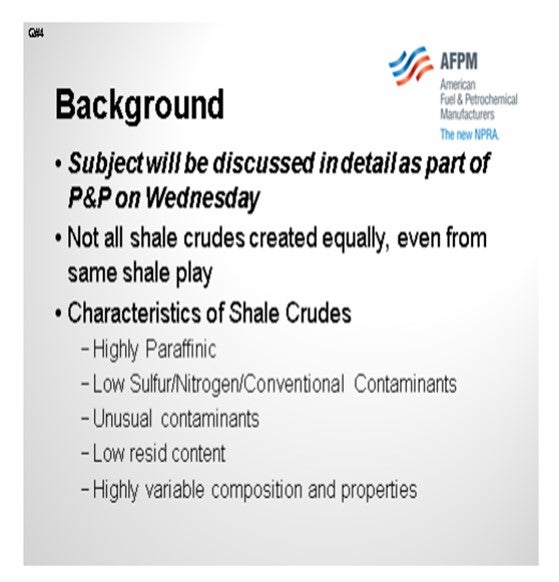
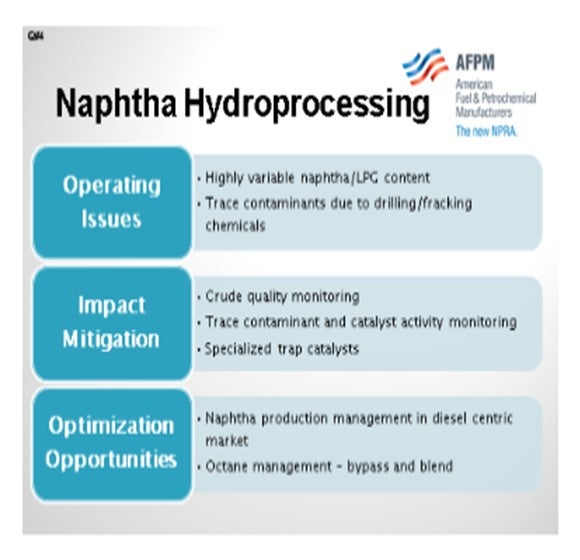
I will make a few points on each of these technologies as we go through the slides. In the naphtha area, you really need to determine if you will be able to process all of the naphtha coming in with crude. Not only does it fit with your facility’s capacity for naphtha; but also, does the market support high naphtha processing rates, particularly if you are in a more diesel-centric market? Look for some of the trace contaminants. Most people are actively managing catalyst activity, but you may want to tighten up on this internal work process. And again, what are you going to do about octane management? Because if you are now filling up your reformers and have a lot of excess octanes, you will want to bypass some blend. Or, is there some low octane blend stock you can bring in to keep yourself in balance and not have any giveaway?
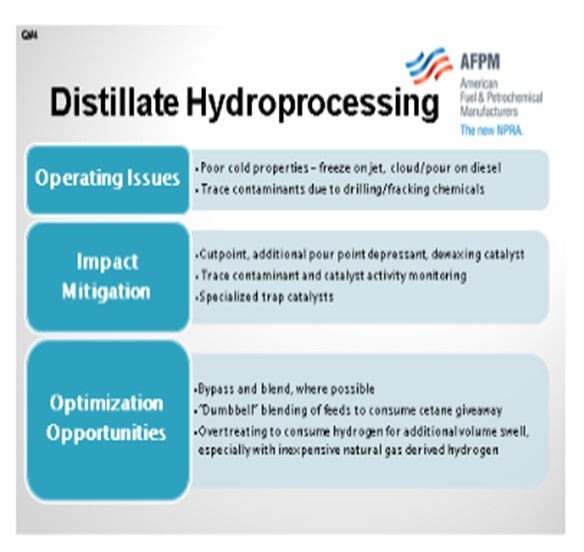
In the distillate area, most people have been able to process this crude without having cold flow property issues because of other streams that are available in the plants and in the blends. The subject of dewaxing catalyst is coming up again as a way to improve cold properties. Because of the highly paraffinic nature, it is great cetane stock; so now you will have some room in your cetane of the diesel pool. You may be able to process a little more cracked stock or some additional purchase streams and do some dumbbell blending around that.
In the gas oil area, the primary focus is on the future impact on the FCC downstream. For your gas oil hydrotreater, you are going to have some nice feed to put in there. What are you going to do with the rest of that capacity? Some people are considering increasing severity to achieve Tier 3 whenever that comes to fruition. This situation may also provide an opportunity to process some of the heavier streams to utilize available capacity.
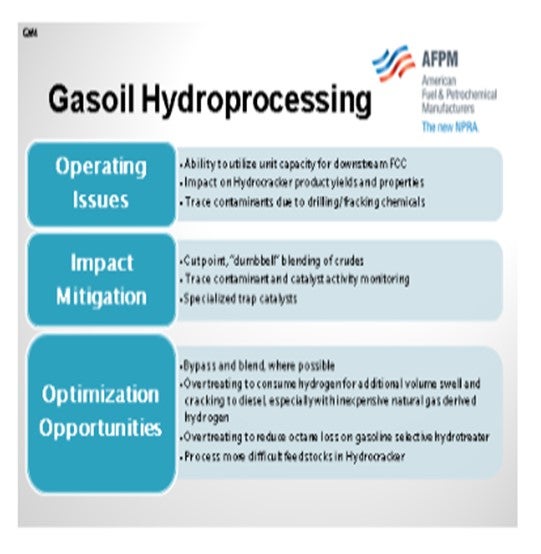
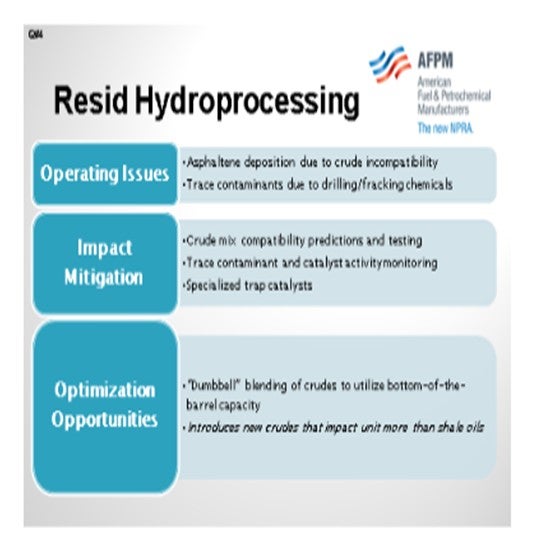
On the hydrocracking front, there is a similar issue of where to get your feeds and how to manage them. You may now have additional catalyst activity available that could cause you to have an entire step change on catalyst cycle length. We would see it as an opportunity to process some more difficult feedstocks. In the resid area, there are only a few folks in the U.S who have resid hydrotreating or bed units. The biggest challenge with the shale crudes is incompatibility when you mix them with some of the other either conventional or unconventional crudes, and that incompatibility would normally present itself in the crude unit or in the coker. But again, if you do have an ebullated bed unit or some type of fixed bed hydrotreater, then you should monitor steam incompatibility. The biggest impact we see is that people are trying to figure out how to balance all of these light sweet crudes being brought in with the available kit, and then they have to do some dramatic dumbbell blending of their crudes and bring in some heavy materials to utilize the plant’s capabilities.
CARLSON (Criterion Catalysts & Technologies)
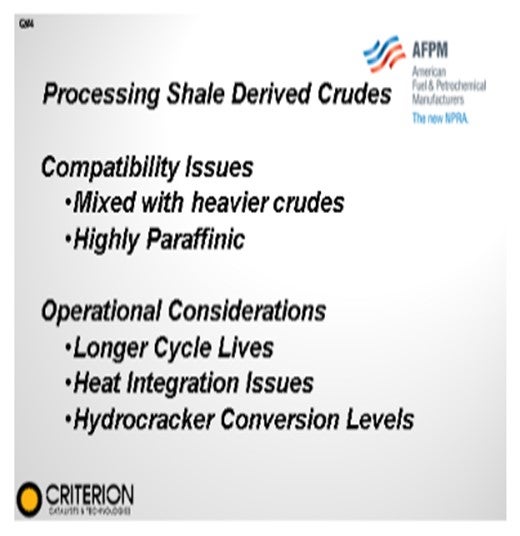
Before I get into my answers, I would like to acknowledge the support I received from my colleagues at Criterion, Shell Global Solutions, and our operating sites. The great answers, I attribute to them. For the mediocre answers, I will take full credit. The subject of processing these crudes was covered very well by Robert. To add a little, when considering the processing of these lighter, sweeter, but highly paraffinic crudes, Criterion would review the impact of compatibility issues, as well as the operational considerations.
Most refiners are processing relatively small percentages of these “bottom-less” crudes with their typical refinery feed slate (less than 25%). The high paraffinicity can result in compatibility issues with the balance of the feeds potentially resulting in asphaltene, precipitation, and fouling occurring in the facility.
In addition to this precipitation fouling, we have seen instances where increased levels of Fe (iron) and BS&W (bulk sediment and water) have been arriving with these feeds, again adding to any potential fouling or pressure drop build-ups.
As far as actual hydroprocessing operational impacts, these feeds are low in heteroatom contaminants; therefore, the operational impact is often longer cycle life capabilities, due to lower deactivation rates, which everyone likes. However, the low contaminant levels can strain units that relied on higher exotherms for heat integration, potentially limiting EOR capabilities as well. In hydrocracker operations, the low levels of nitrogen in the feeds can result in “controllability” issues in the cracking beds due to low nitrogen slips. However, adjusting pretreat operations can aid heat integration, which can come into play again.
DAN WEBB (Western Refining)
I have seen that when some people are processing dumbbell-type crude blends, the total sulfur going to the unit does not decrease and the amount of higher molecular weight sulfur compounds increases. Does this result in more difficult sulfur compounds going to your unit, while moving towards a catalyst’s activity limits? The feed may contain a higher concentration of sterically hindered compounds even though the total sulfur may be lower or the same.
CARLSON (Criterion Catalysts & Technologies)
It would depend on the individual site and how they are blending their crudes. In general, these lighter paraffinic crudes are easier to process in the hydrotreaters, so it would only be a potential issue if they compensated by bringing in alternate difficult crudes. Many refiners are bringing in lower percentages of these easier feeds and displacing the more difficult feeds. The “dumbbell” impact is often more of an issue where we blend our crude API to a target and end up with more bottoms and diluents without getting the expected distillates or gas oil yields.
BODOLUS (CVR Energy)
This particular slide was aimed at shale-derived crudes. The other kind, of course, is the mined crudes or the tar sands-type crudes. Actually, the next question addresses that particular issue.
AHMAD AL-JEMAZ (Kuwait National Petroleum Company)
How do you see the future of resid hydroprocessing with the bed? Is it moving toward or away from the fixed bed? What is the success of the moving beds in the hydroprocessing of tough residues?
LEICHTY (Chevron USA, Inc.)
Chevron Lummus Global (CLG) has both fixed-bed and ebullating-bed resid processing technology. The decision as to which technology to apply in a particular situation depends on the feed quality, products desired, and other site-specific factors. Both technologies have been, and continue to be, applied successfully within the industry.
OHMES (KBC Advanced Technologies, Inc.)
We are getting questions from clients on both ebullated technology and fixed beds. We say that it is still a robust technology which should be considered, particularly with MARPOL coming in a few years and the reduction in sulfur and fuel oils. People are going to have to do something to manage that issue. There are some questions later that address a couple of the points on ebullated bed.
OHMES (KBC Advanced Technologies, Inc.)
As part of the 2012 Q&A, an entire P&P (Practices and Principles) session is devoted to the impacts of shale oil on refineries. Also, this subject is quite broad, so that a complete answer cannot be given within the space of the Answer Book. However, the following points are made to provide some context and information on the subject.
Though it may sound cliché, not all shale oils are created equal. Even those produced within a given field or region can have drastically different properties and boiling range material content at any given time. Shale oil quality vary to a larger degree and more frequently that refiners may be used to, even those facilities processing opportunity crudes or with variable crude slates. Therefore, one of the first aspects that refiners and hydroprocessing units must account for is how the facility will manage these quality shifts on a daily basis.
The most common property generalities of the shale crudes, when compared to other benchmark crudes, are:
•highly paraffinic in nature,
•poor cold flow properties,
•low sulfur, nitrogen, and conventional contaminants,
•low resid (1000°F+) content and high naphtha (300°F-) content, and
•high levels of unusual and non-conventional contaminants.
Given the broad impact of shale oil in a refinery, the following sections are broken down by process area, and operating issues, impact mitigation options, and optimization opportunities are highlighted.
Naphtha Hydrotreating
Operating Issues: As highlighted above, shale crudes contain a high content of naphtha range material. In addition, if the production fields are recovering light ends (methane through butanes) and retaining them in the crudes, the refinery will see increased production of fuel gas and LPG (liquefied petroleum gas) from the crude units. In addition, many of the chemicals used for shale oil production can contain significant levels of unconventional contaminants, such as phosphorous, titanium, and silica. Depending on the boiling point of these chemicals, many of the associated contaminants are found in naphtha range material.
Impact Mitigation: Several options are available to manage these operating issues. First, the refiner should more frequently monitor shale oil quality to understand how given shipments are varying in quality, and to adjust how the shale crude is fed to the refinery as part of the larger crude basket. In addition, the resultant naphtha streams from the crude unit should be monitored regularly for conventional and unconventional contaminants. Finally, naphtha hydrotreater catalyst loading and catalyst grading should be reviewed to understand if the catalyst can handle the new contaminant levels.
Optimization Opportunities: The primary optimization opportunity is trying to balance the high naphtha content of shale oil against the capacity of the naphtha hydrotreating and reforming sections and the market demand for gasoline or downstream chemicals. As the most facilities will run shale crude as part of a larger crude basket, processing shale crude allows the refiner to “dumbbell” blend the crude slate with a much heavier crude slate to achieve the overall facility’s operating targets. Linear Programs (LPs) and detailed refinery-wide simulations models (such as KBC’s Petro-SIM®) can assist in that optimization. Finally, many U.S. refiners are working to balance an operation where the facility is long octane barrels, primarily driven by the gradual shift to a distillate-centric market. Therefore, shale crude can exacerbate this situation. If the refiner is not able to mitigate the overall naphtha and gasoline balance through crude slate and cutpoint between naphtha and distillates, then the refiner may need to examine options to avoid octane giveaway. Some options include hydrotreating and bypassing naphtha around the reformer as an octane soak or selling naphtha.
Distillate Hydrotreating
Operating Issues: In addition to the trace contaminants discussed in the naphtha section, other issues impacting the distillate pool when processing shale crude are the cold properties (freeze, cloud, and pour) and low sulfur and nitrogen content. Essentially, these issues become challenges around product blending and treatment, as well as highlight areas for optimization.
Impact Mitigation: Given the shale oil derived distillate is easier to hydrotreat due to the lower sulfur and nitrogen levels, the downstream diesel hydrotreaters should have “spare” catalyst activity. However, the amount of spare activity will be driven by the overall facility crude slate. These recommendations provided on contaminant management in naphtha hydrotreating apply to distillate hydrotreating as well.
To manage the cold property issues, the refiner has several options. In the Kerosene region, the crude unit cutpoint will require adjustment to maintain the product specification on freeze point. Therefore, some cutpoint kerosene material will end up in the diesel pool. To manage the diesel cloud and pour point limits, several options exist.
1. Adjust crude unit cutpoint.
2. Utilize additional pour point depressant, for pour point management.
3. Blend whole kerosene into the diesel pool for cloud and pour point management, either in diesel hydrotreater feed or as part of final product blending
4. Evaluate a partial bed of dewaxing catalyst to achieve slight reductions in cold properties.
This last point may be a more realistic option than in the past due to the “spare” catalyst activity that may be available, meaning the refiner can reduce the loading of conventional hydrotreating catalyst and create room for the dewaxing catalyst. The yield and unit performance aspects must be reviewed on a detailed basis.
Optimization Opportunities: If the diesel hydrotreater units do, indeed, have additional catalyst activity or cycle length available, several optimization opportunities are available.
1. Increase processing of cracked stock up to cetane limits (also helps cold properties).
2. Increase severity to increase hydrogen addition and volume gain.
3. Adjust cutpoints on heavier and hard-to-hydrotreat streams.
4. Load regenerated catalyst.
Depending on the overall facility balance, many of these options require additional hydrogen. However, given the relatively lower hydrogen requirement for shale oil distillate, the overall hydrogen balance impact will depend on the facility crude slate and optimization options selected.
Gasoil Hydrotreating
Operating Issues: Similar to the discussions above, contaminants can be a problem for the gas oil units and require the same mitigation approach. The other operating issue involves capacity utilization, both in gas oil hydrotreaters producing feed for FCC and gas oilhydrocrackers. Otherwise, given the qualities of the gas oil compared to other conventional sources, these units should have catalytic capacity. Obviously, the hydrocracker yields and product qualities will be impacted, especially given the paraffinic nature of the gas oil feed. For example, hydrocracker naphtha will have a lower N+A or N+2A value, thereby impacting the reformer and gasoline blender.
Impact Mitigation: As highlighted previously, processing shale crude opens up opportunities to rebalance the overall crude slate. Given that the gas oil processing units are integral to high margin units such as the coker or FCC or are highly profitable in their own right, in the case of the hydrocracker, keeping these units fully utilized is important for refinery profitability. Therefore, if the gas oil units are not full and if the economics support operating these units near maximum capacity, then several mitigation options are available.
1. Alter overall crude slate.
2. Process purchased gas oils or sell virgin or hydrotreated gas oils.
3. Adjust upstream cutpoints in vacuum units, crude units, and coker fractionator. In many instances, these options tie directly to optimization opportunities.
Optimization Opportunities: Several optimization opportunities are available for the FCC feed hydrotreater.
1. Bypass gas oil around the hydrotreater and blend to required overall feed qualities.
2. Increase unit severity to 1) reduce octane loss across gasoline selective hydrotreater, 2) improve FCC LCO properties, and 3) increase volume gain and conversion.
3. Process alternate feedstocks, such as LCO or opportunity feeds.
4. Consider block operation in an alternate service (diesel production).
5. Increase facility diesel selectivity by installing mild hydrocracking catalyst.
These options are strongly impacted by the overall strategy of the FCC, refinery marginal economics, and gasoline blending. Therefore, technical and economic analysis is required to define the best options.
On the hydrocracker, several optimization options exist, as the unit will likely have spare catalytic capacity.
1. Process opportunity feeds, such as additional cracked stocks, purchased feeds, and deeper cutpoint feeds.
2. Depending on unit configuration and catalyst loading, the conversion per pass targets may be adjusted to fine tune yield selectivity.
3. If a catalyst changeout is imminent, the catalyst loading may be adjusted to replace hydrotreating catalyst with additional cracking catalyst or even change catalyst activity profile, thereby improving selectivity.
4. Depending on the limiting quality, the product cutpoints targets may need to be adjusted to meet required specifications or adjusted to shift unit selectivity.
5. Alternate modes of operation may now be possible or profitable. Processing shale crude derived gas oils in the hydrocracker opens up several optimization opportunities.
Resid Hydrotreating
Operating Issues: As with the other hydroprocessing units covered above, contaminant levels and types are particularly problematic for resid hydroprocessing units, both fixed and ebullated bed types. Therefore, careful tracking and management of these contaminants becomes especially critical in these services. One of the biggest challenges with processing shale crudes is how the resultant refinery crude slate will be varied to meet overall product slate and profitability targets. Given the highly paraffinic nature of the shale crudes, some refiners are seeing crude compatibility problems, which lead to asphaltene deposition, coking, and fouling. Normally, these compatibility problems show up in the crude, vacuum, and coking units, but they can also be found in downstream resid hydroprocessing units.
Impact Mitigation: Several options are available to identify potential crude blends that lead to incompatibility including:
1. practical experience, especially in tracking actual crude blends and impact on equipment fouling
2. laboratory testing,
3. anecdotal guidelines
4. predictive models
For many years, KBC has been active in trying to understand and estimate crude incompatibility. The techniques and tools started around understanding maximum conversion and compatibility issues associated with Visbreaker technology and have evolved into estimating incompatible blends for crude and vacuum units, as well as resid hydroprocessing units. These tools and techniques are now being further enhanced by the recent acquisition of Infochem Computer Services Limited, which has proprietary techniques that are used in the upstream oil and gas industries for understanding how reservoirs and production fluids will behave.
Optimization Opportunities: As highlighted above, the primary optimization opportunity in the area of resid hydroprocessing is the ability of the refinery to bring in alternate crudes to help balance the low resid content shale crude. The use of “dumbbell” blending of the crudes can be highly profitable, but only if the facility is able to understand, predict, and manage potential crude compatibility problems. In fact, refiners will likely find that the biggest impact to their operation is not the shale crudes directly, but rather how the new crudes or crude slates affect the ability to maintain reliable and profitable operation.
KEVIN CARLSON and GEOFF WIERSEMA (Criterion Catalysts & Technologies)
Processing of light, sweet and highly paraffinic shale-derived crude oils can present unusual challenges to the refiner. One of the most significant problems is with compatibility with other crude oils. Due to the light nature of the shale-derived crude oils, there is little “bottoms” material in the shale-derived crude oils and these crudes are often mixed with other, much heavier crude oils to provide the proper amount of bottoms material to enable the refinery to operate the units effectively. However due to the highly paraffinic nature of the shale-derived crudes, blending with these heavier, more aromatic crudes can result in “incompatibility” and the precipitation of asphaltenes.
Together with a higher paraffinicity, shale-derived crudes often have much lower nitrogen, sulfur, Conradson carbon levels but can vary in contaminant metals. In particular, the Eagle Ford shale oil, while quite high in Fe content, is very low in CCR and Ni+V (nickel plus vanadium) content relative to typical crude oils. The lower nitrogen, sulfur, and metals concentrations result in reduced severity of reactor operation which can lead to longer cycle lengths; however, the contaminant Fe can result in fouling to occur necessitating good filtration and top-bed grading augmentation. Also associated with these lower aromatic and heteroatom containing feeds are reduced heat integration effectiveness (due to reduced reactor exotherms), and reduced hydrogen consumption and its associated volume swell can be observed.
In hydrocracking applications, the low levels of nitrogen can lead to higher conversion levels and larger reactor exotherms if the temperature cannot be controlled adequately due to the low NH3 (ammonia) concentration and changes in the yield slate due to the paraffinic nature of the feed.
GREG ROSINSKI, BRIAN WATKINS, and BRIAN SLEMP (Advanced Refining Technologies)
The processing of highly paraffinic crudes can pose difficulties with various product grades meeting specifications such as cloud and pour point, as well as cold filter plugging point. In cases where the refiner’s market demands meeting a more stringent specification, changes to the hydrotreating operation may require the combined system of a catalytic dewax catalyst inULSD/jet/kero hydrotreating, or some form of mild hydrocracking in heavier applications, in order to limit the longer paraffinic chains.
In refineries designed with higher hydrogen pressures and low space velocities for dealing with more refractory feedstocks, the introduction or switching to lighter paraffinic crudes can experience incremental light end generation. The high horsepower of these hydrotreaters can cause the undesirable reaction of eliminating some of the paraffin chains once the remaining reactions have gone to near completion.
Some crudes from these areas have been known to contain higher quantities of iron than what are found in typical crudes. Processing the heavier fractions will require the use of adequate feed filtration in order to prevent fouling and plugging in equipment. The use of additional top-bed particulate trapping materials is also recommended in order to avoid an unexpected skim or turnaround.
The processing of light, sweet crudes can have benefits to a refinery as well, as the demand on hydrotreating performance can be lessened at similar processing rates. It can also allow for additional upgrading barrels by increasing throughput or if the process conditions warrant, the ability to place additional hydrogen into the feed making for higher distillate yields at the current processing rates.
Year
2012
Process
Registration
Session Start End
-
Pre-Conference Environmental Enforcement Workshop: The nuts and bolts to the enforcement process
This event is open to conference registrants only. A separate registration fee is required for this event.
Speakers: Rich Alonso, LeAnn Johnson, Justin Savage, Doug Parker, Taylor Wilson
Moderators: Taras Lewus & Jeremy Sell
Speakers
Session Start End
-
Monday Breakfast
Session Start End
-
Registration
Session Start End
-